
OSIRIS-REx Landing: A Historic Touchdown on Asteroid Bennu
OSIRIS-REx Landing
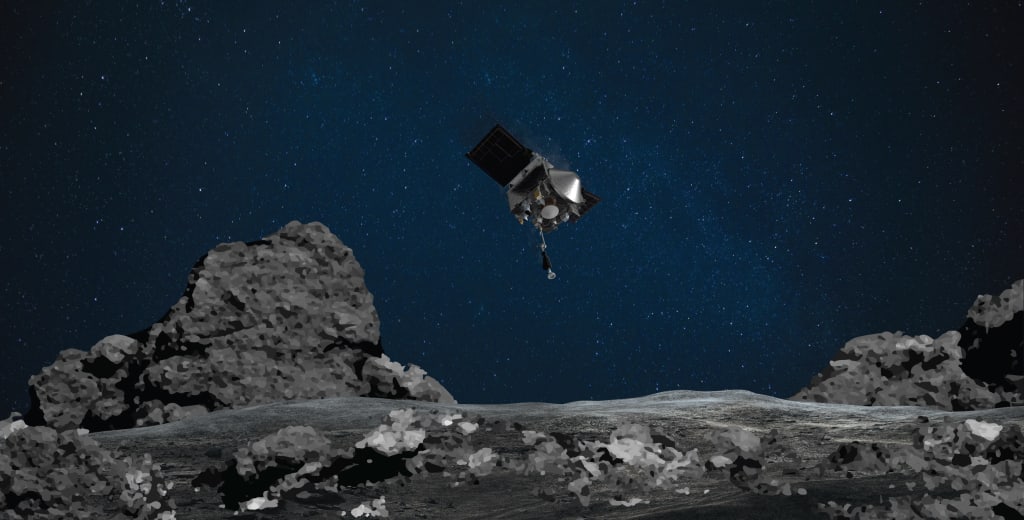
On October 20, 2020, NASA's OSIRIS-REx spacecraft achieved a remarkable feat that captured the world's attention—a successful landing on the surface of the near-Earth asteroid Bennu. This historic mission, which stands for Origins, Spectral Interpretation, Resource Identification, Security, Regolith Explorer, marked a significant milestone in space exploration, providing valuable insights into the composition and history of asteroids and potentially offering critical information about the origins of life on Earth.
The OSIRIS-REx Mission
The OSIRIS-REx mission, launched by NASA in September 2016, was designed to study and collect samples from asteroid Bennu. The spacecraft's primary objective was to understand the formation and evolution of our solar system by studying this ancient space rock, which is believed to be a remnant from the early solar system. Additionally, OSIRIS-REx aimed to investigate the potential threat posed by Bennu as it is classified as a Near-Earth Object (NEO) and has a small chance of impacting our planet in the future.
The spacecraft was equipped with a suite of scientific instruments, including cameras, spectrometers, and a sampling arm, to carry out its mission. It spent over two years surveying Bennu from a distance before making its daring descent to collect a sample from the asteroid's surface.
The Touch-and-Go (TAG) Sample Collection
The most critical and nerve-wracking part of the OSIRIS-REx mission was the Touch-and-Go (TAG) sample collection attempt. In October 2020, the spacecraft descended towards Bennu's surface with the goal of touching down for just a few seconds to collect regolith (surface material) from the asteroid.
The TAG maneuver was meticulously planned, requiring pinpoint accuracy to ensure the spacecraft's safety while securing a sample. To achieve this, OSIRIS-REx used its onboard navigation system and autonomous capabilities to target a relatively small site called Nightingale, which was chosen for its relatively smooth surface and abundant sample potential.
After a series of carefully choreographed maneuvers and a tense descent, OSIRIS-REx made contact with the asteroid's surface for a mere six seconds, during which the spacecraft's sampling arm extended to touch the surface. It fired a burst of nitrogen gas, causing regolith to be stirred up and captured in the sample head before backing away from the asteroid. Analysis later confirmed that the spacecraft had successfully collected a significant sample of Bennu's surface material, securing a piece of the asteroid for return to Earth.
Scientific Significance
The sample collected by OSIRIS-REx is of immense scientific importance. Asteroids like Bennu are believed to be remnants from the early solar system, and analyzing their composition can provide critical insights into the processes that led to the formation of planets, including Earth. These ancient rocks may contain organic molecules and water, key ingredients for life, shedding light on the possibility of life's origins on our planet.
Moreover, studying the composition and properties of Bennu's regolith can aid in understanding the potential threat posed by NEOs. This knowledge is crucial for developing strategies to mitigate the impact risk posed by asteroids and comets, which could have catastrophic consequences if they were to collide with Earth.
Return to Earth
Following the successful sample collection, OSIRIS-REx began its journey back to Earth with the precious cargo. The spacecraft is scheduled to return to our planet in September 2023, bringing the Bennu sample safely home. The collected material will be analyzed by scientists around the world, providing invaluable data on the asteroid's composition and history.
About the Creator
The Uncopiable Human Wit to Write
We all have been in that spot at least once in our schooldays where we have been wringing our brains off to curate written articles of some sort until our soul-less friends were born. At just four years old, our beloved soul-less, metallic, digital assistant who is always by our side when we turn on our computers and smart phones, will be doing much more than curating written content for us all, if you know what I mean.
By Sound Savvy4 days ago in Art
Miss Persephone's Manual to a Seemingly Ordinary Life
Miss Persephone was found at the dining table, her blue eyes swollen, her tears arriving and retreating like the tides of the ocean. Earlier that day, her family had visited her in the retirement home where she had lived for eight years. It was her eightieth birthday.
By Imola Tóth2 days ago in Fiction



Comments
There are no comments for this story
Be the first to respond and start the conversation.