
Neoformalism ; film as an aesthetic system
Parviz Jahed
David Bordwell acknowledged a broader filmmaking tradition in his 1985 work that was centered on European art and modern cinema from the 1950s to the 1970s. This tradition posed a challenge to the classical film style. In his book Narration in the Fiction Film, Bordwell explores the relationship between narrative structure and cinematic form, arguing that the way a story is told is just as important as the story itself. With his wife Kristin Thompson, Bordwell introduced a methodological approach in film theory known as neo-formalism. He has also been associated with cognitive theory of film narrative. Bordwell has drawn inspiration from the Russian formalists and earlier film theorists like Noel Burch. Kristin Thompson has employed the neo-formalist approach in two significant books. In her extensive examination of Sergei Eisenstein’s Ivan the Terrible (1944), she examined and assessed the contributions of the early Soviet Formalists, who primarily focused on literature but also covered film in their interests and practices. Furthermore, in Breaking the Glass Armor, Thompson presented an illuminated description of her neo-formalist method by analysing films by renowned directors such as Godard, Hitchcock, Renoir, Bresson, and Preminger.
Neoformalism is a method of film analysis that builds on the ideas first presented by the Russian formalists and literary theorists who recognized a difference between a film's perceptual and semiotic characteristics. The cognitivist perspective is what sets neo-formalism apart from traditional formalism and is the primary reason for its prefix "neo." Bordwell's research focuses extensively on the cognitive processes of film viewers when they engage with the film's non-textual, artistic components. This approach investigates how movies direct the audience's attention towards significant narrative information and how they utilize 'defamiliarization,' a formalist term used to describe the way art presents familiar and commonplace objects and concepts in a manner that encourages the audience to perceive them as new entities.
In their neo-formalist approach, Bordwell and Thompson, argue that the meaning of a film is not solely dependent on its narrative, but also on its formal elements and the way they are used to create a specific viewing experience.
The Neo-Formalist approach enables film students and analysts to actively and intellectually engage with the form and meaning of films. It is a method of critically analyzing film texts that seeks to develop not only new and advanced viewing skills but also to foster a deliberate understanding of form as a means of artistic expression by utilizing defamiliarization techniques. According to John Blewitt; “ Neo-Formalism is an approach that allows the film student/analyst to become affectively and cognitively engaged with form and meaning. It is an development of new and increasingly sophisticated viewing skills but also, through the process of defamiliarisation, to nurture a strategic awareness of form as a modality of expression. “ (Blewitt, 1997, p.92) John Blewitt argues: “The interpretive strategies stem from the analytical structure and language of Neo-Formalism that allow value judgments to be formed and applied, based on reason rather than sentiment or self-confirming or tautological theories.” (Blewitt, 1997, p.92)
Bordwell distinguishes between two key concepts in his analysis of narrative: syuzhet (plot) and fabula (story). Syuzhet refers to the way in which the story is presented in the film - the arrangement of events, the use of flashbacks or other narrative devices, and so on. Fabula, on the other hand, refers to the underlying story or plot that the film is telling. In other words, syuzhet is the film's narrative structure, while fabula is the actual story that is being told.
As Bordwell and Thompson put it: "The filmmakers have built the plot (syuzhet) from the story (fabula), but viewers build the story from the plot… From the viewer’s perspective, the plot consists of the action visibly and audibly present in the film before us. The plot includes, most centrally, all the story events that are directly depicted. (Thompson/Bordwell. pp.75-76) Bordwell explains that the fabula embodies the action as a chronological cause-and-effect chain of events that occur within a given duration and a spatial field. This means that the fabula is a pattern that perceivers of narratives create through assumptions and inferences. However, Bordwell warns against mistaking the fabula, or story, as the profilmic event. He emphasizes that a film's fabula is never materially present on the screen or soundtrack, highlighting the importance of distinguishing between the story and its representation in the film's narrative. (Bordwell, 1985, pp.49-50)
This is similar to Boris Tomashevsky's view that the fabula and syuzhet are distinct concepts. Tomashevsky explains that the fabula represents the events of the story, while the syuzhet is built from the same events but respects their order in the work and the series of information processes that design them. (Tomashevsky, 1965, pp.66-67)
In this way, Bordwell and Tomashevsky emphasize the importance of the syuzhet in shaping the audience's experience of a film and the meaning they derive from it. Bordwell also identifies three principles that relate the syuzhet to the fabula: narrative logic, time, and space. Regarding narrative logic, Bordwell argues that when constructing a fabula, the perceiver defines certain phenomena as events and constructs relations among them. The syuzhet can facilitate this process by encouraging linear causal inferences or can complicate it by blocking or rearranging events.
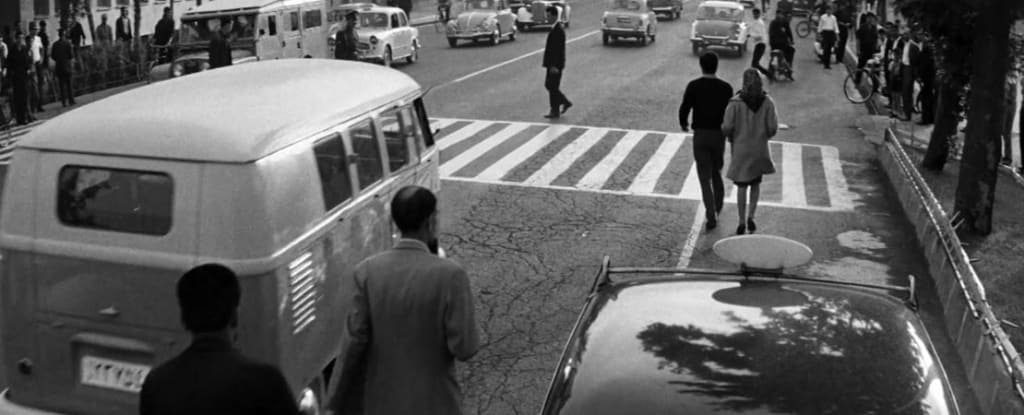
In Brick and Mirror the fabula of the film is about a taxi driver named Hashem who finds a child on the back seat of his car. He is trying to find a safe place where he can hand over the abandoned child to be kept and cared for, considering the fact that he has a condition that makes it impossible for him to keep the child himself. The story (fabula) takes place in 24 hours but the syuzhet of the film is about 2 hours. Although the syuzhet is presented in a chronological order, but the way that the scenes are composed and being shown on the screen is different with the fabula. This narrative structure is crucial to the film's overall impact, as it allows the audience to experience the same disorienting sense of confusion that Hashem feels. In Brick and Mirror, there are events that are causally related and can be constructed linearly in the viewer's mind as a fabula. However, the syuzhet is more complex and does not always allow for the construction of causal relations between events. For example, in the sequence at the police station where Hashem is waiting to register his case, the narrative momentarily distances itself from the main plot and confronts the viewer with sub-plots that have no causal link to the main plot. This illustrates how the syuzhet can arrange events in a way that challenges the viewer's ability to construct a linear causal narrative.
About the Creator
La Strada
A passionate film critic and cinema lover.
The Uncopiable Human Wit to Write
We all have been in that spot at least once in our schooldays where we have been wringing our brains off to curate written articles of some sort until our soul-less friends were born. At just four years old, our beloved soul-less, metallic, digital assistant who is always by our side when we turn on our computers and smart phones, will be doing much more than curating written content for us all, if you know what I mean.
By Sound Savvy6 days ago in Art


Comments
There are no comments for this story
Be the first to respond and start the conversation.