
Napoleon Movie Review
Three Cannon Balls out of Five

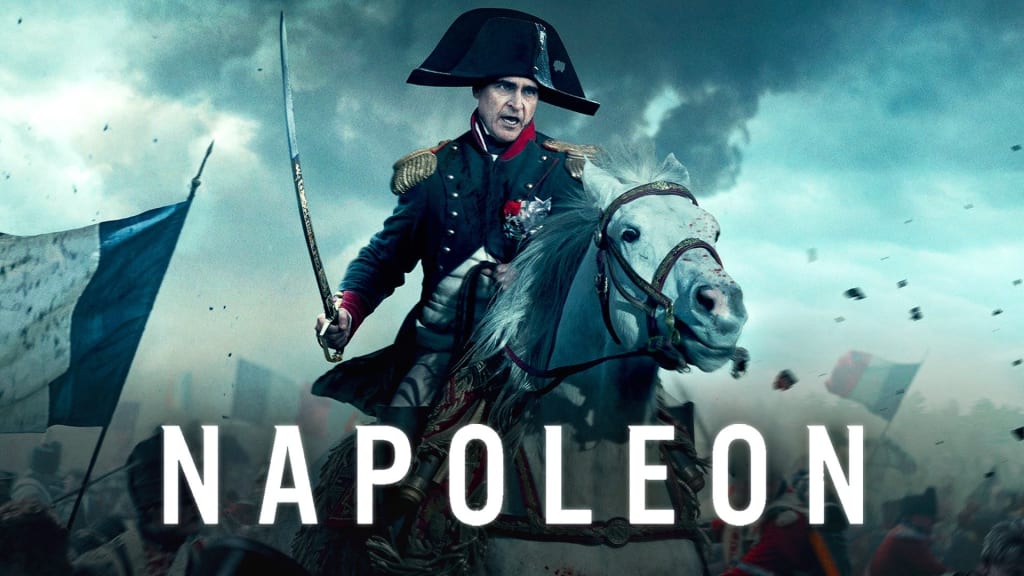
Have you ever questioned how many shots of cannons shooting balls you could endure in a two-hour and thirty-eight minute movie time frame? One? Ten? While I do not know the exact number of times filmgoers watching Napoleon saw the large black machines slide back with a cloud of smoke, if that is your thing, this movie is for you.
Napoleon, directed by Ridley Scott and starring Joaquin Phoenix and Vanessa Kirby, follows the rise and fall of the twice exiled French Emperor, Napoleon Bonaparte. The movie also focuses on his complicated relationship with his wife, Joséphine de Beauharnais.
I should preface this review by stating my lack of interest in war and films that focus on the tedium of battle strategy and technique. Most of the battles in this film were repetitive and not solely because of the aforementioned focus on cannons. Outside of what I will call the 'battle on the lake', and the last scenes of the final battle, they lacked imagination.
While this movie did spend a lot of time off the battlefield to show how the social issues that plagued France during the French Revolution led to Napoleon's rise in power, these scenes did not do enough to maintain my interest. Not even Vanessa Kirby’s amazing performance as Joséphine, a woman trying to survive during the revolution, could carry the moments the audience spent waiting for the next fight.
Through Napoleon’s relationship with Joséphine, we learned more about Napoleon's personality and his hopes and fears. What I found oddly entertaining about this film were the misplaced moments of humour. These moments were not funny to me and did receive a few chuckles from the audience, but the ridiculousness of it broke up the film’s seriousness and made a spectacle of the person history defines as a “great man.” Maybe that was the point?
"You think you're so great because you have boats?"
For example: When Napoleon is speaking with the Emperor of Britain, at the end of the conversation he childishly says, “You think you’re so great because you have boats.” This may have been a way to drive home the point that Napoleon was not a “great man,” but an insecure and fearful man forever trying to achieve greatness. However, the tone with which Phoenix delivered the line seemed like a cheap way to gain laughs.
The film made up for its boring fighting scenes with its cinematography and set design. The director of photography for Napoleon is Dariusz Wolski, who has worked on projects such as The Martian, House of Gucci and The Last Duel.
So much of this movie was reminiscent of baroque paintings. One of the most beautiful scenes was Napoleon's coronation. The way the warm light highlighted the red and gold of the coronation hall illuminated a world of wealth and opulence that greatly contrasted the dull gray French streets, which represented the common people's destitution.
My favourite scene was Napoleon and Joséphine's wedding. It is clear during the wedding that their marriage is doomed, and not only because Joséphine lacks affection for Napoleon.
Two simple gestures foreshadow their divorce. The first is seen when Napoleon says “I do” when it is Joséphine's turn to say it. This can represent how enthusiastic Napoleon is to be married to the love of his life, or it can demonstrate how Joséphine does not have the power to determine her future for herself; whatever comes is to be decided by her husband. The second action that foretells the dissolution of their marriage is seen when Napoleon tries to hand Joséphine his pen to sign her name on the marriage certificate. Instead of accepting the pen, Joséphine reaches for a different one, representing her desire to choose her fate for herself, which she does by not getting pregnant with Napoleon’s heir.
I also enjoyed that throughout the film there was not one glorifying scene of a naked woman. Joséphine did utilize the “power between her legs”, and while there were scenes with intercourse, the sterile lovemaking showed the absence of any real love at all.
My experience of the film can be summed up by a conversation I overheard as I exited the theatre. A man had asked a woman her thoughts on the film. Her reply: “It was long.”
About the Creator
SM Reviews
Reviewer of stories in books and media.
Keep reading
More stories from SM Reviews and writers in Art and other communities.
Year-end review: The Best Movies of 2024 & What I'm Excited for in 2025
As I sit alone in my quiet apartment, reflecting on 2024, it is difficult to recall the events that took place in my life this year. Is this an inexorable effect of aging? Each year seems to fly by so quickly that the only evidence I have that a whole year has passed are the deepening smile lines around my mouth. I have had to start breaking up my year into “eras.” Each era is divided into whatever I was obsessed with for that particular period. For example, the second half of January was my beloved princess-on-a-mission-with-her-hot-protective-guide era, after I watched Fena: Pirate Princess and Yona of the Dawn (and read the manga). While I dabbled in - and swiftly gave up on- various activities like crocheting and studying a foreign language, one thing that remained constant was my engagement with film. I attended numerous film screenings and even volunteered at the Toronto International Film Festival (TIFF) where I saw the Tilda Swinton. Yes, she looks just as otherworldly in-person as she does on-screen. To commemorate the art that has defined my year, here is a list of the top 10 films I’ve seen this year, as well as a list of 5 movies I look forward to seeing in 2025.
By SM Reviewsabout a year ago in Art
'Till Death We Do Art
There would be nothing divine in this world without art. Nature may surpass the divine to all intents and purposes, but like everything it absorbs and is absorbed by, it remains here, stuck on the surface of this world, ever-present, physically bound to the universe.
By Avocado Nunzella BSc (Psych) -- M.A.P 26 days ago in Art




Comments