
Live Aid: The Day The Music Mattered
Looking back 40 years after attending Live Aid, a day when Sir Bob Geldof successfully harnessed the power of popular music to drive change.
“If there`s a problem, you have to go out and solve it.”
– Sir Bob Geldof
The summer of 1985 marked a turning point: freshly graduated from high school, I took a job as Head Counselor at the local Cub Scout Camp and skipped our family's vacation for the first time. As my parents prepared to leave, my Mom handed me her credit card with a strict warning: “This is just for emergencies.”
Driving to camp the following morning, I heard the news on the radio about a once-in-a-lifetime concert. Bob Geldof, lead vocalist of the Boomtown Rats and the force behind the fundraising single, “Do They Know It's Christmas?,” was organizing a global event to raise additional money that would help victims of the ongoing famine in Africa. The highlight of the “Global Jukebox” would be two simultaneous shows in Philadelphia and London.
Immediately after work, I gathered cash together and headed to the one Ticketmaster window serving our area to see if I could get tickets. No more were available, but the employee said that he heard some were still available through its competitor, Ticketron. However, these were only sold over the phone and required a credit card.

When my Mother called that evening, I cut right to the point: “Would getting tickets to Live Aid be considered an ‘emergency’?” Not waiting for the answer, I let her know that “I bought us four tickets.”
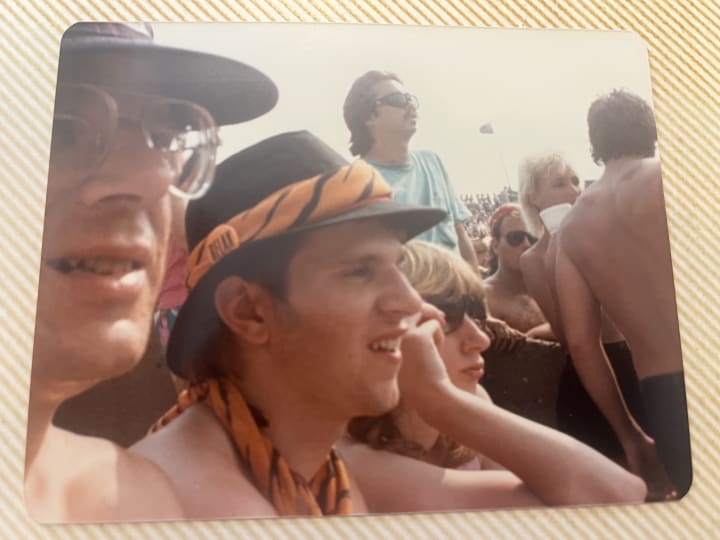
A few weeks later, the family was battling Friday night Jersey Shore traffic to get to Philadelphia. Early the next morning, we headed into John F. Kennedy Stadium, with video from London already playing on the giant video screens.

Looking back, my memories of that day center around the music. Most festivals, like the Woodstock reboots that I also attended, are held in fields. Since they are general admission, there is a constant flow of people around you, allowing the crowd to become as much a part of the experience as what is happening on stage.
Since it was held in a stadium and we sat in reserved seats, we remained with the same people all day. The schedule, with bands switching between performances in Philly and live video from the London stage, kept the music continuous, leaving little chance to meet the strangers around us.
– Sir Bob Geldof
One of the most surprising aspects of the day was how captivating the performances in England were to the audience in Philadelphia. The presentations may have been on the Jumbotrons strategically set on the field, but the most accomplished showmen moved the crowd in a way that made it feel like they were playing right in front of you.
U2’s performance from the Wembley stage was particularly memorable. Though their careers were still young, their performance foreshadowed the greatness they would achieve. A highlight was a mulleted Bono leading a crowd 3,000 miles away in a chant of “No more” during “Sunday Bloody Sunday.”
For years, Queen had been my favorite band, so I eagerly awaited their set. In a performance widely considered to be one of the most memorable in rock history, they energized the crowd at JFK from the stage across the pond despite their American career being at its nadir. Still, the audience was fully engaged, especially during “Radio Ga Ga,” where they mimicked the crowd from the music video by clapping along with their hands above their heads during the chorus.
On stage, there was an eclectic parade of the greatest acts in popular music. This included reunions of the original lineup of Black Sabbath and the surviving members of Led Zeppelin. One of the two drummers stepping in for the late John Bonham was Phil Collins, who had also performed earlier in the day in London. In hindsight, their performance is not looked on favorably, but I remember their set being well-received. Rock and Roll is sometimes best experienced in the moment.
“Give us your money now…there are people dying now, so give me the money.”
– Sir Bob Geldof
Live Aid did more than provide great entertainment for the 1.5 billion viewers across approximately 100 countries; it drew attention to the unfolding tragedy in Ethiopia. It also provided direct assistance for the victims, raising, by some estimates, $245 million for famine relief. It also set the stage for future mega-events in response to disaster, including the series of Farm Aid concerts that continue to raise funds for family farmers.
– Sir Bob Geldof
Live Aid stands out in a decade known for the "me first" attitude cultivated under Reaganomics. Many hippies might have become yuppies by 1985, but enough believers still thought music could change the world. Joan Baez noticed this when she declared, "This is your Woodstock, and it's long overdue," as she took the stage in Philadelphia.

In an era increasingly marked by isolationism, I worry that our willingness to respond to human suffering, especially abroad, has diminished. A more corporatized music industry views political activism as a threat to profits, and even artists as prominent as Taylor Swift have faced criticism for simply revealing who they voted for in the last election. Metallica is known for their charity work and may be the biggest hard rock band on the planet, but they famously avoid politics to prevent alienating their fan base.
July 13, 1985, was a reminder that, at least once, we chose compassion over apathy. Live Aid, which not only raised money for relief but was also a call to action. Is that still possible forty years later?
“I`ve just realized that today is the best day of my life. Now I`m going home to sleep.”
– Sir Bob Geldof
_____
Carl Petersen is a dedicated father of five adult children, including two daughters on the severe end of the Autism spectrum. A passionate advocate for special education, he ran as a Green Party candidate for the LAUSD School Board. Renowned education advocate Dr. Diane Ravitch has praised him as “a valiant fighter for public schools in Los Angeles.” Recently, Carl relocated to the State of Washington, where he is embracing his role as “Poppy” to two grandsons. You can explore his insights and perspectives through his blogs at www.ChangeTheLAUSD.com.
About the Creator
Carl J. Petersen
Carl Petersen is a former Green Party candidate for the LAUSD School Board and a longtime advocate for public education and special needs families. Now based in Washington State, he writes about politics, culture, and their intersections.
Keep reading
More stories from Carl J. Petersen and writers in Art and other communities.
'Till Death We Do Art
There would be nothing divine in this world without art. Nature may surpass the divine to all intents and purposes, but like everything it absorbs and is absorbed by, it remains here, stuck on the surface of this world, ever-present, physically bound to the universe.
By Avocado Nunzella BSc (Psych) -- M.A.P 24 days ago in Art
The Reality Behind Action Films: Physical Performance Through the Lens of Andreas Szakacs
For the audience, the moment lasts only a few seconds. Behind the camera, it represents months of preparation, discipline, and coordination. Action films may appear effortless on screen, but the truth behind those scenes tells a much deeper story about physical commitment and performance.
By Andreas Szakacs2 days ago in Art
Worth the Wait: Puerto Viejo, Costa Rica
Beach bumming in a small Caribbean beach town sounded like a perfect way to end our 6-month trip through Mexico and Central America. Or so we thought. The foul, fishy stench of rotten seaweed hit our nostrils as we stepped from the cramped bus and looked out at a rather depressing, empty, and underwhelming black sand beach. It was pouring with rain, and we had to quickly fish out our ponchos. We thought, this couldn’t be it, could it?
By Sh*t Happens - Lost Girl Travel7 days ago in Wander



Comments (1)
great reminder of a great day, i had to make do with a settee and a tv