
"Letters from the Edge"
In a World Falling Apart, Words Became Her Lifeline

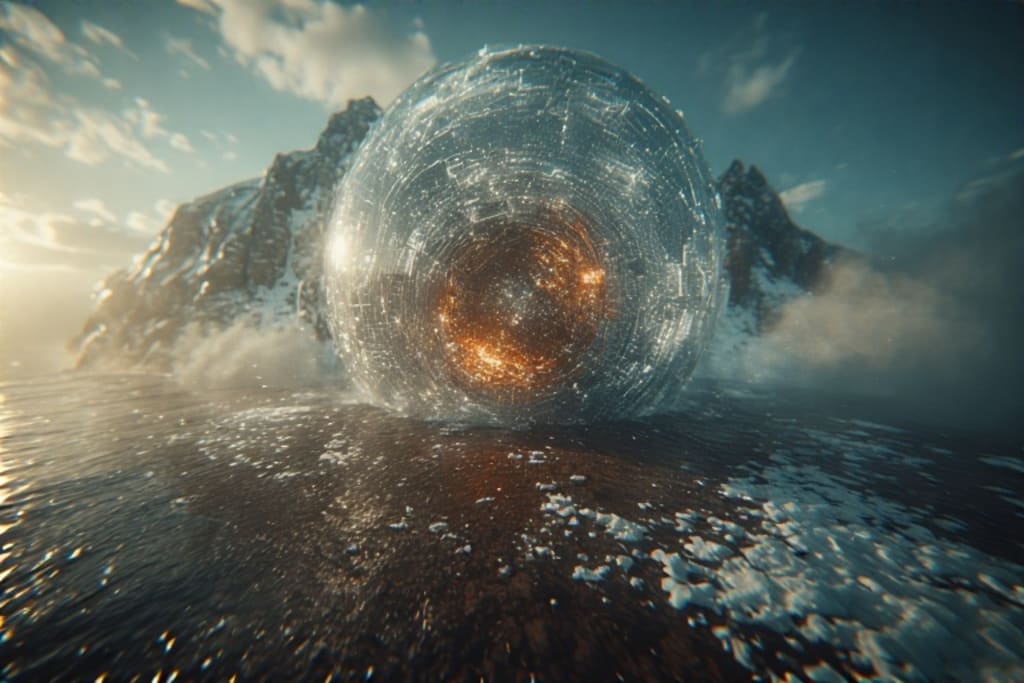
In a small, war-scarred border town where sirens replaced songbirds and every dawn brought uncertainty, lived a girl named Liana.
She was sixteen.
And every day, she wrote letters.
Not emails. Not texts.
Real letters—ink on paper, sealed with trembling hands and hope.
There was no one left to send them to, and no one to receive them. But Liana wrote them anyway.
She called them "Letters from the Edge."
The edge wasn’t just the edge of her town.
It was the edge of sanity. The edge of fear. The edge of giving up.
Before the war, her life had been simple—sunlight pouring through kitchen windows, dusty library books, songs from her mother’s radio, and school uniforms with scribbled hearts on the sleeves. Her father was a postman, and her mother was a teacher. Words were always part of her life.
Then the bombs came.
The school was the first to fall. The post office crumbled next. Her parents disappeared in the chaos of evacuation—promising they'd find her, promising they’d return.
They never did.
Liana ended up alone in a basement, in what used to be her grandparents’ house, now cracked and half-buried under rubble. Power was gone. Food was scarce. Neighbors had fled.
But somehow, she survived. And she wrote.
Her first letter was to her mother:
“Mama, it’s cold at night. I wrap myself in your old scarf. It still smells like rose water and chalk dust. I dream of your voice reading poetry. I don’t cry anymore. I’m afraid if I start, I won’t stop.”
The second was to her father:
“Papa, I found one of your old stamps today. A dove in flight. You always said stamps were tiny passports. Where would this one take me now?”
Then she began writing to people she never met.
“Dear Stranger,
If you find this letter, I want you to know I lived. I dreamed. I loved the smell of rain and the sound of leaves in the wind. I was here.”
She slid letters into bottles and released them into the river that snaked through the edge of town. Some she tucked inside library books buried under rubble. Others, she folded into paper planes and let the wind decide.
Writing kept her sane. Gave her purpose. She didn’t know if her words would ever be found—but they made her feel human.
One evening, weeks into her solitude, she heard something she hadn’t in months: footsteps.
Careful. Hesitant.
Her heart leapt. She peered through a crack in the boarded window.
A boy. Her age. Dust-covered and thin, with a makeshift backpack and tired eyes.
He was carrying something in his hand—a paper plane.
Her paper plane.
His name was Elias. He had fled from the city, walking for days. He found the plane near the ruins of a checkpoint. The letter inside stopped him in his tracks.
“Even if I am forgotten, I want to be remembered.”
It had led him here.
They stared at each other—two ghosts in a crumbling world. Then they smiled. And something shifted.
From that day forward, they survived together.
They built routines—gathering clean water, scavenging food, and each night, writing letters.
Now they wrote together. Letters to the world. To peace. To whoever might rebuild after them.
Liana’s words were full of quiet hope. Elias’s, full of questions and defiance. They left their letters everywhere—tucked into trees, buried in bottles, and pressed into the walls of broken buildings.
*“We are still here,” one letter said.
*“We still believe,” said another.
“This is not the end.”
Then, one morning, the sky changed.
Instead of smoke—there was silence. Instead of sirens—birds. A drone flew overhead, but this time, it dropped something unexpected: a leaflet with a red cross and the words “Humanitarian Corridor Open – Evacuation Begins”
Liana and Elias stared at it, barely believing.
They ran—toward hope, toward life.
Before leaving, Liana took one last sheet of paper and wrote her final letter from the edge.
“To whoever finds this:
We made it. We’re alive. We left stories in our wake. If you’re reading this, know the edge did not break us.
Words saved us.
Use yours to save someone else.”
She tucked it into the cracks of the wall. Then, hand in hand with Elias, she walked into the light.
Moral:
In a world that feels like it's ending, words can keep us alive. They carry memory, meaning, and connection. Even when everything is lost, your voice is the one thing no one can take.
Final Thought:
The edge is not always the end. Sometimes, it's where we begin to write the most important chapters of our lives. So write. Speak. Share. Your words might be the letter someone is waiting for.
Ask ChatGPT
About the Creator
Keep reading
More stories from Najeeb Scholer and writers in Art and other communities.
'Till Death We Do Art
There would be nothing divine in this world without art. Nature may surpass the divine to all intents and purposes, but like everything it absorbs and is absorbed by, it remains here, stuck on the surface of this world, ever-present, physically bound to the universe.
By Avocado Nunzella BSc (Psych) -- M.A.P 15 days ago in Art
THE MYSTICAL RELATIONSHIP BETWEEN BACH AND BEETHOVEN - ALEXIS KARPOUZOS
THE SECRET OF THE DIALECTICAL RELATIONSHIP BETWEEN BACH AND BEETHOVEN Music, as an art of time, constitutes the deepest field where consciousness meets the universe in its primordial ontological dimension, in its uninterpretable form. In this ontological dimension, the forms of music are not mere aesthetic expressions but ways of revealing Being. Two of the most pivotal ways of this revelation emerge through the music of Johann Sebastian Bach and Ludwig van Beethoven. Their comparison cannot be external; it constitutes a comparison of two anthropological and cosmological principles, two forms of relationship between Humanity and the World, two primordial possibilities of existence: necessity and freedom, cosmic order and human transformation.
By alexis karpouzos4 days ago in Art



Comments
There are no comments for this story
Be the first to respond and start the conversation.