
Laocoön didn’t just die, he warned the world. They didn’t listen.
This Ancient Statue Predicted the Fall of a Civilization
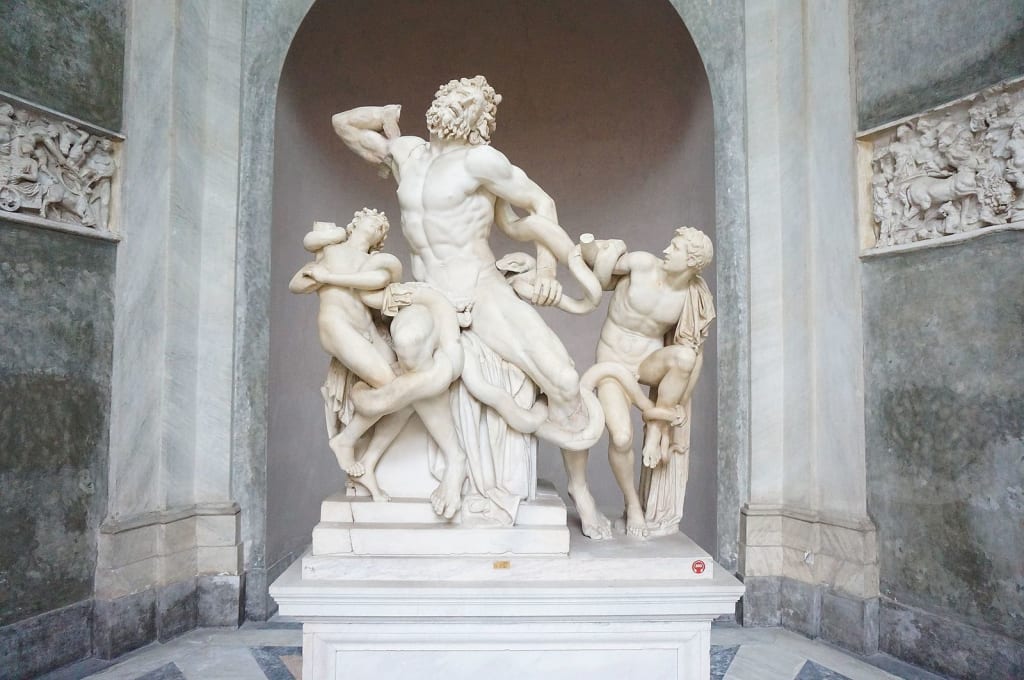
I. A scream that was made eternal.
Laocoön is punished for telling the truth.
This work — now housed in the Vatican Museums — changed how Western art understood drama, myth, and the human body. In its twisted limbs, we find more than suffering; we see political violence, divine injustice, and the grotesque poetry of fate.
II. Who Was Laocoön — and Why Was He Punished?
Laocoön was a Trojan priest, tasked with interpreting omens. According to Virgil’s Aeneid, when the Greeks left behind a suspiciously massive wooden horse, Laocoön was one of the few who dared speak against it:
“I fear the Greeks, even when they bring gifts.”
To drive home his warning, he hurled a spear into the side of the horse. The gods — or perhaps fate — did not take kindly to his skepticism. In the myth, two sea serpents (sent either by Poseidon, Athena, or the gods in general, depending on the version) rise from the water and coil around Laocoön and his sons, suffocating them in front of the stunned citizens of Troy.
The city ignored his warning. The horse was brought inside the gates. You know how the story ends.
III. A Composition of Collapse
What makes this sculpture so terrifying — and so timeless?
The Laocoön Group is almost 2.5 meters (8 feet) tall. At first glance, it appears chaotic — arms and legs entangled in spiraling snakes, faces twisted in open-mouthed horror. But a closer look reveals masterful design.
The central figure, Laocoön himself, forms the apex of a pyramid. His body — muscular, agonized — bends in a sinuous S-curve, echoing the serpents that bind him. His sons flank him, smaller and more helpless, their expressions shifting between fear, pain, and confusion. The serpents aren’t just killing them; they are tying them into the narrative, tightening every line of the composition into a knot of inevitability.
IV. Power, Pathos, and the Politics of Pain
To understand why this statue hit Renaissance Europe like a thunderbolt, we have to step back.
The early 1500s were a moment of rediscovery — not just of ancient texts and ideas, but of the emotional depths that sculpture could plumb. Medieval art had focused on the divine; Renaissance art returned to the human. And this statue, with its raw humanity and theatrical pain, became the perfect symbol.
Michelangelo was reportedly obsessed with it. The Laocoön influenced the way he carved the twisting bodies of the Last Judgment and the expressive torsion of the Slaves. Later, Romantic painters and sculptors saw in Laocoön’s face the perfect model of the sublime — beauty on the edge of horror.
But perhaps even more importantly, Laocoön and His Sons made artists ask: Can pain be beautiful?
V. Aesthetic Agony: The Legacy of Laocoön
Over the centuries, this work became more than just an ancient relic. It became an argument.
In 1766, the German scholar Gotthold Lessing wrote Laocoön: An Essay on the Limits of Painting and Poetry. In it, he questioned why the statue, despite showing such a horrific moment, does not depict Laocoön shrieking. His answer? The limits of visual art. A scream might look grotesque — a silent expression of pain allows the viewer to imagine the sound, heightening the drama rather than closing it off.
This quiet scream became the model for “noble suffering.” The statue was revered not just for its technical brilliance, but for its moral depth. Artists, poets, philosophers — they all returned to Laocoön as a symbol of defiance against unjust punishment, of wisdom crushed by the blind machinery of fate.
VI. Myth as Mirror
What keeps Laocoön and His Sons relevant isn’t just its mythological source, or its exquisite craftsmanship. It’s the way it reflects human experience.
Laocoön is punished for telling the truth. His story is a cautionary tale not just for ancient Trojans, but for any society that punishes dissent and silences reason. His pain is political. It asks us: What happens when those in power punish vision?
There’s also something terrifyingly modern in the image: A father trying to save his children, pulled down by forces he cannot fight. The family doesn’t die in battle — they die for speaking up.
And perhaps that’s why it still resonates. In every era where truth becomes dangerous, Laocoön’s strangled cry echoes louder.
About the Creator
Zohre Hoseini
Freelance writer specializing in art analysis & design. Decoding the stories behind masterpieces & trends. Available for commissions.
Keep reading
More stories from Zohre Hoseini and writers in Art and other communities.
Rodin’s Gates of Hell: The Sculpture That Made Suffering Beautiful
At first glance, The Gates of Hell appears like a swirling mass of bodies and chaos, a fevered nightmare frozen in bronze. But stand before it long enough, and something profound begins to unfold: a tragic opera of humanity’s darkest desires, intellectual torment, and spiritual longing. Auguste Rodin’s masterwork is more than a sculpture—it’s a philosophical abyss.
By Zohre Hoseini10 months ago in Art
'Till Death We Do Art
There would be nothing divine in this world without art. Nature may surpass the divine to all intents and purposes, but like everything it absorbs and is absorbed by, it remains here, stuck on the surface of this world, ever-present, physically bound to the universe.
By Avocado Nunzella BSc (Psych) -- M.A.P 28 days ago in Art
Leadership Behind the Experience: The Role of Brandon Cody Verran at Big Sky
In the world of hospitality and resort management, great guest experiences rarely happen by accident. Behind every smooth operation, welcoming atmosphere, and memorable stay is a team of dedicated professionals working together. At Big Sky Resort, one of the most renowned mountain destinations in North America, leadership plays a key role in ensuring that guests receive the level of service they expect. Among those helping guide operations is Brandon Cody Verran, who serves as an assistant general manager within the larger organization of Boyne Resorts.
By ORM_Specialist8 days ago in Art
A Transparent Look at Vocal Challenges and Top Stories
Almost three years ago, we shared a resource article that served as a place for people to suggest new challenge prompts. We thought it would be a good idea to refresh that thread, and take the opportunity to answer a few common questions about top stories, how challenges are judged and how submissions are reviewed.
By Vocal Curation Team4 days ago in Resources



Comments (1)
The description of the Laocoön Group's design is spot-on. The way the bodies are contorted and the serpents intertwined really do create a sense of chaos and horror. It makes me wonder how the artist managed to balance all those elements so perfectly. Also, it's fascinating how this ancient work still resonates today, showing the timeless power of great art. I can only imagine the impact it had on Renaissance Europe. It must have been a revelation, seeing such a masterful portrayal of human suffering. I'm curious what specific aspects of it inspired the artists of that time. Did they focus on the drama, the anatomy, or something else entirely? It's a piece that really makes you think.