
Laghami Church in Svaneti
A tour by its keeper Rezo


If you are not familiar with the history of Christianity in Svaneti, Georgia, you would not guess this building is a church. It looks more like a very old house, with no distinct Georgian church dome or bell tower. The only thing suggesting it’s a religious structure is the cross on its roof and the cemetery on its grounds.
But that low-key character is a sign of how old the church actually is. Due to their isolation in the mountains, Svans adopted Christianity later than lowland Georgia (Iberia, in 326 AD), gradually in late 4th-6th centuries.
At the time, Svans were wealthy farming clans fighting each other and invaders (building the distinct defense towers that became a symbol of Svaneti) that worshiped Christ in their own family churches. In early days, those churches looked more like homes and had the dome structure inside rather than on the outside.
The Laghami Church of the Transfigulation of Savior is one of such early Christian structures, built and frescoed for the Kirkishliani noble family, most probably by the local monks, in the 9th century. Walking the streets of the small town that still has these old houses well preserved, you would probably never take it for a church. But it is a truly unique representative of the architecture and religious art of its time.
To give you an idea of how different and old this church is, here’s a side-by-side comparison of Laghami Church with the newest St.George Church I hiked to on my own after I saw it on the hill during our previous day's hike with K.
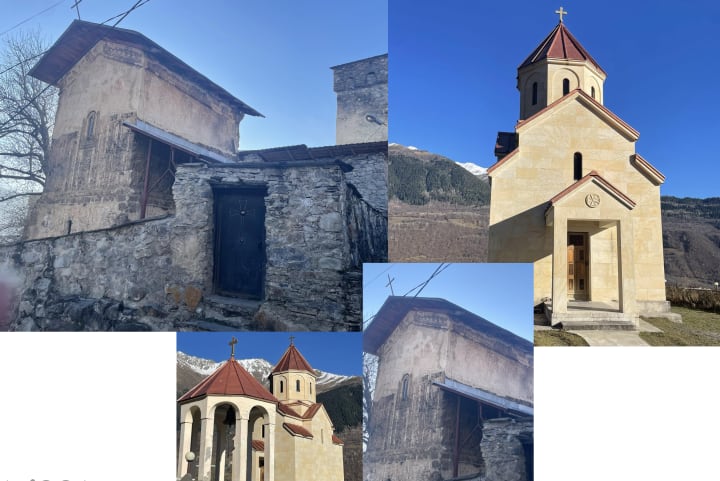
On the day I wanted to explore the churches and house museums, the entire region had no electricity because of some repairs to the main power line. When I called Rezo, the current keeper of the Laghami Church, to ask for a tour, he said to come in 3-4 hours (Georgians have a very relaxed relationship with time), hoping the lights would be back on. So I decided to take a hike to the new church.
It took me about an hour to walk to the church, which happens to have the same name as another active church in Mestia - St.George. When I asked my hotel manager Marina about the new church, she said that it had been built by a wealthy Svan who now lives in Russia, probably as a way to pay back to his community. In any case, it’s a beautiful church with the striking views from its grounds but it was closed when I finally got to it.
Slightly disappointed but not surprised, I hiked back to Laghami, Mestia’s satellite town. As I was walking past the famous mountain climber Mikheil Khegriani's house museum, I saw a man coming out of the house (it was also closed previously due to no power) and talked him into giving me a tour with a flashlight. But that deserves a separate story. After the tour I called Rezo again and he said, "Since you are already here, come on over."
The church was literally around the corner from the Khegriani Museum, and I snapped a couple of pictures on my rapidly discharging iPhone before Rezo, a thin but muscly Svan man of about 65-70, showed up, smoking a cigarette. He put it out before opening the church's gate and told me about the church before entering it.
"When I was trusted with the keys more than 30 years ago, the church had been completely neglected for over 150 years and started to fall apart, with its first level collapsing almost entirely. It still needs a lot of work, like restoring that Expulsion from the Eden fresco, and a lot of cleaning and repairs," he says, pointing at the contours of trees and hardly noticeable Adam and Eve to the right on the upper side fresco.

We climb a set of old stone stairs, go through a short hallway and Rezo unlocks the door to the church. Before entering, he crosses himself and say a short prayer. I am not a religious person, but I do cross myself as well before entering the church, out of respect.
As I enter, I am struck by the beauty, significance, and reverence of what I see. I ask if I can take pictures and Rezo says, "of course." As my dying iPhone struggles to take pictures in the dark, Rezo highlights the frescoes with a flashlight. You can see the difference in lighting here, when I took the first pictures:
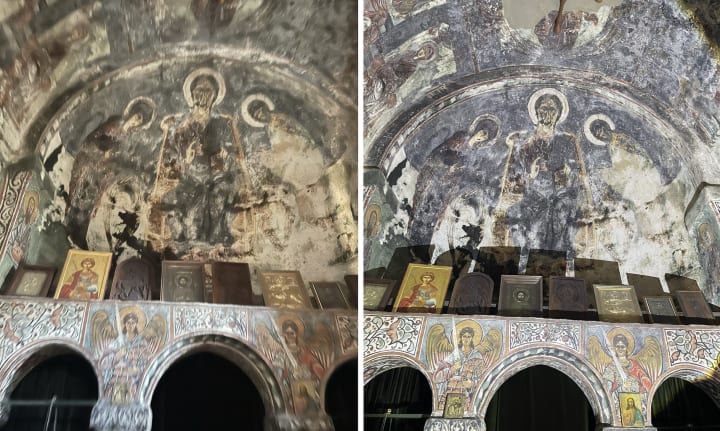
I ask about the black traces on the fresco, "Was there a fire?"
"Nope, just smoke and soot from centuries of burning candles and incense, very hard to clean out without damaging the frescoes. So we just left it like this," Rezo explains. He then says that the upper-level dome frescoes are depicting scenes from Christ's life, such as these ones:

The lower levels and the arch pillars depict the saints, including the female ones. There are also portraits of the members of the Kirkishliani family that I didn't photograph.
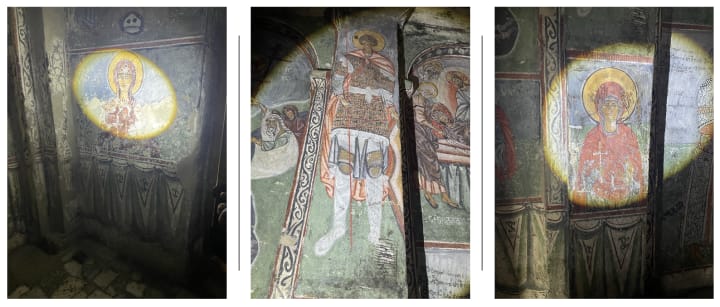
Rezo then adds that all these frescoes were painted between the 12th-14th century in the Byzantine style of iconography. I ask about the Svan style and he proudly says that most of the icons displayed on the altar are drawn or cast in gilt silver in Svan style.
He points at the Christ on the Throne icon and says, "This one is priceless, the most important Svan icon here that was gifted to the family in the 12th century by the master himself."
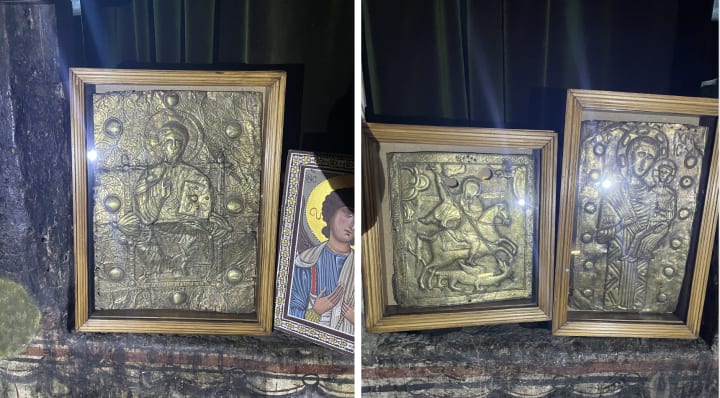
I take several minutes more to look at the frescoes and absorb the history and iconography genius I am witnessing. As we leave, I ask Rezo if he gets any help with money or restoration works for the church.
"When I just started, Europeans helped a lot: I got funds from the Dutch, French, and German foundations for religious work restoration. I'm very grateful to them for that, including the expertise they provided with teams of people who actually came here to restore and clean out the frescoes. But now it has largely dried up."
"And the Georgian government?" I ask.
"Compared to Europeans - peanuts, and I have to fight and beg even for that. Tours like this help, and sometimes I meet generous people who give large individual donations."
My public-relations-trained mind is estimating if I can set up a GoFundMe or something like it for him. As I am ready to bid good-bye and thank him for his generosity with time, he asks, "Don't you wanna see the first level?"
"Is it possible?" I ask, shocked and grateful as I remember him saying that it almost collapsed and it was dark there with no power.
"Of course, I cleaned it out well, and it's even more interesting," Rezo replies, opening the door of the first level for us. Crossing himself with a short prayer again, he enters first.
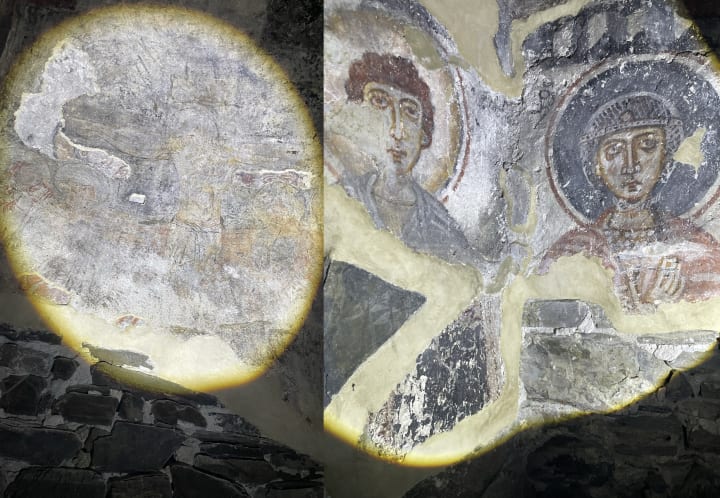
There's even less light here, hardly entering through the small round holes in the walls built of broken cliff rocks (the second level was built with well-hewn travertine cubes). But I am completely stunned by what I see, several layers of frescoes on top of each other.

"When I first entered here, all this space was full of rocks and debris. As we cleaned it out and put the rocks back in, we started working on cleaning the frescoes, and deliberately left some of the squares the way they were, to show the difference," Rezo points at the darker soot-covered squares in several spots. "Originally, we thought that the church was build in the 10th century, judging by the time of the outer layer of the frescoes. But then a piece of plaster fell off as we tried to clean it and we saw even older frescoes underneath, see there?"
"Wow!" I say, completely shocked. "How did that happen?"
"There are no records, but I think that the monk who was tasked with redoing the church did not dare to paint over the old frescoes as he probably understood their historical significance and beauty. I suspect he just slapped a thick layer of new plaster on top and painted his frescoes on it. See, in some places only the contours of figures remain, and most of the detail and color is gone. But we now believe that the first layer was done in the 9th century, which dates the church older than originally thought 10th century."
He then points out the cracks in the stone walls and a reinforced arch-bearing keystone, "If this one falls out, the entire structure will collapse as the second church sits on top of this one. So I have to keep an eye on it and make sure that this does not fall apart."
"Do you have other family members helping you out?" I ask.
"Not really," he says, "Everyone's busy with their own lives. Sometimes people volunteer but I honestly don't know what will happen to the church after I'm gone."
I again thank him for this generosity and time and give him a donation. He smiles and says, "I'm thankful too, you were so eager to see it and I like sharing the church history, especially with people who are genuinely interested."
I left the church deeply impressed with its history and Rezo's dedication to its preservation.
About the Creator
Lana V Lynx
Avid reader and occasional writer of satire and short fiction. For my own sanity and security, I write under a pen name. My books: Moscow Calling - 2017 and President & Psychiatrist
@lanalynx.bsky.social
Keep reading
More stories from Lana V Lynx and writers in Art and other communities.
Ditched - Index
This index is just for my subscribers. I finished and published this long story or short novella of 6,000 words recently. I tried to link all previous parts of the story in the next one, so if you went along you shouldn't have been lost. This index is just put everything in one place.
By Lana V LynxExclusive • 3 months ago
The Difference Between Decorative Sculptures and Landmark Sculptures
In many outdoor projects, sculptures are often grouped under a single category. However, in real-world applications, decorative sculptures and landmark sculptures serve very different purposes. Treating them as interchangeable elements can result in design conflicts, inefficient use of budget, and weakened spatial impact. For anyone involved in outdoor space planning, understanding the distinction between these two types of sculptures is essential.
By Shenzhen Ruiheng Crafts2 days ago in Art
7 Steps of Choosing Right Block Print Cushion Covers in 2025
In 2025, the love for handcrafted home décor items has reached a new level. Among all the beautiful options available, block print cushion covers have become one of the most preferred choices for adding a touch of tradition and charm to modern homes. These covers not only bring color and creativity into your space but also reflect India’s artistic heritage. However, with so many designs and materials available, choosing the right cushion covers can be a bit tricky. Let’s go through 7 simple steps to help you pick the best block print cushion covers for your home this year.
By Heros Fashion2 days ago in Art
Fair Exchange, No Robberies
Dark Memoirs - Index There are at least two kinds of people in the world: those who write this half-arsed kind of intro to a story that looks to separate the rare and the norm, and those who realise it's an overused framing device and don't.
By Paul Stewart6 days ago in Chapters



Comments (6)
Fully admired too. He's really committed to its restoration! And the buildings are steeped in history, no pun intended. You unearthed much during your visit.
This is such a rich, immersive read, I learned so much about Svaneti and felt the emotional weight of the place.
So beautiful, and so very old. I would have been awestruck.
Wow! Those pictures and icons are beautiful so I can just imagine with lights on how glorious they would be! That man has found his life’s calling - keeping up this relic of a church. You are a curious adventurer who is getting lots of new knowledge to share. 🤩
You have certainly been making good use of your time while in Georgia and I can appreciate your interest in the churches. Thanks for sharing the photographs
Whoaaaa, 9th century?? That's like soooo long ago! Mindblowing! Idk why but the photos felt very spooky to me 😅😅 It was so nice of him to show you around and so nice of you to give him a donation. Thank you for sharing this with us!