
Journey to the Future: Revolutionizing Transportation
Future transport.
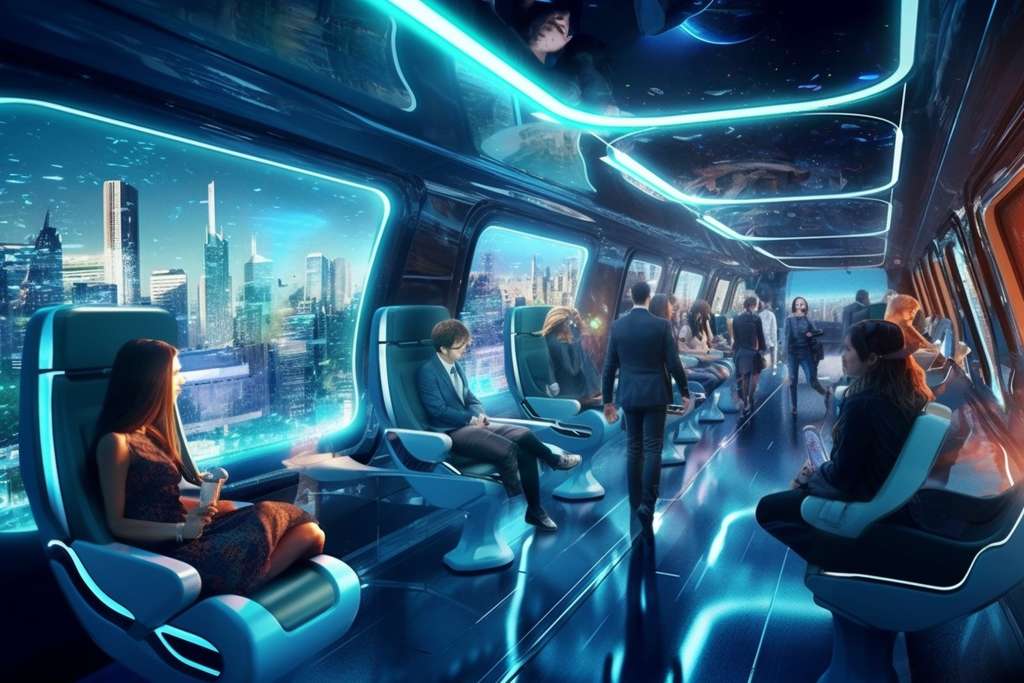
Once upon a time, in a not-so-distant future, the world underwent a transportation revolution that changed the way people moved from one place to another. The once familiar sights of congested roads, noisy engines, and long commutes became a thing of the past as innovative technologies and visionary ideas transformed the landscape of transportation.
One of the most significant breakthroughs was the widespread adoption of autonomous vehicles. These self-driving wonders became the norm, seamlessly navigating through cities and highways, ensuring efficient and safe journeys for all. With artificial intelligence at the core of their operations, these vehicles were not just mere modes of transport; they were personal assistants on wheels. Passengers could relax, work, or enjoy entertainment while their autonomous vehicles took them to their destinations, free from the worries of accidents or traffic delays.
In this future, the concept of private car ownership drastically changed. The rise of ride-sharing services, fueled by the availability of autonomous vehicles, allowed people to request transportation at their fingertips. With a simple tap on their smart devices, passengers were connected to the nearest available autonomous vehicle, ready to whisk them away to their desired location. This sharing economy reduced the number of vehicles on the road, minimizing traffic congestion and environmental pollution.
Cities transformed their infrastructure to accommodate this new era of transportation. Roads were redesigned to prioritize autonomous vehicles, featuring smart traffic management systems that communicated with each vehicle, optimizing traffic flow and reducing travel times. Dedicated lanes for public transportation and cycling became the norm, promoting sustainable modes of travel and fostering healthier, greener cities.
Public transportation also experienced a renaissance in this future world. Electric buses and trains became the backbone of urban mobility, powered by renewable energy sources. These vehicles offered comfortable and efficient transportation for the masses, seamlessly integrated with other modes of travel. Smart ticketing systems allowed passengers to effortlessly move from one mode of transportation to another, ensuring a seamless and interconnected journey.
The skies also witnessed a revolution of their own. Flying taxis, powered by clean energy and guided by advanced navigation systems, soared through the air, providing an aerial alternative for short to medium-distance travel. These vertical takeoff and landing (VTOL) vehicles enabled passengers to bypass traffic on the ground, reaching their destinations swiftly and in style. Skyports dotted the city skylines, serving as landing and takeoff points for these futuristic flying taxis.
Beyond Earth's atmosphere, the concept of intercity and even intercontinental travel underwent remarkable transformations. High-speed hyperloop systems connected distant cities at unprecedented speeds, shrinking travel times from hours to mere minutes. These vacuum-sealed tubes propelled capsules at incredible speeds, utilizing magnetic levitation and reducing air resistance to a minimum. Passengers could effortlessly travel hundreds of miles in the blink of an eye, revolutionizing business, tourism, and personal connections.
The future of transportation also focused on sustainability and environmental consciousness. Electric vehicles, powered by renewable energy, were the norm. Charging stations were ubiquitous, making it convenient for travelers to power their vehicles. Solar-powered roads became a reality, harnessing the sun's energy to generate electricity while providing a safe and durable surface for vehicles to traverse.
As the transportation landscape continued to evolve, the possibilities seemed endless. Concepts such as subterranean tunnels, floating cities, and even teleportation were being explored, pushing the boundaries of human imagination. The future of transportation promised a world where distance was no longer a barrier, where movement was seamless, and where the joys of travel were accessible to all.
In this future world, the possibilities were not confined to the limits of our current reality. It was a world that merged convenience, efficiency, sustainability, and adventure into a harmonious tapestry of interconnected transportation systems.
And so, as the sun set on the horizon, painting the sky with vibrant hues, people embraced the future of transportation, embarking on journeys that transcended time and space, bringing the world closer together in ways never imagined before.
About the Creator
Keep reading
More stories from Kajus Jozauskas and writers in Art and other communities.
Lonely tree
In a vast and serene meadow, there stood a lonely tree. Its branches reached out to the sky, as if yearning for a touch of companionship. The tree had weathered many seasons, witnessing the dance of flowers, the whispers of the wind, and the laughter of playful creatures. Yet, it stood alone, its roots deeply embedded in the earth, anchoring it to a solitary existence.
By Kajus Jozauskas3 years ago in Art
Getting Serious About Comedy (Part I)
If I were asked to remark on my life and the childhood that paved some road leading me to this point, I would have to say something about all the funny people who surrounded me for the last 26,872 days (and counting). Somewhere along that road, I became a big fan of laughter and the comedy that spawns it – and, I mean not only my own laughter, but the laughter of others, some of which I have actually been responsible for inducing.
By John Oliver Smith6 days ago in Humor



Comments
There are no comments for this story
Be the first to respond and start the conversation.