
Impression, Sunrise - by Claude Monet
Characteristics of Impressionist painting.

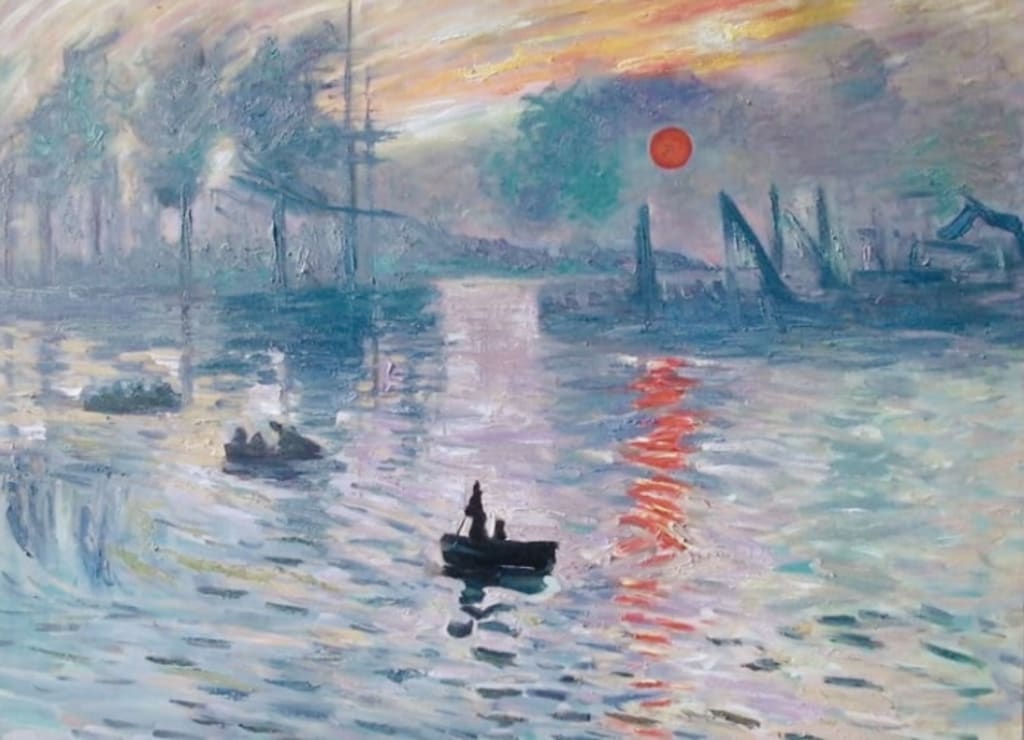
Impressionism is a 19th-century art movement that originated with a group of Paris-based artists, whose exhibitions brought them to prominence during the 1870s-1880s.
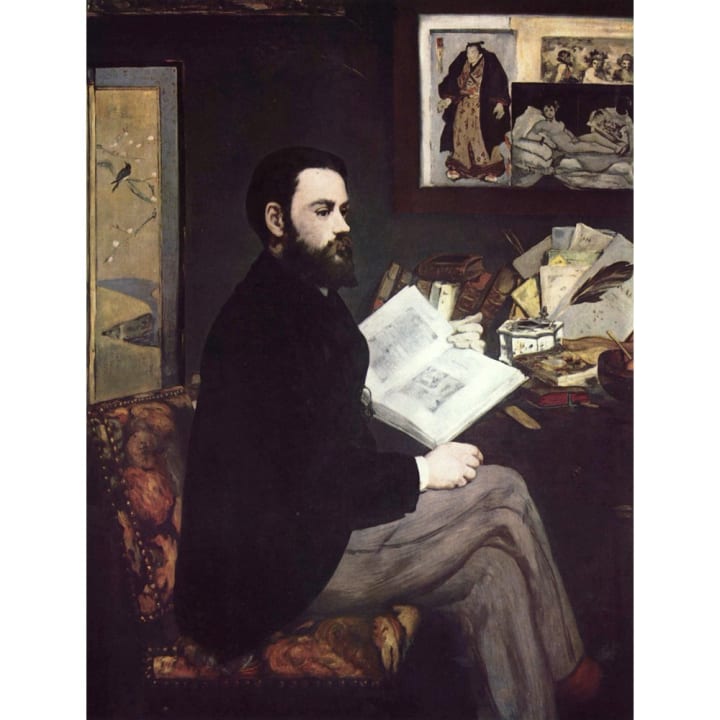
Monet painted his art following the defeat of France in the Franco-Prussian War of 1870–71, the regeneration of France was exemplified in the thriving port of Le Havre. Art historian Paul Tucker suggests that the contrast of elements like the steamboats and cranes in the background to the fishermen in the foreground represent these political implications: "Monet may have seen this painting of a highly commercial site as an answer to the postwar calls for patriotic action and an art that could lead. For while it is a poem of light and atmosphere, the painting can also be seen as an ode to the power and beauty of a revitalized France.
The representation of Le Havre, hometown of Monet and a center of industry and commerce, celebrates the "renewed strength and beauty of the country... Monet’s ultimate utopian statement." Art demonstrating France’s revitalization, Monet’s depiction of Le Havre’s sunrise mirrors the renewal of France.
The painting by Claude Monet, was first shown at what would become known as the "Exhibition of the Impressionists" in Paris in April, 1874. The painting is credited with inspiring the name of the Impressionist movement.
The artwork depicts the port of Le Havre, Monet's hometown. It is now displayed at the Musée Marmottan Monet in Paris.
Impression, Sunrise captures the port of Le Havre at sunrise, the two small rowboats in the foreground and the red Sun being the focal elements. In the middle ground, more fishing boats are included, while in the background on the left side of the painting are clipper ships with tall masts. Behind them are other misty shapes that "are not trees but smokestacks of pack boats and steamships, while on the right in the distance are other masts and chimneys silhouetted against the sky." In order to show these features of industry, I believe Monet eliminated existing houses on the left side of the jetty, leaving the background unobscured.
Gordon and Forge discuss boundaries and the use of color in Impression, Sunrise, claiming that sky and water in the painting, are hardly distinguishable, boundaries between objects are not obvious, and the paint "becomes the place" and effect, the colors of the paint melding together in "its glooming, opalescent oneness. It is foggy blankness, and had a featureless, expectant emptiness that resembles, for the painter, an empty, uninflected canvas." They comment that the accents of blue-gray and orange cutting through the haze "are like last-minute revelations that had to wait, not only for the particular glimmer of orange to burn its way through the fog and find its reflective path onto the water and Monet’s eye but for the canvas itself, pregnant with the foggy space outside, to be ready to receive it."
Monet painted a series of artwork depicting the port. The six painted canvases depicted the port during dawn, day, dusk, and dark and from varying viewpoints, some from the water itself and others from a hotel room looking down over the port.

Other views are shown below


Impression, Sunrise became the most famous in the series after being debuted in April 1874 in Paris at an exhibition by the group "Painters, Sculptors, Engravers etc. Inc".
As an artform, the characteristic of Impressionism involves using relatively thin, small, yet visible brush strokes, open composition, emphasis on accurate depiction of light in its changing qualities, and ordinary subject matter. The inclusion of movement as a crucial element of human perception, and experience and unusual visible angles, completes the visual composition.
Opposition
The Impressionists faced harsh opposition from the conventional art community in France. The Impressionist soon joined together to present their own art show. The name of the style derives from the title of Monet's work Impression Sunrise.
Monet claimed that he titled the painting Impression, Sunrise due to his hazy painting style in his depiction of the subject: "They asked me for a title for the catalogue, it couldn't really be taken for a view of Le Havre, and I said: 'Put Impression.' In addition to this explanation for the title of the work, art historian Paul Smith claims that Monet might have named the painting Impression to excuse his painting from accusations of being unfinished or lacking descriptive detail, but Monet received these criticisms regardless of the title.
The development of Impressionism in the visual arts was soon followed by analogous styles in other media, which became known as Impressionist music and Impressionist Literature.
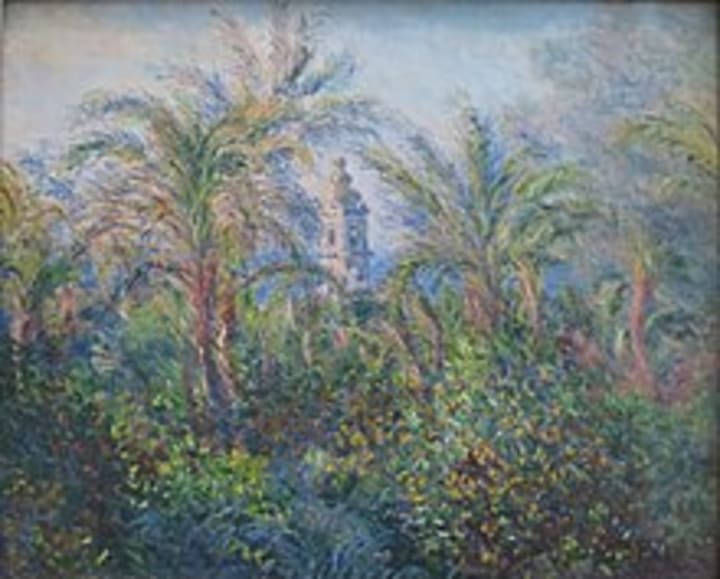
Claude Monet, Garden in Bordighera, Impression of Morning, 1884, Hermitage.
Chrysanthemums

Water Lilies -1916

The garden of Monet in Argentuill

Fasci Garden painting

Making Light of it

Sunset in Venice

Haystacks

Before the 1860s and the debut of Impression, Sunrise, the term "impressionism" was originally used to describe the effect of a natural scene on a painter, and the effect of a painting on the viewer. By the 1860s, "impression" was used by transference to describe a painting which relayed such an effect. In turn, impression came to describe the movement as a whole.
The hazy scene of Impression, Sunrise, strayed from traditional landscape painting and classic, idealized beauty. Paul Smith suggested that with this style, Monet meant to express "other beliefs about artistic quality which might be tied to the ideologies being consolidated by the emergent bourgeoisie from which he came". Loose brush strokes meant, as Smith claims that, "Impression, Sunrise was about Monet’s search for spontaneous expression, but was guided by definite and historically specific ideas about what spontaneous expression was.
While the movement and the painting initially garnered controversy, Monet’s Impression, Sunrise gave rise to the name and recognition of the Impressionist movement, arguably exemplifying more than any other work or artist, the Impressionist movement as a whole in style, subject, and influence.
About the Creator
Novel Allen
You can only become truly accomplished at something you love. (Maya Angelou). Genuine accomplishment is not about financial gain, but about dedicating oneself to activities that bring joy and fulfillment.
Reader insights
Outstanding
Excellent work. Looking forward to reading more!
Top insights
Compelling and original writing
Creative use of language & vocab
Easy to read and follow
Well-structured & engaging content
Excellent storytelling
Original narrative & well developed characters
Expert insights and opinions
Arguments were carefully researched and presented
Eye opening
Niche topic & fresh perspectives
Heartfelt and relatable
The story invoked strong personal emotions
On-point and relevant
Writing reflected the title & theme
Keep reading
More stories from Novel Allen and writers in Art and other communities.
'Till Death We Do Art
There would be nothing divine in this world without art. Nature may surpass the divine to all intents and purposes, but like everything it absorbs and is absorbed by, it remains here, stuck on the surface of this world, ever-present, physically bound to the universe.
By Avocado Nunzella BSc (Psych) -- M.A.P 19 days ago in Art
Review of 'Man on the Run'
My wife and I saw Man on the Run, a nearly 2-hour documentary on Amazon Prime, about Wings, Paul McCartney's group that flew around the world from shortly after The Beatles broke up in early 1970 to shortly after John Lennon was murdered at the end of 1980, making a Beatles reunion forever impossible.
By Paul Levinson7 days ago in Beat



Comments (4)
This impressionistic impression of the impressionist movement impressed me!
Lol, I initially did think they were trees. So glad you clarified that! I'm not a fan of flowers but I liked his Chrysanthemums the most!
You had me with his name!!! Loved this!!!♥️♥️💕
amazing dear