
How this Japanese artist helped saving Japan’s legacy
Kastushika Hokusai’s great contribution to save Japanese history

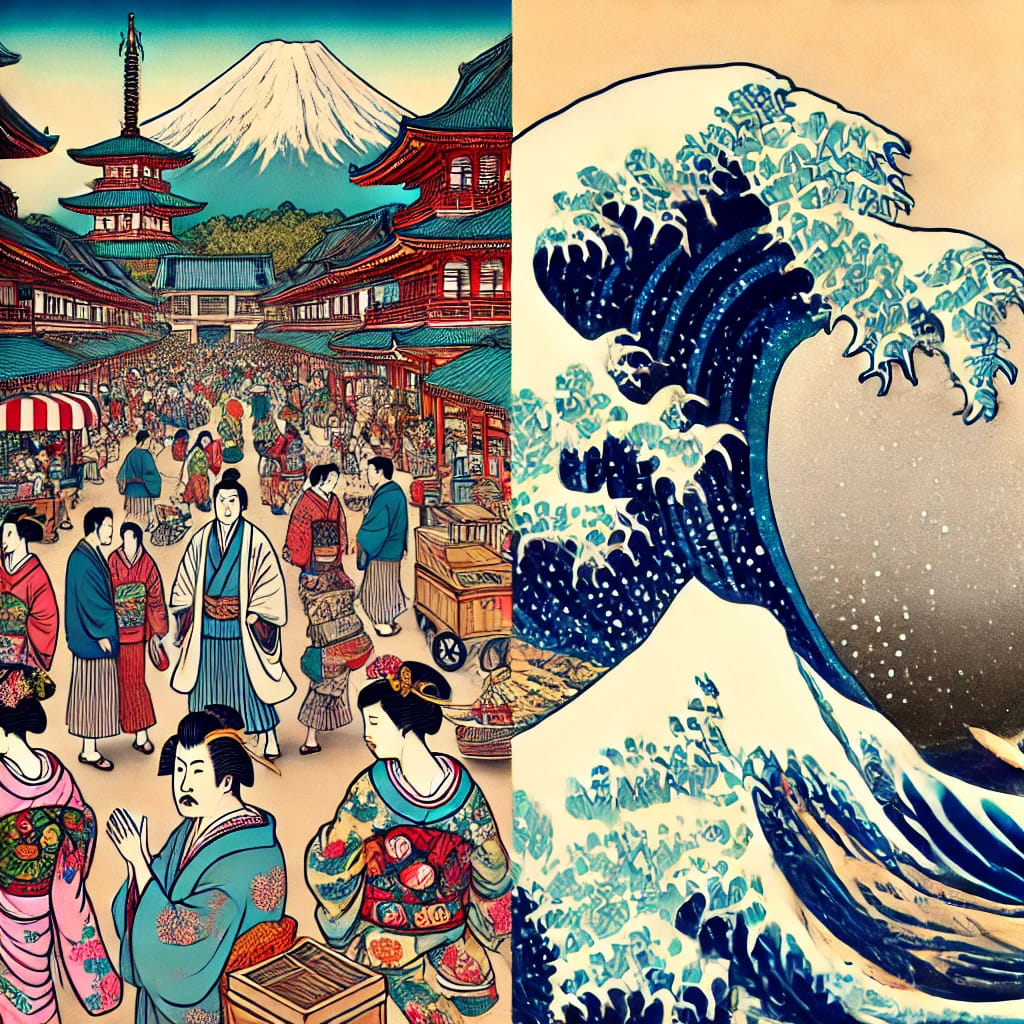
In 1639, Japan closed its borders. It cut itself off from the outside world. Foreigners were expelled. Western culture was forbidden. Entering or leaving Japan was punishable by death. This situation lasted over 200 years. During this time, a unique Japanese art form developed. It was art for the people and was consumed widely.
The Great Wave off Kanagawa, by Hokusai, was made around 1830. This was when the world was industrializing. The Japanese were concerned about foreign invasions. At first glance, The Great Wave appears to show a serene Japan. However, a closer look reveals that a beautiful wave is about to engulf three terrified fishermen. Mount Fuji and Japan’s shores recede into the distance. This image represents Japan's fear of losing its long-standing peaceful isolation. It reflects a nation facing an uncertain future.
The Edo period refers to both the city of Edo, now Tokyo, and the time from 1615 to 1868. During this time, the Tokugawa Shogunate regained control after years of civil war. The shogun believed that foreign influences, especially Christianity, threatened Japan's newfound stability. To protect this stability, Japan severed ties with the outside world. A strict social order was established. The emperor, court nobles, and shoguns were at the top. Below them were the samurai, farming peasants, artisans, and finally merchants. Interaction between classes was forbidden. Each social class adhered to strict public behavior codes.
By the mid-18th century, Edo became the largest city in the world, with a population of one million. As the economy grew, merchants—once the lowest class—began to rise socially. They could now afford luxuries like education, travel, books, and art. The merchant's pursuit of pleasure became known as "ukiyo," meaning "the floating world." This culture emerged in Edo's red-light districts, alongside brothels and Kabuki theaters. Commercial prints featured famous courtesans and kabuki actors. Much like today, sex and celebrity drove sales.
Woodblock prints, known as "ukiyo-e," or "pictures of the floating world," sold in thousands. They created a craze similar to modern trading cards. The constant demand for new images drove profit for publishers. The Great Wave was probably printed at least 8,000 times. It is important to note that traditional painting was still seen as noble and out of reach for most merchants. In contrast, these prints were affordable but low in social prestige.
Despite the controlled environment of the Edo period, the arts flourished. Ukiyo-e made art accessible to those of lower status. Hokusai, born in 1760, gained initial fame as a teenager, creating portraits of kabuki actors. He later shifted focus to landscapes and daily life in Japan. This change marked a breakthrough in ukiyo-e and Hokusai’s career, making his work highly sought after.
Hokusai faced personal hardships. Both his wives and two children died before him. He was also struck by lightning at age 50 and had to re-learn how to draw after suffering a stroke. In Japan, turning 60 is a cause for celebration—a time for rebirth rather than aging. In his last decades, Hokusai produced some of his best-loved works. He famously stated that all he did before 70 was not worth bothering with. At 70, he embarked on his ambitious project: "36 Views of Mount Fuji," which included The Great Wave.
Mount Fuji holds sacred significance in Japan, with over 800 shrines dedicated to it. Hokusai viewed Mount Fuji as a personal obsession. It symbolized strength and stability in a country still steeped in its own traditions. In "36 Views," Hokusai captured Mount Fuji from various perspectives, including forests, villages, lakes, rivers, and beaches. However, The Great Wave off Kanagawa gained international interest in Japanese art.
Hokusai was the first ukiyo-e artist to focus on landscapes in mass-produced images. His works condensed images to their purest forms while emphasizing line and color. They showcased ordinary working-class people alongside sacred landscapes, blending the physical and metaphysical worlds. Landscape prints, however, were less popular than celebrity prints. Their sales began to rise as domestic travel increased.
By the late 18th century, a steady stream of merchants, peddlers, pilgrims, and travelers visited Mount Fuji. They became an enthusiastic audience for woodblock prints of famous locations in Japan. In 1829, the introduction of Prussian blue—a synthetic color—revolutionized ukiyo-e prints. Hokusai's publisher quickly commissioned "36 Views" to leverage this innovative color. The first five prints primarily used shades of Prussian blue. Even the outlines, usually in black, were done in blue. Prussian blue was vivid and more resistant to fading, making the prints
About the Creator
Ahmed mohsin
As a passionate history enthusiast, I weave captivating tales inspired by real events, with a love for movies, dramas, manga, and anime, where every story carries the echoes of history with the excitement of the fictional worlds I adore.
Keep reading
More stories from Ahmed mohsin and writers in Art and other communities.
Shades of Sorrow: Picasso’s Emotional Evolution
Picasso's evolving style is clearly illustrated through his self-portraits. Among them, one stands out for its dominant hue. This self-portrait from 1901 was created when Picasso was only 20 years old. The painting is flat, grim, and predominantly blue.
By Ahmed mohsin12 months ago in Art
Impressive Artwork by Odilon Redon
French symbolist artist Odilon Redon was famous for his drawings in the 1880s. The artist’s artworks were mentioned in the popular 1884 novel “A Rebours,” or “Against the Grain,” by Joris-Karl Hysmans. His later artworks were created in oils and pastels. He developed an interest in Hinduism and Buddhism, and this interest in mysticism is reflected in his works of art.
By Rasma Raisters4 days ago in Art


Comments
There are no comments for this story
Be the first to respond and start the conversation.