
How I found myself in the desert: architectural 3D visualizations serving as a compass
The impact of 3D architectural visualizations on shaping desert building designs and their sustainable development.

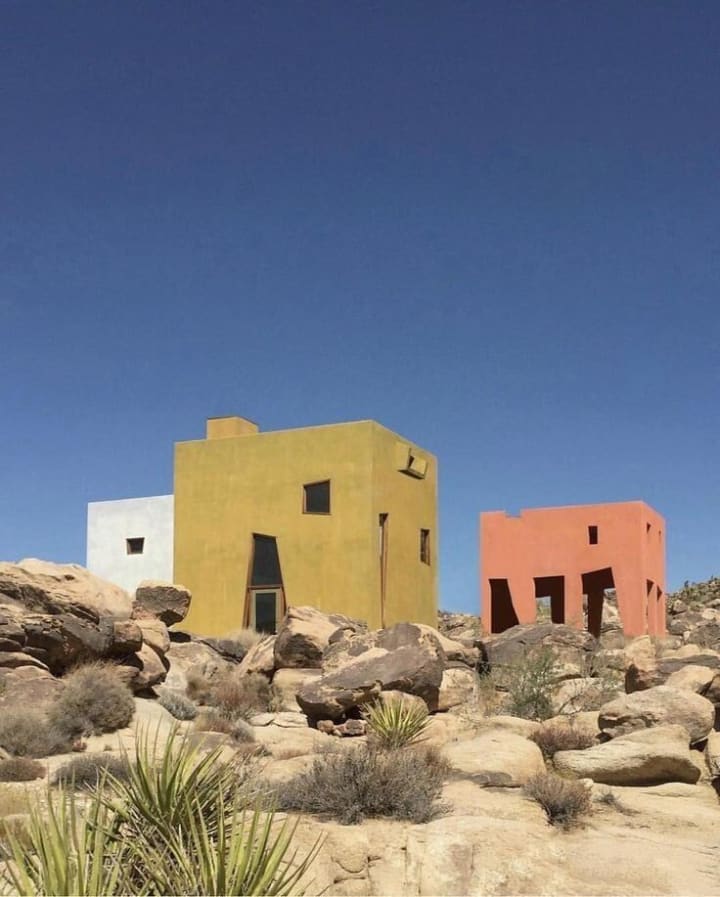
If you can spot concentric circles in architectural renders, “rippling” out like the iconic building they’re inspired by, you’re probably in Arizona’s capital. If you see three strange cubes (resembling architectural structures) in hues that mirror the stony landscape – and, by the way, these cubes have a pretty cool backstory – then… we hope you’ve actually landed in California and are standing at the entrance of a “hotel” with your reservation in hand. Because the restored "Monument House" is best appreciated in person, both inside and out, especially now that it’s available on Airbnb. If parts of a house suddenly seem skewed, and its silhouette mentally transports you back to the days of the Pueblo settlements (whose name now defines an entire regional architectural style), then congratulations – you’re somewhere in New Mexico.
Architectural renders, a subset of 3D visualization, wield incredible influence. Contrary to the famous words of Frank Lloyd Wright, they can justify large-scale development in the wilds of the American Southwest, drawing the attention of architectural talent. And considering the advances in technology, the process of building new homes, complete with infrastructure for comfort, no longer seems utopian. Thanks to the magic of 3D renderings, these visions are 100% achievable! Factuality and perception: the role of architectural renderings
This straightforward introduction serves as a pretext for exploring the concept of architectural design in the desert as a unique phenomenon. There’s no need for a specific client here, as creativity and free-thinking will always guide the process, grounded in fundamental principles. While concepts may not have tangible potential for implementation, they can at least act as a "compass" for the principles of sustainable design. This can also be reflected in visualizations, adhering to three fundamental truths.
Even conceptual works, rooted in analysis of the surroundings, style and character of a location
The first one takes us back to the beginning of this text – offering some consolation. If a trip to Joshua Tree National Park is still an unfulfilled dream, then 3D renders can become a tool for manifesting that dream, intensifying your desire to visit this stunning place. Alright, truthfully, the benefits of photorealistic imagery are far more practical. They help you see a project before it's built or, if you're on the other side of the world, give you the ability to make a fair judgment of the designer working on your “sanctuary’s” exterior.
This second is all about the feelings that 3D visualization can evoke. Thanks to the expertise of a 3D artist, a client can distinguish between a brutalist interior and one that, with its neutral beige palette, is more suitable for a young family with a child. It’s through the technical skills of a 3D artist that a buyer can make an informed decision about purchasing an apartment in a new residential complex, evaluating its layout and much more through the renders.
I believe that 3D visualization plays a crucial role in shaping our understanding of architectural styles. It not only allows us to manifest dreams and enhance our desire for beautiful spaces, but it also empowers clients to make informed decisions by distinguishing between various design aesthetics. Ultimately, visualization bridges the gap between concept and reality, reflecting modern trends while honoring the rich narratives of the past
– Alexander Kasperovich, CEO of Studio57.
This third is the reason we’re here – factuality. Even conceptual works, rooted in analysis of the surroundings, style and character of a location, will always reflect modern architectural trends while telling stories of the past, paying homage… Having discussed the fundamental truths, we now invite you to discover five indicators that you are in a desert environment.
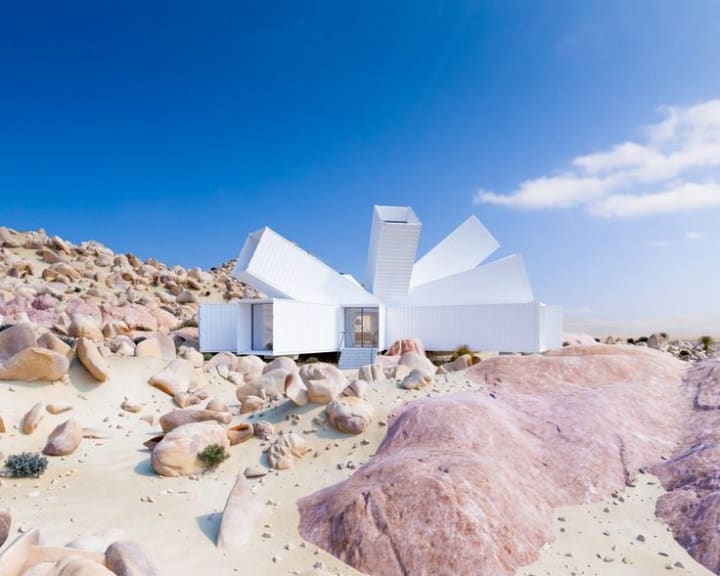
1st sign: the influence of organic architecture
When looking at certain projects created in the desert, you instinctively notice the influence of Lloyd Wright and his principles of "organic architecture." In many of these designs, polygonal building structures seamlessly integrate into the surrounding arid landscape. Some sections seem to grow directly from the earth, creating an image of a robust, monolithic form. These projects do not adhere to the concept of biomimicry; they do not attempt to replicate the likeness of a "fish" or a "lotus" but clearly demonstrate maximum integration with boulders, rocks, and sparse vegetation. This is the key indicator that lets me know I am in a desert environment.
2d sign: mass and shade in desert architecture
In "desert" architectural renders, there is often a deliberate effort to depict the walls of the house as appearing "thick." This feature automatically conveys stability to the building, which is essential in deserts with strong winds. Additionally, these robust walls are designed to regulate the internal temperature: at night, they create a greenhouse effect, while during the day, they provide protection from the heat.
The goal of any render is to depict reality, which is why 3D artists often incorporate technical innovations such as green roofs
Another way to escape the desert sun is by taking refuge in the shade cast by structural overhangs that form unusual shapes around the perimeter of the building. Is this influence from Wright? Absolutely! It’s worth noting that homes designed for hot climates often feature flat roofs, and there’s a good reason for that…
3rd sign: locally sourced materials
A touch of local soil in wall materials is never a bad idea, especially considering the growing popularity of rammed earth as a foundational building material in the desert regions of the United States. In "desert" projects, it is common to use concrete made from screened granite (which can theoretically be sourced right beneath our feet) and mixtures that mimic the color of sandstone. This approach not only reflects contemporary architectural trends in the American Southwest but also helps protect the environment by minimizing its impact through the use of local resources. Sustainability and prosperity go hand in hand! Furthermore, this gives homes additional points for "camouflage". They naturally blend into the landscape, subtly "hiding" while adhering to the same principles of "organic" design.
4th sign: water collection and other modern environmental concerns
Solar panels and rainwater harvesting systems (in the deserts of Texas, precipitation is just sufficient to make this luxury feasible) have now become standard in architectural projects, regardless of climate conditions.
The goal of any render is to depict reality, which is why 3D artists often incorporate technical innovations such as green roofs. They take into account potentially desert-dwelling plants, from mesquite to cholla, with their straight (and not-so-straight) trunks. In this context, the flora not only regulates temperature by toggling between "hot" and "cold", but also enhances water circulation efficiency. Additionally, it protects the home itself, directly contributing to the durability of materials by combating the effects of ultraviolet radiation.
Architectural rendering services enable work on a project to begin with the assurance of its 100% feasibility
5th sign: a flowering garden atrium
One of the key features highlighting the character of most architectural projects in desert regions is the presence of an inner courtyard. In renders, these courtyards are often enclosed in a glass "box" creating a seamless connection between the interior space and the wild, outer landscape. This is yet another tribute to those who champion harmony embodied in the union of man-made and natural masterpieces!
3D visualizations: a guide for creatives, client satisfaction – guaranteed
3D visualizations play a crucial role in the modern world, serving as an effective solution not only for architects and designers but also, indirectly, for their clients. Architectural rendering services enable work on a project to begin with the assurance of its 100% feasibility. Every concept is a chance to bring an idea to life, making it tangible and physically real while solving practical challenges. The realism of the renders acts as a guarantee for designers and architects, allowing them to calculate the project's potential in advance, apply the right materials and textures, and adjust the lighting to meet the client's expectations. It also allows for any necessary revisions before the first brick is even laid.
About the Creator
'Till Death We Do Art
There would be nothing divine in this world without art. Nature may surpass the divine to all intents and purposes, but like everything it absorbs and is absorbed by, it remains here, stuck on the surface of this world, ever-present, physically bound to the universe.
By Avocado Nunzella BSc (Psych) -- M.A.P 19 days ago in Art
Review of 'Man on the Run'
My wife and I saw Man on the Run, a nearly 2-hour documentary on Amazon Prime, about Wings, Paul McCartney's group that flew around the world from shortly after The Beatles broke up in early 1970 to shortly after John Lennon was murdered at the end of 1980, making a Beatles reunion forever impossible.
By Paul Levinson7 days ago in Beat


Comments
There are no comments for this story
Be the first to respond and start the conversation.