
History in blue
Cyanotype fabric prints by Cathy Corbishley Michel

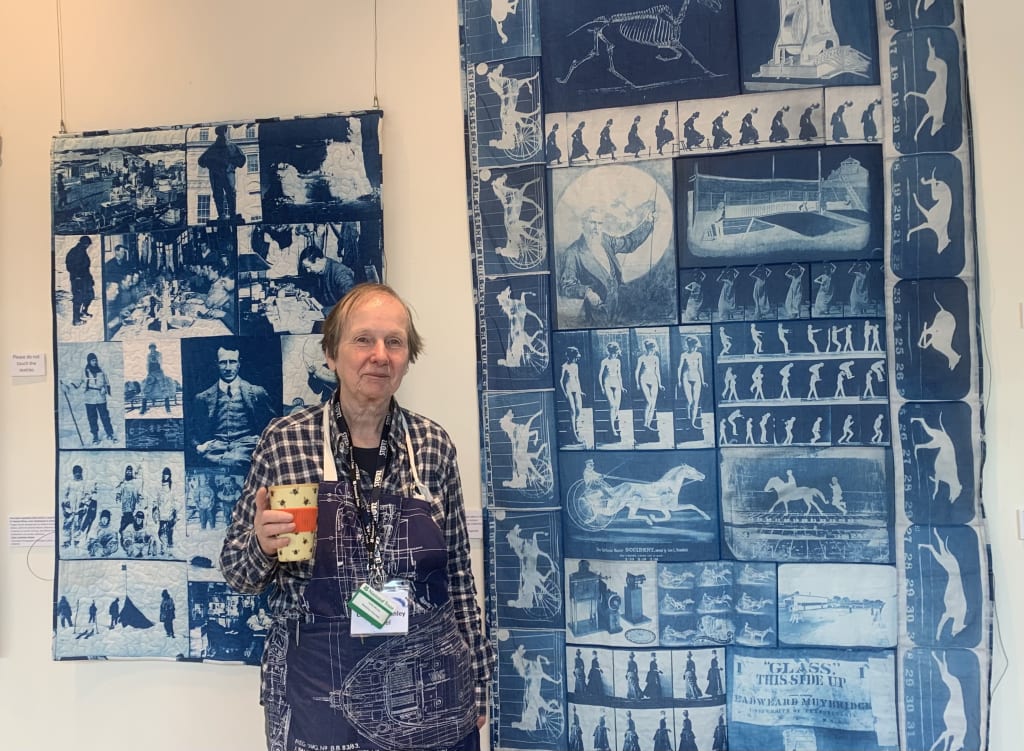
Like many people who have retired from full time employment, Cathy Corbishley Michel has used some of her time to develop an interest in art. In Cathy’s case the results are quite astounding. Her remarkable cyanotypes have been designed using images sourced from the historical collections of the British Museum and other institutions in England, Scotland and around the world.
Cyanotype printing is a historical photographic printing process that produces prints in a single colour: blue. Used in the 19th and 20th centuries to copy engineering and architectural drawings, hence the term 'blueprint.' The process involves coating a paper or fabric surface with a light-sensitive iron salt solution. Once dried in a dark environment, objects or negatives are placed on the coated material. Sunlight or another ultra-violet light source is then used to expose the material, which is later washed and dried to remove the reactive chemicals (Google Gemini).
I came across this work at an exhibition held in one of the former stable buildings of Morden Hall in the suburbs of South London. This is one of many historic properties managed for the nation by the National Trust. It was quite fortunate I wandered into the exhibition while out on a walk around the glorious river parkland that forms the Morden Hall estate.

Cathy's interest in cyanotype printing began after seeing the work of quilter Dorothy Stapleton in 2001. She extended her techniques to include photographic printing on textiles and paper using digital negatives. From 2009-2016 Cathy created a series of works using the photographs taken by Frank Hurley on the ill-fated Endurance expedition led by Ernest Shackleton, 1914-1917. Her original works from this series are now part of the permanent collection at the Shackleton Museum in Athy, Ireland.
In 2014 she completed a series of quilts depicting Robert Falcon Scott's ultimately fatal Terra Nova expedition to the South Pole, featuring photographs taken by Herbert Ponting. These works were exhibited in the UK, before touring the US with the World Quilt Competition 2014-2015. One of these works is shown in the featured image above, behind the artist. It depicts the English polar explorer and natural historian Dr Edward Adrian Wilson, who was part of the Terra Nova team and who also lost his life.
The other fabric features work by the pioneering photographer Eadweard Muybridge. I learnt a great deal from what was a fascinating conversation with Cathy. Not least that Muybridge shot and killed his wife's lover in California, before handing himself and the murder weapon over to the authorities. Yet, despite admitting the act, he was cleared of murder, the court recording a verdict of justifiable homicide.
Muybridge is known for his early work depicting animal locomotion, along with detailed studies of human movement. His pioneering 19th century photographic studies of motion were groundbreaking and highly influential on the development of the first motion picture technologies.

Detail from a cyanotype print by Cathy Corbishley Michel, from a negative by Eadweard Muybridge showing human motion, in this case a woman descending steps
By using such reference points as the historical exploration of the Antarctic and the photographic motion studies of Muybridge, Cathy brings a new dimension to our understanding of these episodes from history. In creating her work using the photographic process of cyanotype printing, she has given us a remarkable view of art and photographic history through a historical lens. Using textiles, cyanotype printing, researching historical images of epoch making photography, Cathy has created a new and original approach to the discovery and interpretation of visual history.

Cyanotype prints on fabric by Cathy Corbishley Michel, exhibited at Morden Hall, South London, until April 27, 2025. The artist can be contacted via: [email protected]
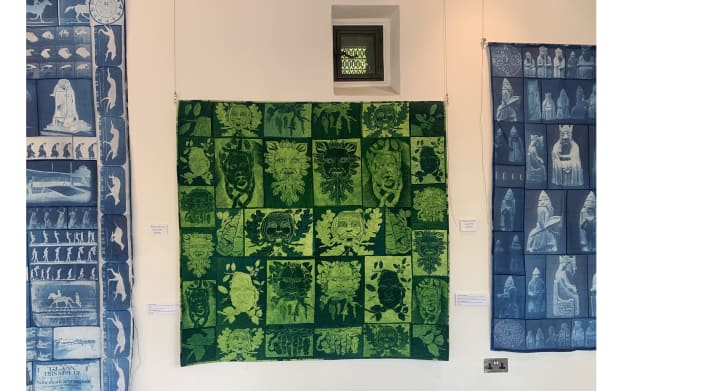
The final piece shown here depicts images of the green man, a mythical character from rural folklore. The fabric hangs between prints of Muybridge photography (left) and the Lewis Chessmen (right).
All in all, what started out as a walk in the spring sunshine in the grounds of an English historical stately home, ended up being a fascinating insight into some remarkable work. It was also a lovely introduction and conversation, for which I am most grateful. Thanks, Cathy.
Thanks for reading.
About the Creator
Raymond G. Taylor
Author living in Kent, England. Writer of short stories and poems in a wide range of genres, forms and styles. A non-fiction writer for 40+ years. Subjects include art, history, science, business, law, and the human condition.
Keep reading
More stories from Raymond G. Taylor and writers in Art and other communities.
This is Laura Knight
Today, I have rediscovered an art treasure I thought I had lost. And on my own doorstep. Foolishly, when I saw it in the Queer British Art exhibition in 2017, I didn't check where the painting was located. It is ironic, then, that despite several visits to the National Portrait Gallery in London over the past year, I had not seen the gallery where this sumptuous painting hangs in pride of place. Not until today, April 21, 2025.
By Raymond G. Taylor10 months ago in Art
Love Is Folly 2016
Love Is Folly 2016: Peter Ayolov Between Cinema, Education and Memory In 2016, at the International Film Festival Love Is Folly in Varna, Dr Peter Ayolov—lecturer in screenwriting at Sofia University St. Kliment Ohridski and author of the book Медийният сценарий (2026)—was invited to serve as a member of the festival jury. His participation marked not only a professional recognition of his work in media and narrative theory, but also placed him at the intersection of Bulgarian cinematic history and contemporary film education.
By Peter Ayolov7 days ago in Art


Comments (7)
Oh wow, that was so fascinating and cool!
Beautiful work, & what a serendipitous encounter, Raymond!
This was fascinating, Raymond! I’ve learned a lot from this story, especially about early photography.
Nice!!! It's amazing where artist find inspiration and rarely let go of it after that. Cyanotype is an interesting form. Thank you for sharing and introducing me to Cathy and her work!
This is wonderful, Ray, that Cathy is using an old medium to celebrate and feature such historical treasures! Thanks for sharing!
What a wonderful story — it sounds like a beautiful and unexpected encounter with some truly fascinating art and history. Thank you for sharing it!
Excellent article and thanks for sharing this artwork