
Graffiti in America: Painting Life
A dive into street art's impact on America's culture

From the rail yards of New York to the back alleys of Los Angeles, from Florida’s coastal highways to Chicago’s brick underpasses, graffiti has left a trail of color, code, and meaning across every corner of the United States. It is one of the few art forms born from both defiance and need—a response to invisibility, inequality, and the human desire to be seen. But beneath its vibrant beauty lies a dual history: one that shaped America’s art scenes, and another that carved itself into the nation’s criminal underworld.
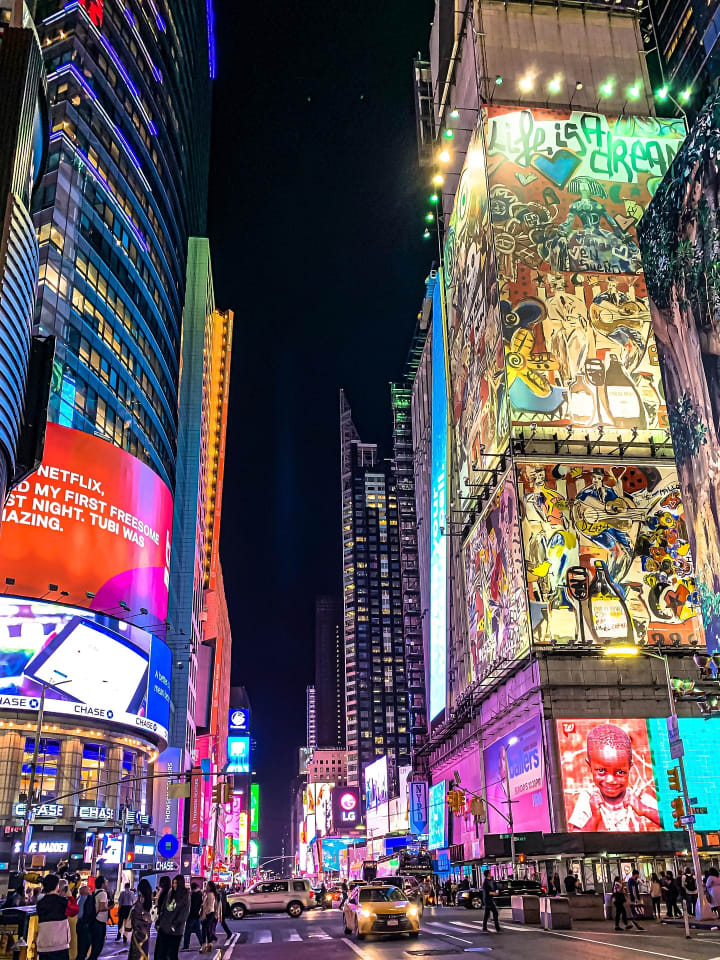
The Northeast: Where Voices First Echoed
Graffiti’s modern American genesis began in the Northeast, particularly Philadelphia and New York City, during the late 1960s and 1970s. Teenagers like Darryl McCray, known as “Cornbread,” became one of the first to sign his name across public walls, unknowingly sparking a nationwide movement. New York followed, with legends like Taki 183 transforming subway cars into moving galleries of rebellion. These tags were not acts of destruction but declarations of presence—urban poetry written in aerosol.
In the Northeast, graffiti quickly evolved from mere vandalism into a complex visual language. Cities like Philadelphia later embraced it, launching programs such as Mural Arts Philadelphia, which turned the city into one of the world’s largest outdoor galleries. This was redemption through paint—former vandals becoming community artists.
Yet, graffiti’s underworld roots ran parallel. In New York and New Jersey, gangs like the Savage Skulls and Savage Nomads used tags to mark turf, announce allegiance, and issue warnings. These coded walls became the street’s form of intelligence—a system of communication in neighborhoods ignored by city hall.
The South: Heat, Heritage, and Hidden Codes
The Southern graffiti scene bloomed more slowly but developed its own rhythm. States like Florida, Georgia, and Texas turned graffiti into a language of heat, hustle, and heritage. In Miami, graffiti blended with Latin and Caribbean aesthetics, producing vibrant murals that told stories of migration and struggle. Atlanta and Houston became epicenters of Southern street art, often connected to the rise of hip-hop culture in the 1990s.
In Texas, the lines between art and underworld blurred sharply. Houston’s Fifth Ward and Dallas’ Oak Cliff neighborhoods saw walls double as both artistic statements and coded warnings between rival gangs. Over time, cities like Austin began to reframe graffiti through legal walls and art districts, transforming defiance into design.
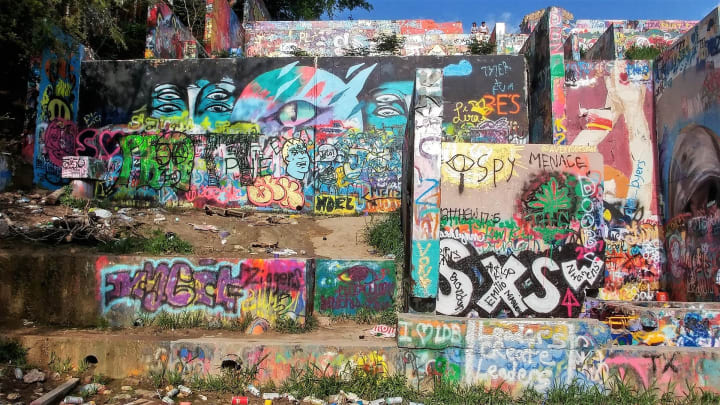
Florida’s 34th Street Wall in Gainesville is a symbol of that shift—a 1,200-foot stretch that began as unsanctioned tagging but became a protected landmark for public expression. Here, the Southern sun shines on graffiti’s evolution: from rebellion to recognition.
The Midwest: Industry, Labor, and Rusted Canvases
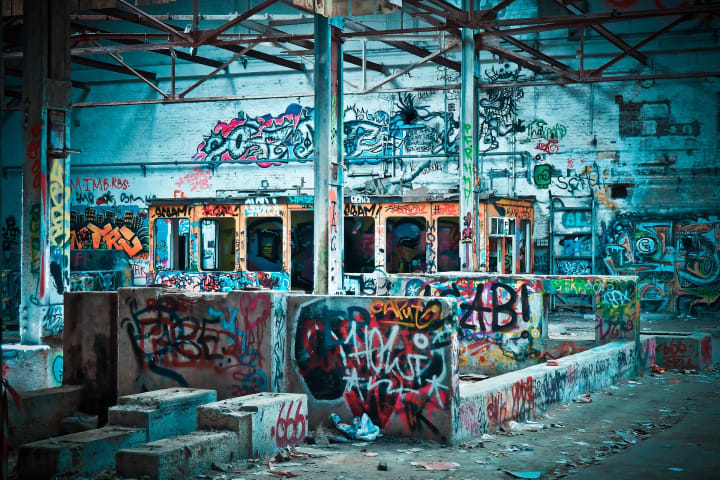
The Midwest carries graffiti’s grittiest poetry. In industrial states like Illinois, Michigan, and Ohio, graffiti emerged as the voice of the working class, the unemployed, and the forgotten. Chicago’s train yards and Detroit’s decaying factories became the backdrop for massive murals and ghostly tags—expressions of survival in post-industrial America.
Detroit’s Chimera mural stands as a testament to the city’s ability to reclaim ruin through art. Yet just miles away, abandoned rail corridors still bear coded graffiti used by local gangs and freight train crews—a living record of underground networks moving quietly across the Rust Belt.
In Cleveland and St. Louis, graffiti bridged two worlds: hip-hop and the hustler. Writers and gang members often shared the same walls, each leaving messages meant for different audiences. To outsiders, they were random colors; to locals, they were living news feeds, territorial boundaries, or prayers for the dead.
The West: From Walls to World Stages
The Western states—California, Nevada, Arizona, and beyond—turned graffiti into global culture. In Los Angeles, the fusion of Chicano muralism, skate culture, and hip-hop birthed styles recognized worldwide. Artists like Chaz Bojórquez and RETNA transformed traditional gang script into high art, bridging the gap between barrios and galleries.
California also revealed graffiti’s darker side: in the 1980s and 1990s, tagging became central to gang communication. The Bloods, Crips, and Sureños each used specific color schemes, typography, and placement to signify dominance or disrespect. Law enforcement began to treat graffiti analysis as a form of criminal intelligence.
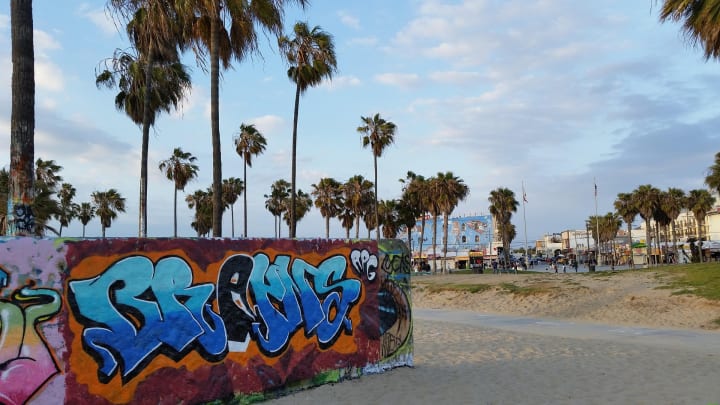
But the West Coast was also where graffiti achieved its highest artistic legitimacy. The Venice Art Walls in Los Angeles stand as a symbol of sanctioned rebellion—artists paint freely under the sun, in a city that once waged war on tagging. Nevada’s desert towns and Las Vegas alleys tell similar stories: graffiti as tourism, graffiti as rebellion, graffiti as a survival mechanism.
The Mountains and the Plains: Silence, Freight, and Freedom
In the quieter states—Colorado, Utah, Kansas, and Nebraska—graffiti travels more than it stays. Freight trains act as the region’s moving art galleries. Thousands of boxcars tagged in Denver, Omaha, or Salt Lake City carry the visual fingerprints of anonymous artists across the entire nation.
This region’s graffiti culture is less about turf and more about transcendence. The trains themselves are metaphors for escape, migration, and anonymity. For many writers, hitting freights isn’t a crime—it’s communion. Yet even here, coded messages sometimes travel with the paint. Law enforcement in Colorado and Utah tracks graffiti connected to transient crews and outlaw motorcycle gangs, using the same visual clues that define its artistry.
The Pacific and the Islands: Nature, Identity, and Resistance
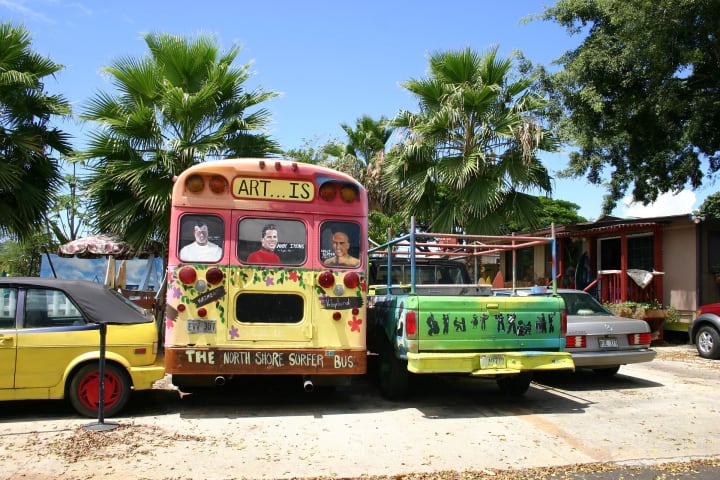
On the Pacific coast and in island states like Hawaii, graffiti absorbed elements of indigenous art, surf culture, and activism. In Seattle and Portland, graffiti became a protest language—used during anti-war movements, climate marches, and anti-gentrification campaigns. Walls became manifestos, not just art.
In Hawaii, graffiti tells stories of cultural reclamation. Tags often include Hawaiian language words and island symbology, asserting identity against the tide of commercialization and displacement. Unlike the mainland, where graffiti often signals rebellion against urban decay, island graffiti resists erasure—its presence is both political and poetic.
Graffiti as a Mirror of the Nation
Across the map, graffiti reveals what America hides. It’s a mirror of urban neglect, artistic ingenuity, racial tension, economic despair, and human resilience. Each state’s walls whisper its own truths: some about poverty, others about protest, and many about pride.
Sociologists describe graffiti as “visual communication through illicit art,” a way for the marginalized to reclaim space. Philosophically, it is freedom manifested through color—an act of self-creation in a society that often seeks conformity.
Even law enforcement acknowledges graffiti’s dual nature. The FBI defines it as both a public nuisance and a tool for criminal organizations. Yet, in the same breath, art institutions and museums celebrate graffiti as one of the most important contemporary art movements. The contradiction isn’t hypocrisy—it’s proof that graffiti occupies a space where order and chaos coexist.
Conclusion: The Wall as a Canvas of the Human Condition
Graffiti in America is not just about spray paint—it’s about humanity. Each state contributes its own accent, culture, and rhythm to a vast national mural that tells the story of freedom and control, of art and crime, of visibility and erasure.
Every tag and mural, whether scrawled in the Bronx or brushed across a bridge in Montana, carries the same primal message: I am here. It is both defiance and declaration—a reminder that beneath the country’s glossy exterior lies an enduring, restless creativity that refuses to be silenced.
When we read America’s walls, we are reading its conscience.
References:
- Ilan, J., & Snyder, G. J. (2016). Graffiti. In J. Ilan & G. J. Snyder (Eds.), Oxford Handbook Topics in Criminology and Criminal Justice (pp. …). Oxford University Press. https://doi.org/10.1093/oxfordhb/9780199935383.013.144
- Feitosa-Santana, C., Gaddi, C. M., Gomes, A. E., & Nascimento, S. M. C. (2020). Art through the colors of graffiti: From the perspective of the chromatic structure. Sensors (Basel), 20(9), 2531. https://doi.org/10.3390/s20092531
- “Vandalism or art? Graffiti straddles both worlds.” (1991, March). UW Magazine. University of Washington. https://magazine.washington.edu/feature/vandalism-or-art-graffiti-straddles-both-worlds/
- “The City Beneath: A century of Los Angeles graffiti.” (n.d.). Phillips, S. A. [PDF]. Department of Art, Pitzer College. https://www.chapman.edu/wilkinson/art/_files/ah---susan-phillips.pdf
About the Creator
xJRLNx
Im a dude letting out his madness with the help of Ai.
'Till Death We Do Art
There would be nothing divine in this world without art. Nature may surpass the divine to all intents and purposes, but like everything it absorbs and is absorbed by, it remains here, stuck on the surface of this world, ever-present, physically bound to the universe.
By Avocado Nunzella BSc (Psych) -- M.A.P 24 days ago in Art
Rewire Your Mind for Success
brilliant inventor and worked day and night in her small lab, filled with glowing screens and strange gadgets. Despite her talent, she struggled to find success. Her inventions were often overlooked, and her ideas remained trapped in her mind.
By Hamad Afridi 2 days ago in Art



Comments
There are no comments for this story
Be the first to respond and start the conversation.