
From Paint to Power: How Sotheby’s and Christie’s Made Art a Billionaire’s Playground
Inside the secretive world where canvases become currency.

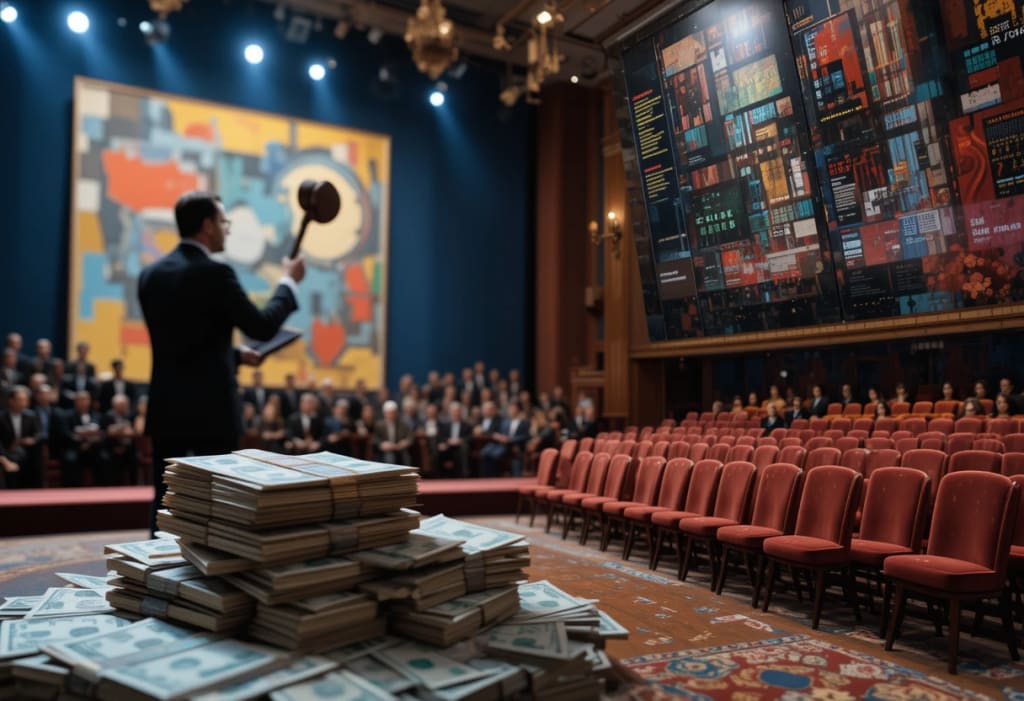
Inside the secretive world where canvases become currency.
The hammer falls, the gavel echoes, and in less than a second, millions change hands. To the uninitiated, an art auction may look like a glamorous spectacle — elegant bidders raising paddles, champagne flutes in hand, masterpieces flashing on stage under golden lights. But beneath the polish lies a marketplace as strategic, competitive, and opaque as Wall Street.
At the center of this glittering yet secretive world are Sotheby’s and Christie’s, the two titans of art auctions. Together, they have transformed paintings and sculptures into more than objects of beauty. They are now assets, weapons of prestige, and tokens of power in a global billionaire class.
How did two auction houses, both founded centuries ago, reinvent themselves into players in the modern luxury economy? And what does it say about the strange new role of art, when a canvas can sell for the price of a skyscraper?
The Origins: A Tale of Two Auction Houses
Sotheby’s was born in 1744, when Samuel Baker held a sale of rare books in London. Christie’s followed in 1766, founded by James Christie. For much of their early histories, these houses dealt not with celebrity art sales but with libraries, estates, and antiques.
Over the centuries, they grew into trusted institutions of taste — the arbiters of what was valuable, rare, and desirable. But their true metamorphosis came in the 20th century, when they expanded beyond Europe, built strongholds in New York, and turned art auctions into theater.
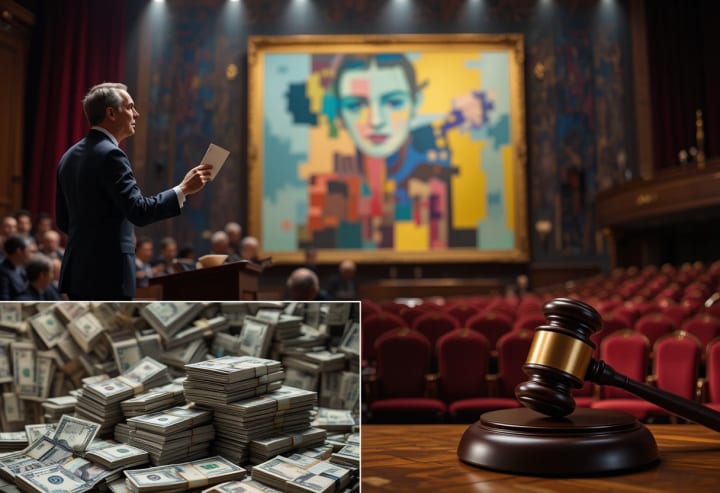
No longer were they simply brokers of estates; they became stages of spectacle, where wealth and ambition collided under the bright lights.
The Auction as Performance
An auction at Sotheby’s or Christie’s is not merely a sale; it is a performance carefully choreographed to seduce the wealthy.
The room itself is a character: marble floors, velvet chairs, walls lined with multimillion-dollar paintings awaiting their moment in the spotlight. The auctioneer, with their rapid-fire patter and sharp gavel strikes, orchestrates tension like a conductor. Every bid is a drumbeat, every nod of a paddle a crescendo, until the final hammer falls.
This ritual transforms art into theater, and theater into competition. For the billionaires in the room, buying a Picasso or a Basquiat is not just about acquiring beauty; it’s about dominating the room, displaying power, and cementing status.
Art as Currency
The world’s elite now treat art as a financial instrument. Paintings are collateral for loans, stored in freeports (tax-free storage facilities) in Geneva or Singapore, rarely seen by the public. Some never even hang on walls; they exist purely as assets, traded in hushed private deals.
Christie’s and Sotheby’s have facilitated this shift. By marketing works as “investment-grade assets,” they made it clear: a canvas is no longer just paint on linen, but a store of value.
Consider the numbers:
In 2017, Christie’s sold Leonardo da Vinci’s Salvator Mundi for $450.3 million — the highest price ever paid for a painting.
Sotheby’s has sold Warhols and Monets for nine-figure sums, often doubling estimates after frenzied bidding wars.
These record-breaking moments aren’t accidents; they are engineered. Auction houses meticulously cultivate buyers, offer guarantees to sellers, and stage previews like luxury fashion shows, ensuring the art becomes not only desired but unattainably prestigious.
The Billionaire Playground
Why do the ultra-wealthy flock to these sales? In part, it is a club — an elite circle where billionaires measure themselves against one another through acquisitions. Owning a Rothko or a Koons is not just cultural capital but social armor, proof of belonging to the highest tier of global society.
Art is also a discreet way to park wealth. Unlike real estate or stocks, it can be moved across borders quietly, with fewer regulations and scrutiny. A $100 million Picasso can slip into a Swiss vault with ease, beyond the eyes of governments.
This has made art auctions magnets for oligarchs, hedge fund moguls, and royals. The competition is not just financial but psychological. In a bidding war, ego often trumps logic. Paying far beyond market value becomes a way of saying: I can afford to win.
Controversies in the Canvas
But with secrecy and staggering wealth come shadows. Critics argue that Sotheby’s and Christie’s perpetuate inequality, turning cultural treasures into trophies for the few.
The use of “third-party guarantees” — where wealthy backers ensure a work sells at a minimum price in exchange for a cut of the upside — blurs the line between open market and insider deal.
Then there are questions of provenance. Stolen, looted, or misattributed works occasionally surface, revealing the murky underbelly of art circulation. In the pursuit of record-breaking sales, auction houses sometimes look the other way until scandals erupt.
The Future of Auctions
Despite criticisms, the allure of Sotheby’s and Christie’s only grows. They have expanded into online sales, NFTs, and luxury goods, further entrenching themselves as arbiters of global wealth culture.
In recent years, younger billionaires from tech have entered the fray, buying digital art alongside Picassos. The market is adapting, but the principle remains: art is power, and auctions are its battleground.
The Ghost in the Gallery
Behind the glamour, one question lingers: what happens when masterpieces vanish into private vaults, unseen by the public for decades? Has art lost its soul, reduced to a zero-sum game of wealth and ego?
Sotheby’s and Christie’s would argue otherwise. By commanding attention and astronomical sums, they ensure art remains at the center of global culture. But perhaps the true irony is this: the more expensive art becomes, the fewer people actually get to see it.
What began as an expression of beauty has become a mirror — reflecting not just the genius of artists, but the ambitions, egos, and excesses of those who buy them.
About the Creator
Keep reading
More stories from waseem khan and writers in Art and other communities.
Dog Shoes for Small Dogs and Puppy Shoes A Practical, Paw-Friendly Guide
Small dogs and puppies may look tough, but their paws often need more protection than people realize. Their bodies are lighter, their paws are smaller, and many of them spend a lot of time on surfaces that were never designed for delicate paw pads. Add cold sidewalks, hot pavement, rough gravel, wet grass, or even slippery indoor floors, and you start to see why dog footwear has become more than just a cute trend.
By aliyashahzadi3 days ago in Art




Comments
There are no comments for this story
Be the first to respond and start the conversation.