

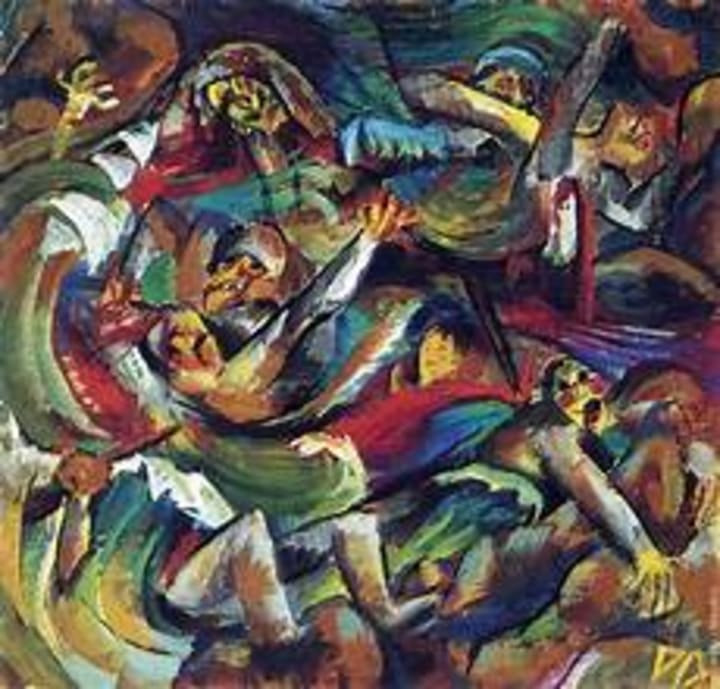
German artist Wilhelm Heinrich Otto Dix was among the most famous German Expressionist painters. The artist was deeply impacted by the horrors of war; his paintings are quintessential expressionist depictions of existential angst, alienation, and suffering reinforced by the thick, black lines and passionately bold colors indicative of German Expressionism.
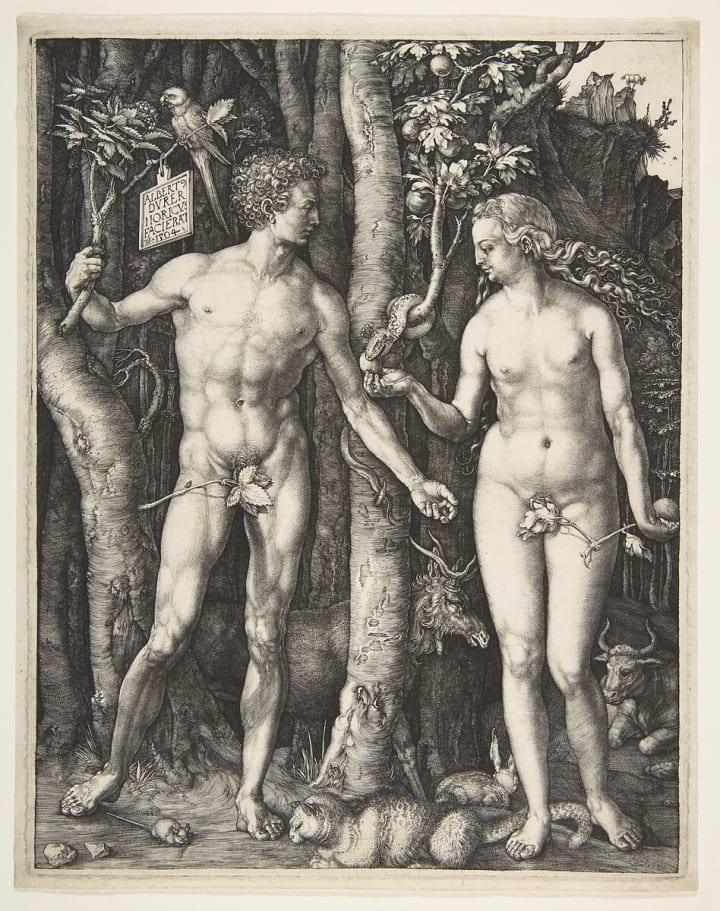
German artist Albrecht Dürer was well known during the German Renaissance art movement in the 14th and 15th centuries, He is best known for his altarpieces, watercolor paintings, and self-portraits. Many of his artworks depict religious scenes, like his famous Adam and Eve (1507). He wrote books on linear perspective, art theory, and anatomical dimensions in art while creating paintings and exquisite engravings and prints.
German artist Max Ernst (pictured above) was an influencer of the Surrealism and Dada art movements in the 1920s. He not only created oil paintings but also collages and sculptures. Returning from WWII, he was diagnosed with post-traumatic stress disorder. The artist started creating Dadaist collages, and among his well-known works is Here Everything is Still Floating, which depicts a bomb falling from a military plane.

German artist Caspar David Friedrich was famous for painting allegorical landscapes that were influenced by the Romantic art movement in the 19th century. His paintings depicted silhouettes of human figures standing in contrast to midnight skies, crumbling Gothic structures, trees devoid of leaves, and heavy fog.

German artist Hans Hartung was influenced by Rembrandt, Emil Nolde, and Lovis Corinth. In Munich he studied with Max Doerner for several years. Escaping the Nazis, the artist fled to Paris. He was recognized for his idiosyncratic monochrome paintings that incorporated rhythmic, elongated scratchings and sweeping brushstrokes. Modern artists adopted some of his abstract ideas, like his use of solid colors and broken bold lines.

German artist Ernst Ludwig Kirchner was the founder of the German Expressionist group The Bridge. By 1920, Kirchner had developed a reputation as an outstanding new artist and exhibited his paintings throughout Switzerland and Germany in the early 1920s. Overlaid with aspects of surrealism, Fauvism, and primitivism, Kirchner’s paintings displayed the classic bold lines, dark hues, and somber visages indicative of Weimar Republic Expressionism.

German artist Paul Klee was among the German Expressionist painters who represented the Der Blaue Reiter group. This art movement was characterized by dark or matte colors, thick lines, hints of Cubism, and existential scenes. The artist worked at the Academy of Fine Arts in Dusseldorf. Among his best-known artworks was Blossoms in the Night.
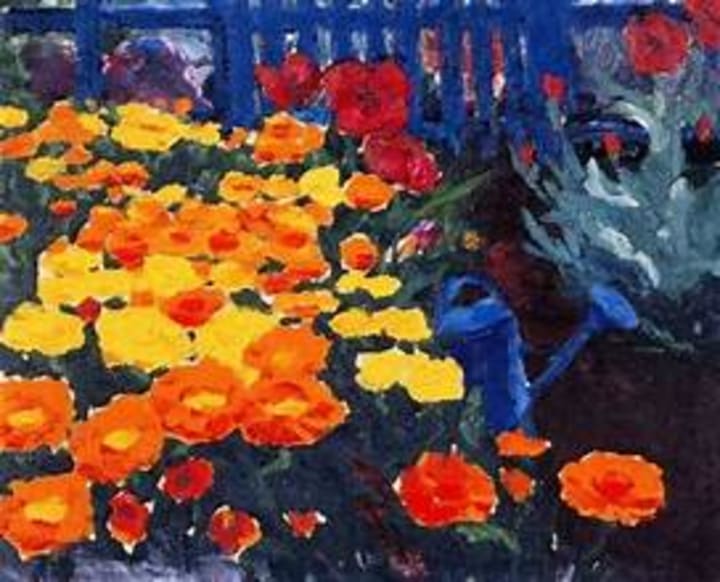
German artist Emil Nolde was one of the first members of Die Brucke (the German Expressionist group The Bridge).His artwork was characterized by his use of warm, passionate red, yellow, and orange hues interacting with melancholy scenes, vivid flowers, and somber human faces. He started painting two-dimensional, religious scenes using bright blues, yellows, and reds.

German artist Gerhard Richter was known for not relegating himself to one particular art movement. He created paintings and photorealistic artworks incorporating copies of monocolor photos in the paintings. The effect of infusing black and white photos in his artwork created a notable blurry smudginess to subjects and scenes. Richter’s photorealistic paintings were done in gray monochromes. His early works of art included portraits of murder victims, intellectuals, and members of a terrorist group called the Red Army Faction. His later work involved depictions of city scenes, landscapes, and portraits.

German artist Hans Holbein the Younger was a prolific painter, stained glass designer, and woodcut printer of detailed portraits, religious scenes, and pro-Protestant, Reformationist artwork. The artist developed a recognizable style of painting referred to as humanistic realism. Among his most famous artworks is the woodcut print called The Dance of Death.
About the Creator
Rasma Raisters
My passions are writing and creating poetry. I write for several sites online and have four themed blogs on Wordpress. Please follow me on Twitter.
Keep reading
More stories from Rasma Raisters and writers in Art and other communities.
Famous Swiss Artists
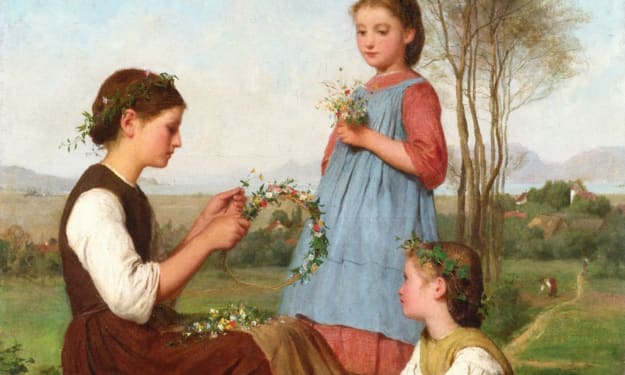
Swiss artist and illustrator Albert Anker became the “national painter” of Switzerland for his endearing depictions of life in a Swiss village in the 19th century. He took drawing lessons with painter Louis Wallinger and later attended the Gymnasium Kirchenfeld in Bern. At the University of Halle in Germany, the artist was inspired by art collections and decided to pursue a career in art. In Paris, he attended the Ecole des Beaux-Arts. His artworks include a series of pieces with Biblical and historical themes.
By Rasma Raisters5 months ago in Art
The River and the Drops
High in the mountains, where no one watched and no one applauded, tiny drops of water slipped from melting snow. Each drop was small, almost invisible, and carried a quiet fear within itself. They began their journey without knowing where they were going, only knowing that they were moving away from where they began.
By Sudais Zakwan2 days ago in Art



Comments
There are no comments for this story
Be the first to respond and start the conversation.