
Famous British Paintings
Painting by British artists

British art includes all artwork that was created in the United Kingdom since the Kingdom of Great Britain was established in 1707.
In the 18th century British art portrait and landscape painting started to become popular.
The Romantic era saw the rise of such artists as William Blake, J.M.W. Turner, John Constable, and Samuel Palmer.
The Fighting Temeraire J.M.W. Turner
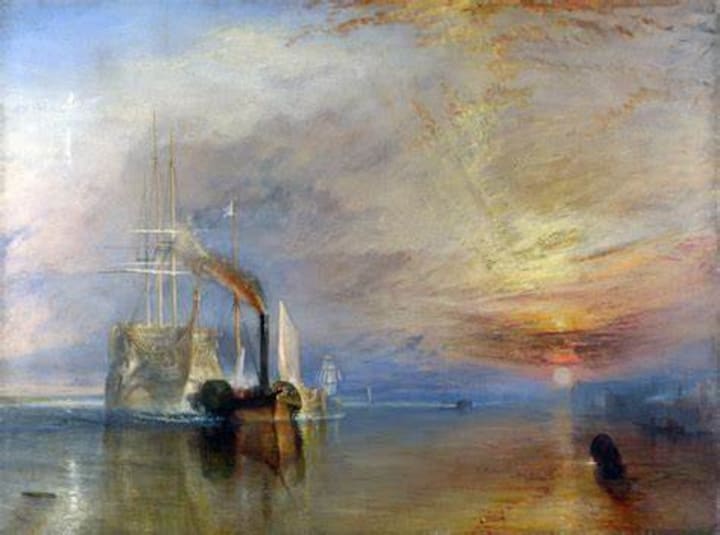
British artist J.M.W. Turner created this oil on canvas depicting the ship HMS Temeraire being tugged to her last berth to be broken up. The painting was completed in 1838 and shown at the Royal Academy in London in 1839.
The artwork shows the 98-gun HMS Temeraire, one of the last second-rate ships of the line that took part in the Battle of Trafalgar. The ship is being pulled up the Thames by a paddle-wheel tug. It is heading for its last berth at Rotherhithe to be broken up for scrap. Today it can be viewed at the National Gallery in London.
The Lady of Shalott John William Waterhouse (Pictured above)
British artist John William Waterhouse created this artwork in 1888. The painting depicts the conclusion of the 1832 poem of the same name by Lord Alfred Tennyson. Presently the painting can be viewed in Room 1840 at the Tate Britain in London.
The painting shows a scene from Tennyson’s poem in which the poet describes the plight of a young woman. She is loosely based on Elaine of Astolat from the Medieval Arthurian legend. In the legend the woman yearned with unrequited love for Sir Lancelot, who was isolated in a tower near Camelot under an unknown curse. The Lady of Shalott is among the artist’s most-recognized artworks. This oil on canvas was completed in 1888,
Mr. and Mrs. Clark and Percy David Hockney
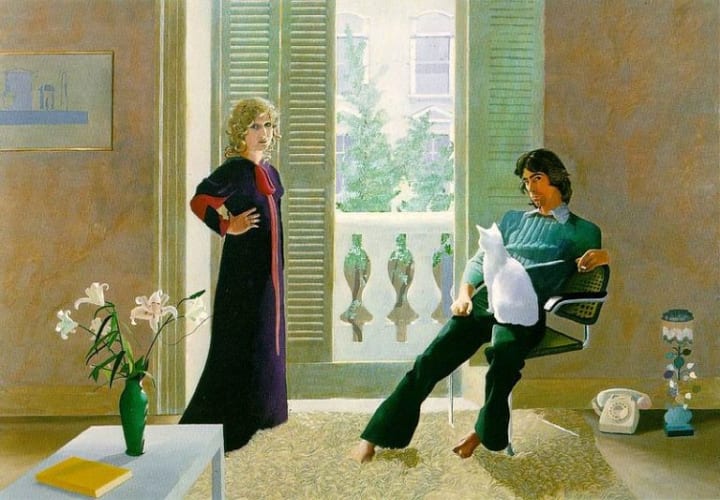
British artist David Hockney was known for his series of huge double portraits usually depicting an impassioned man and woman. He was known for his bright, sunny depictions of life in Southern California. In this painting he depicts a couple in a kind of gloomy interior, looking despondent, with the man holding their cat on his lap.
Ophelia John Everett Millais
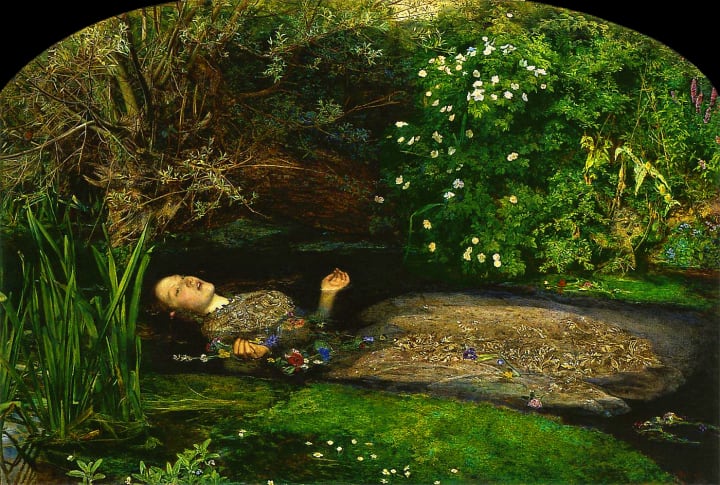
British artist John Everett Millais created this artwork between 1851 and 1852. It can be viewed at the Tate Britain in London.
In the painting, the character Ophelia is from the play “Hamlet” by William Shakespeare. It depicts Ophelia drowning in a river in Denmark. This is considered to be one of the most important artworks of the mid-nineteenth century. Ophelia is shown singing while she floats down the river, The monologue by Queen Gertrude in Act IV, Scene VII of “Hamlet” depicts the action.
The Hay Wain John Constable
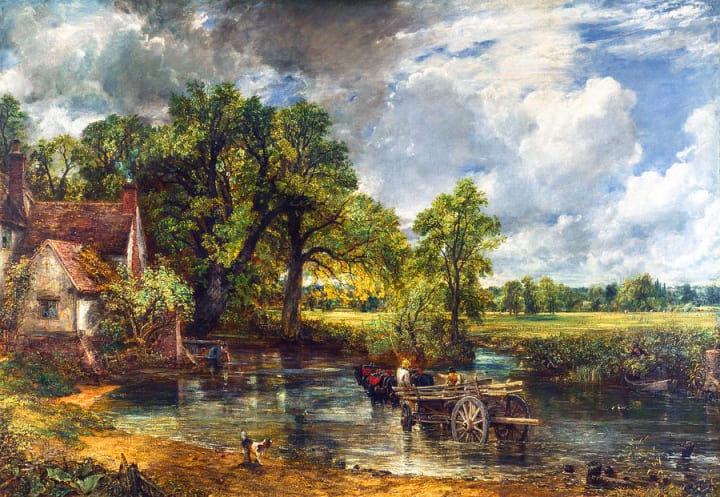
British artist John Constable is a popular painter from the 19th century and is considered to be among the best nature painters of all time. This artwork completed in 1821 is one of his most famous paintings. In the painting, a farmer is seen crossing the River Stour with a horse-drawn wagon in the rural areas on the border between Suffolk and Essex,
Girl with Balloon Banksy
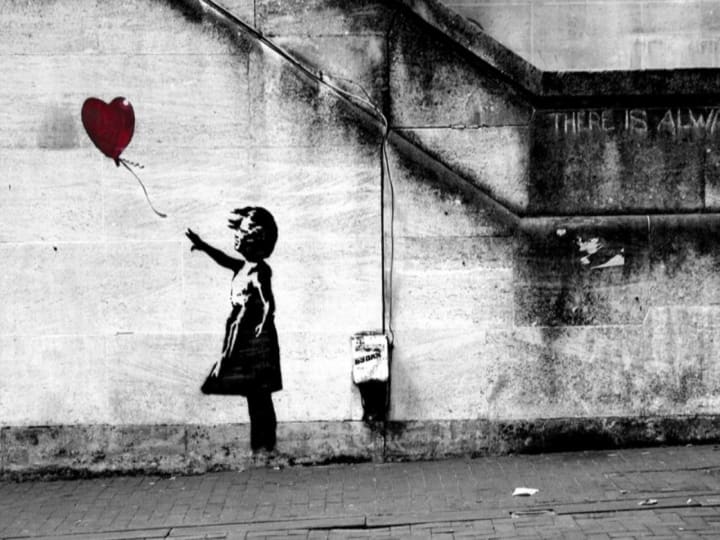
British graffiti artist Banksy started a series of stencil murals in London in 2002. They were titled Girl with Balloon. This artwork depicts a little girl reaching out for a red heart-shaped balloon being swept away by the wind. Samsung voted this as the favorite piece of art in the UK in 2017.
The Ambassadors Hans Holbein the Younger
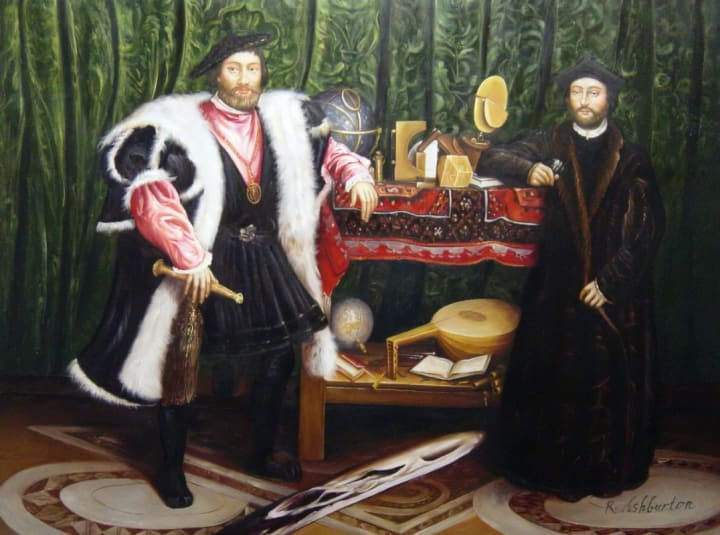
British artist Hans Holbein the Younger created this artwork in 1533 the same year that Elizabeth I was born, during the Tudor period. The ambassadors in the painting are Jean de Dinteville and Georges de Selve. It can be viewed at the National Gallery in London.
The twisted skull in the artwork’s lower center is the most recognizable and well-known of Holbein’s symbols in the painting. To view the skull the viewer must approach the artwork from a high position on the right or a low position on the left side to recognize the shape as a human skull.
Mr. and Mrs. Andrews Thomas Gainsborough

British artist Thomas Gainsborough created this artwork around 1750. It is an oil on canvas that can be viewed in the National Gallery in London.
This was selected as one of four paintings to represent British art in an exhibition to honor the coronation of Queen Elizabeth II in Paris, France. It is a symbol of the paternalistic and capitalist society of 18th-century England.
About the Creator
Rasma Raisters
My passions are writing and creating poetry. I write for several sites online and have four themed blogs on Wordpress. Please follow me on Twitter.
Keep reading
More stories from Rasma Raisters and writers in Art and other communities.
Most Unusual Artwork on Canvas
The Famous Artist Quarreling with His Neighbors Edvard Munch Norwegian artist Edvard Munch was best known for his anxiety-provoking paintings. Munch has a neighbor Axel Gunnerud who adopted a dog named Rolle. The dog grew to love his owner and he became the only human Rolle would tolerate. The dog was aggressive and attacked mailmen and neighbors including the painter. During this time Munch made some drawings of Rolle and it resulted in this painting.
By Rasma Raistersabout a year ago in Art
'Till Death We Do Art
There would be nothing divine in this world without art. Nature may surpass the divine to all intents and purposes, but like everything it absorbs and is absorbed by, it remains here, stuck on the surface of this world, ever-present, physically bound to the universe.
By Avocado Nunzella BSc (Psych) -- M.A.P 26 days ago in Art
The Rise of Decentralized Social Media and What It Means for Content Creators
For most of the past two decades, a small number of centralized platforms have dominated the social media landscape. Companies like Facebook, Instagram, X (formerly Twitter), and TikTok built massive ecosystems that attracted billions of users, but they did so under a model where the platform holds ultimate control over content, data, and revenue distribution. Creators who poured time and energy into building audiences on these platforms often found themselves at the mercy of opaque algorithms, sudden policy changes, and revenue-sharing structures that heavily favored the platform itself.
By Chaturbateme3 days ago in Art



Comments
There are no comments for this story
Be the first to respond and start the conversation.