

J.M.W. Turner, an English Romantic artist, printmaker, and watercolorist, was renowned for his avant-garde depictions of ships and landscapes. More than 500 oil paintings, 2,000 watercolors, and 30,000 sketches are among these creations.

Two oil paintings on canvas depicting the fire that started at the Houses of Parliament in the evening of October 16, 1834, are titled The Burning of the Houses of Parliament. Like hundreds of others on the south bank of the Thames, the artist witnessed the burning. He used watercolor and pencil to draw in two sketchbooks from different angles.

One of the artist’s most famous artworks is Dido Building Carthage, or the Rise of the Carthaginian Empire, an oil on canvas painting. A classical countryside from Virgil’s Aeneid is depicted in the artwork. Dido is the figure in blue and white shown on the left, in charge of building the new city of Carthage. Aeneas, her Trojan lover, is standing in front of her dressed in armor. On the right side of the image, on the opposite bank of the estuary, is the grave of her late husband, Sychaenus, foreshadowing the impending tragedy of Carthage, while children play with a flimsy toy boat in the sea representing the development of the fragile naval strength of the city and its impending tragedy.

An oil-on-canvas painting titled The Fighting Temeraire depicts the ship Temeraire being towed to her final berth to be dismantled. The artwork was completed in 1838. It shows the 98-gun HMS Temeraire, one of the final second-rate ships of the line to participate in the Battle of Trafalgar, being pulled up the Thames by a steam tug with a paddle wheel in order to reach her final dock at Rotherhithe, where she would be disassembled for scrap. The painting can be viewed at the National Gallery in London.

Fishermen at Sea, also known as Cholmeley Sea Piece, is an early oil-on-canvas. It was originally displayed in 1795 at the Royal Academy of Art and is currently on display at London’s Tate Gallery. The painting depicts fishermen riding rough seas to the Needles on the Isle of Wight in the moonlight. The small boat with flickering lanterns represents the frailty of human existence, while The dark, cloudy sky, wide dark sea, and terrifying rocks in the background represent the vast might of nature.
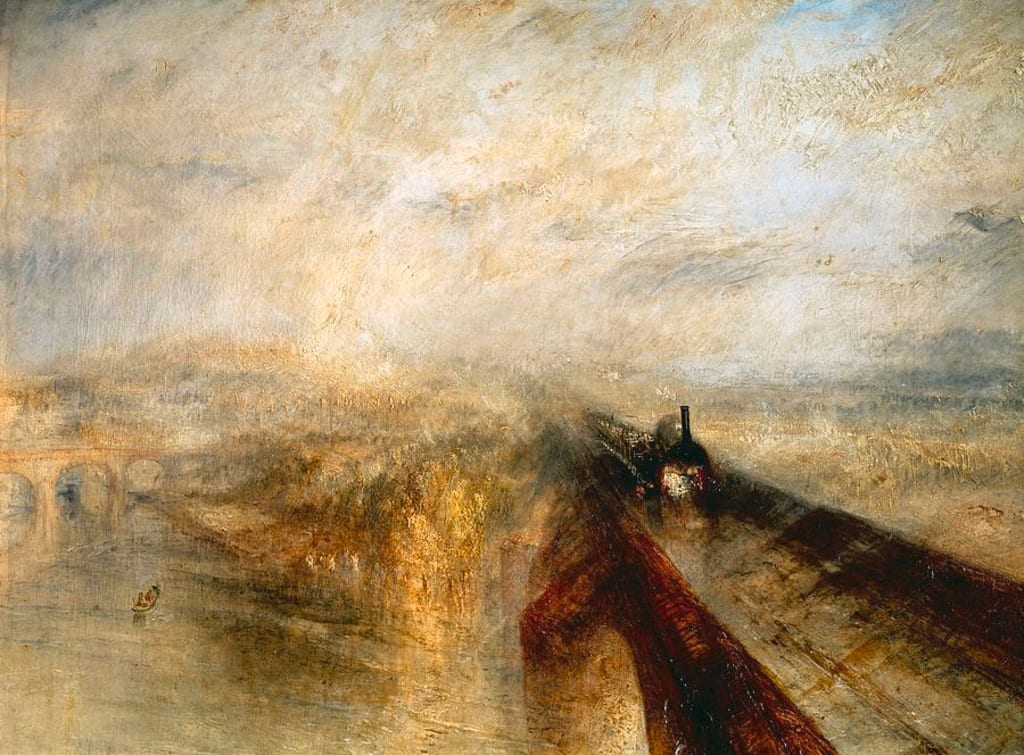
Turner’s oil-on-canvas painting The Great Western Railway titled Rain, Steam, and Speed was finished near the conclusion of the Industrial Revolution, which marked a dramatic shift from an agricultural economy to one centered on machine manufacturing during the Victorian era. (pictured above) One of the most direct representations of industrialization was the railway, Being one of the few painters of the period who considered industrial advancement as a viable subject for art, Turner was a generation ahead of other artists.

The Slave Ship is currently on display at the Museum of Fine Arts in Boston, Massachusetts, USA. It was originally displayed at the Royal Academy of Arts in 1840. The painting shows a ship sailing over a turbulent sea of churning water in the background. It is a classic example of a Romantic artwork scene leaving scattered human figures in its wake. After reading about the slave ship Zong in “The History and Abolition of the Slave Trade” by Thomas Clarkson, Turner was motivated to create The Slave Ship.

The oil painting Snow Storm, or Snow Storm: Steamboat off a Harbor’s Mouth, was finished in 1842. Turner created at least five artworks in the ten years prior that examined the relationship between nature and the new steamboat technology. Throughout his career the artist was interested in railroads, steam power, urbanization, and industry. In this artwork a paddle ship gets trapped in a snowstorm. Turner’s vivid, daring Romantic inspiration is fully realized in this maritime painting.
About the Creator
Rasma Raisters
My passions are writing and creating poetry. I write for several sites online and have four themed blogs on Wordpress. Please follow me on Twitter.
Keep reading
More stories from Rasma Raisters and writers in Art and other communities.
Top Art Museums in Europe
Austria Belvedere Museum has made its home in a Baroque palace complex in Vienna. The art collection ranges from the Middle Ages to modern art, focusing on Austrian painting. The museum has Secessionist masterpieces produced during the Vienna Secession movement by Gustav Klimt, including The Kiss, and artworks by Egon Schiele and Oskar Kokoschka.
By Rasma Raisters3 months ago in Art
'Till Death We Do Art
There would be nothing divine in this world without art. Nature may surpass the divine to all intents and purposes, but like everything it absorbs and is absorbed by, it remains here, stuck on the surface of this world, ever-present, physically bound to the universe.
By Avocado Nunzella BSc (Psych) -- M.A.P 22 days ago in Art
Leadership Behind the Experience: The Role of Brandon Cody Verran at Big Sky
In the world of hospitality and resort management, great guest experiences rarely happen by accident. Behind every smooth operation, welcoming atmosphere, and memorable stay is a team of dedicated professionals working together. At Big Sky Resort, one of the most renowned mountain destinations in North America, leadership plays a key role in ensuring that guests receive the level of service they expect. Among those helping guide operations is Brandon Cody Verran, who serves as an assistant general manager within the larger organization of Boyne Resorts.
By ORM_Specialista day ago in Art




Comments
There are no comments for this story
Be the first to respond and start the conversation.