
Famous American Paintings
Artwork by American artists


Most American artists share in common that their ancestors were immigrants who settled in the US. These painters shared different cultural values and created paintings through their impressions of both individuals and society as a whole.
American Gothic (1930) Grant Wood
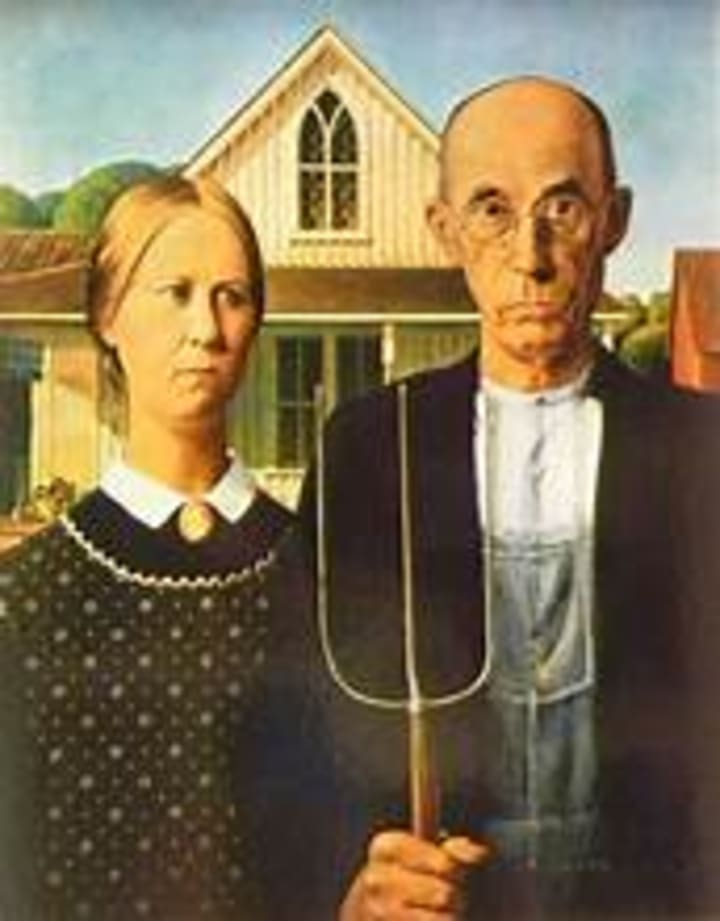
American artist Grant Wood was among the greatest American painters of the 20th century. This artwork is the most popular and considered one of the best American paintings. It depicts a middle-aged farmer and his daugter standing in front of their farmhouse. The timber house was constructed in the American Gothic style of architecture popular in the 1890s. He modeled the home on Dibble House, a residence he observed in the little town of Eldon in Iowa, and dressed Nan, his sister, and his dentist, Dr. Byron McKeeby, as subjects for the pair.
Black Iris (1926) Georgia O’Keeffe
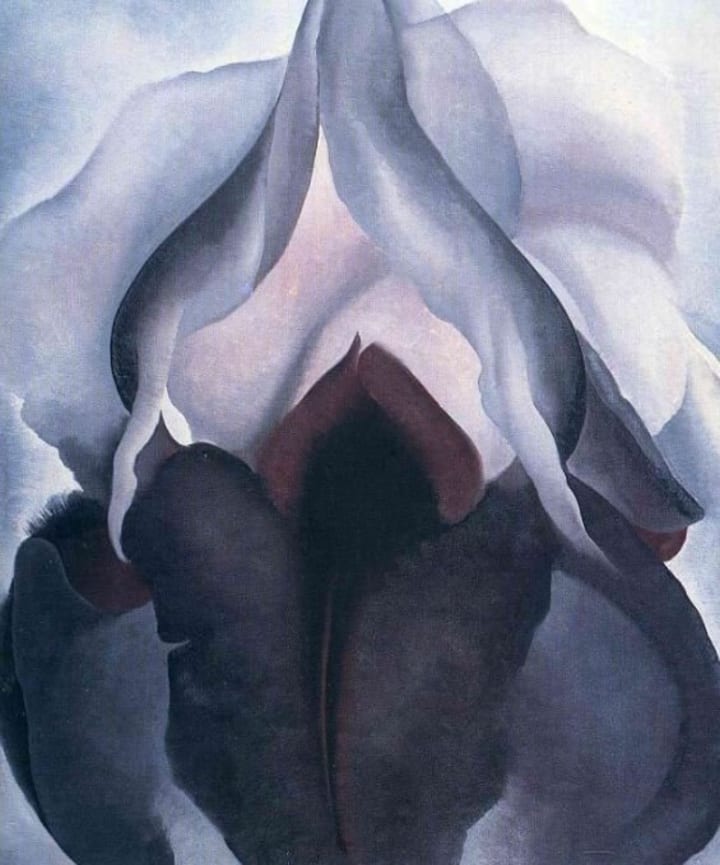
American artist Georgia O'Keefe was known for her paintings of flowers. The iris is a well-known motif in Western art, widely utilized in Religious art; its sword-like blades were particularly used as a metaphor for Mary’s agony, a visual analogy that Georgia O’Keeffe may have been aware of due to her Devout background and catholic education. For several years, her famed irises were a major source of inspiration; she preferred the black iris, which was only available at select florists in New York for roughly two weeks every spring.
Christina’s World (1948) Andrew Wyeth
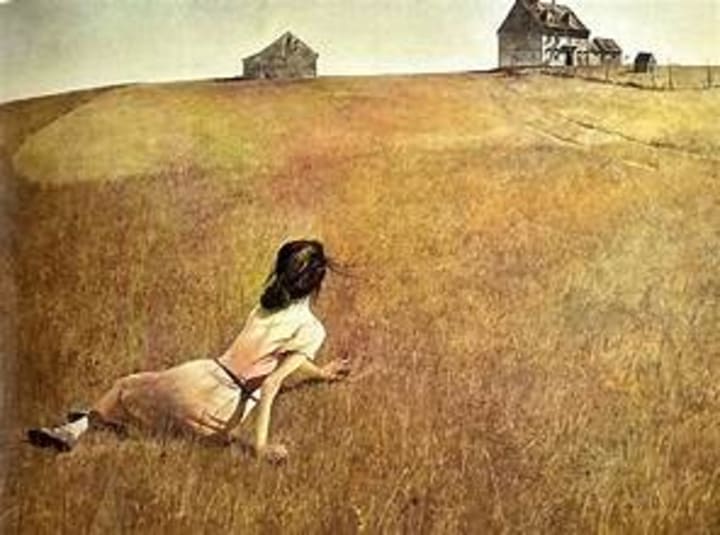
American artist Andrew Wyeth created this artwork set in the harsh environment of the coast of Maine. It depicts a young woman dressed in a pink dress in a field of grass. She supports herself on her wrists and looks toward the farmhouse. This famous American artwork portrays the artist’s neighbor who was unable to walk due to polio and would drag herself around.
Freedom from Want (1943) Norman Rockwell (Pictured above)
American artist Norman Rockwell was inspired by the State of the Union address given by President F.D. Roosevelt. The painting depicts three generations of a family sitting down to enjoy a Thanksgiving dinner. The husband is seated at the head of the table, while his wife prepares to set a big turkey in front of their family.
Mountains and Sea (1952) Helen Frankenthaler
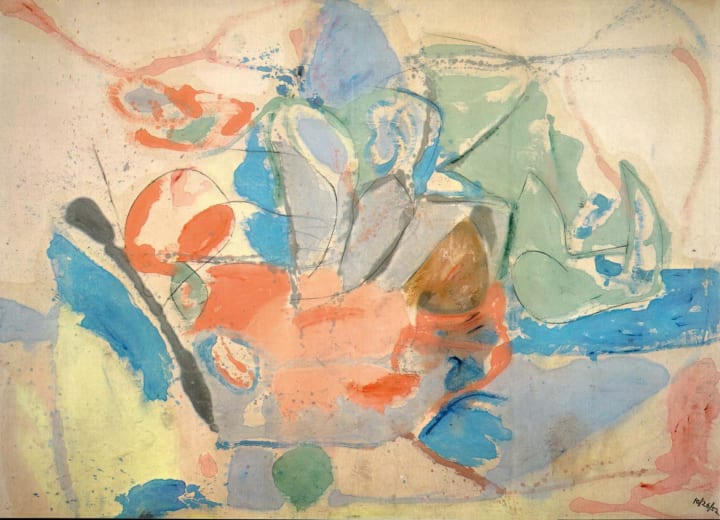
American abstract expressionist artist Helen Frankenthaler created this painting by laying an un-primed panel directly on the ground and staining it with colors by reducing oil paint with solvent and enabling the colors to flow. This was her first time using the staining method.
Nighthawks (1942) Edward Hopper
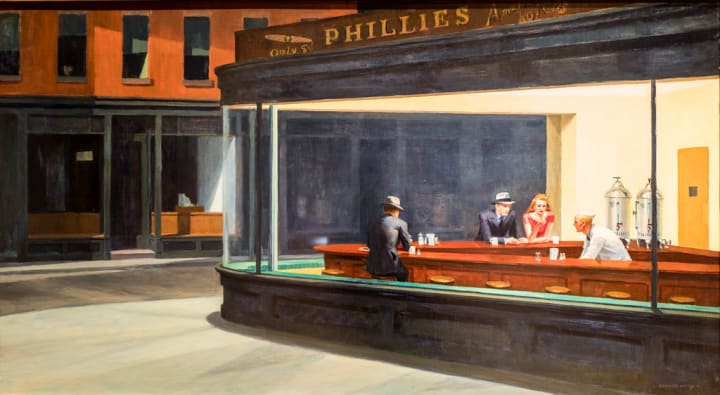
American artist Edward Hopper created this artwork which is considered to be one of the most iconic paintings of American culture, capturing the lifestyle of the 1940s. The painting depicts a late-evening scenario in which a few customers are still hanging around a diner. The light from the diner appears to be inviting people to stop by. The term "nighthawk" refers to a bird known for its nocturnal habits, symbolizing the night-time setting of the painting.
Paul Revere (1770) John Singleton Copley
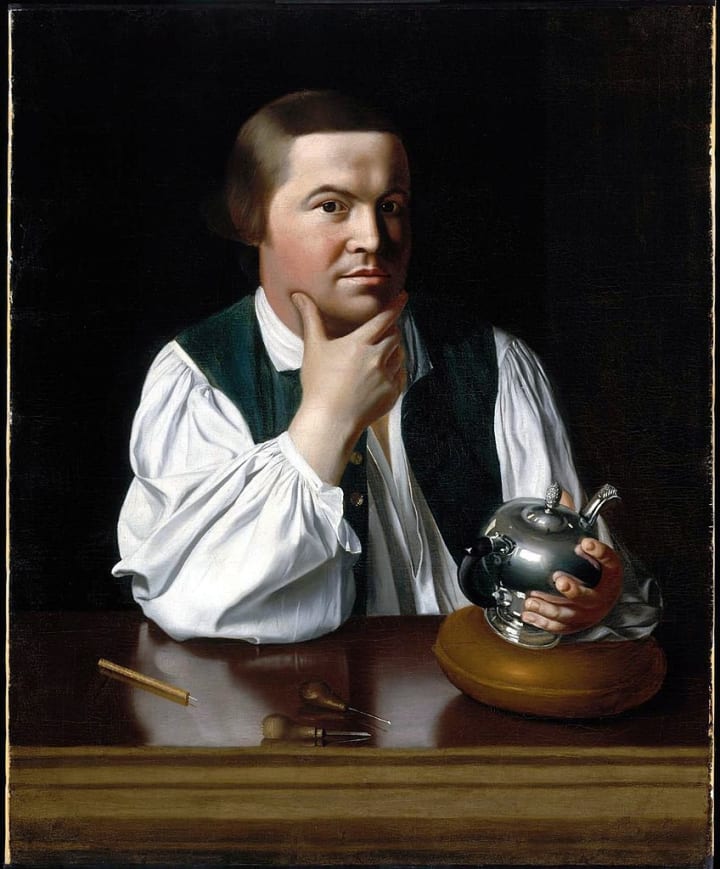
American artist John Singleton Copley created this portrait of a craftsman in shirtsleeve and depicted at work. The craftsman was the famous Paul Revere who was an experienced silversmith. He is depicted half-length as he cradles his chin with his dominant hand and seems to look up at the viewer of the painting. Revere is working at his craft.
Portrait of Madame X (1884) John Singer Sargent
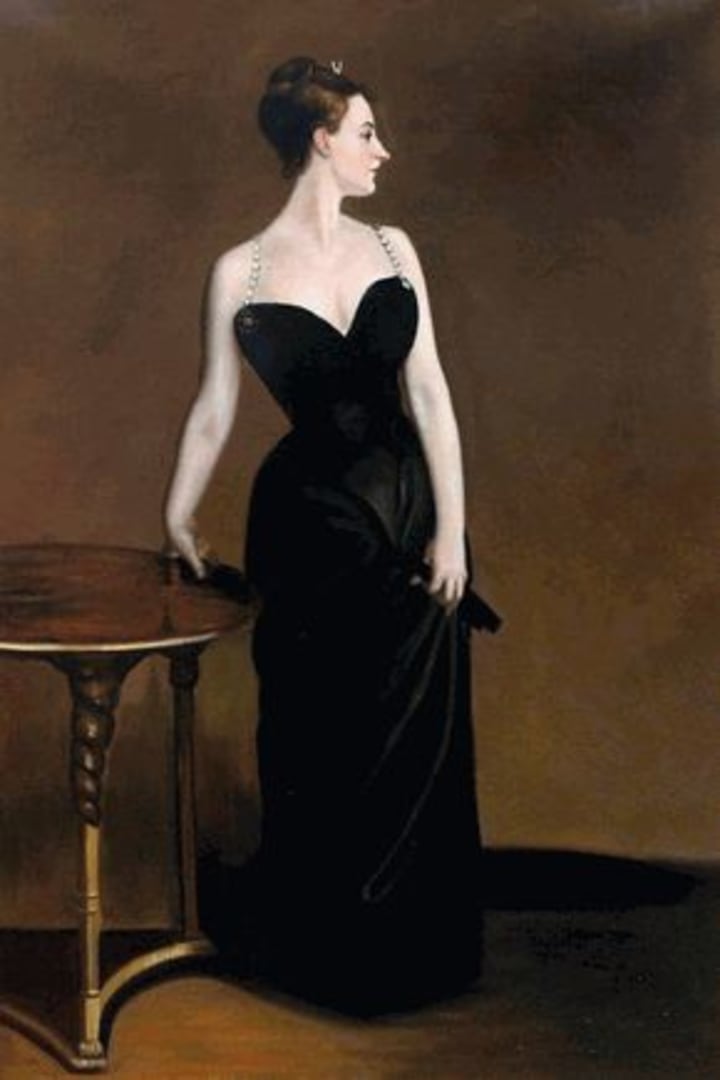
American artist John Singer Sargent created this artwork which shocked and horrified Parisiens in France. In the portrait is depicted a lady with a chignon against a brown backdrop. She is dressed in a black skirt with a golden strap, holding a fan with one hand while resting the other on a circular table, She looks rather dramatic. She is a young socialite, Virginia Amélie Avegno Gautreau, wife of the French banker Pierre Gautreau. For whatever reasons a scandal resulted from the painting's controversial reception at the Paris Salon in 1884. However, this might have helped the artist to later establish a successful career in Britain and America.
Stag at Sharkey’s (1909) George Bellows
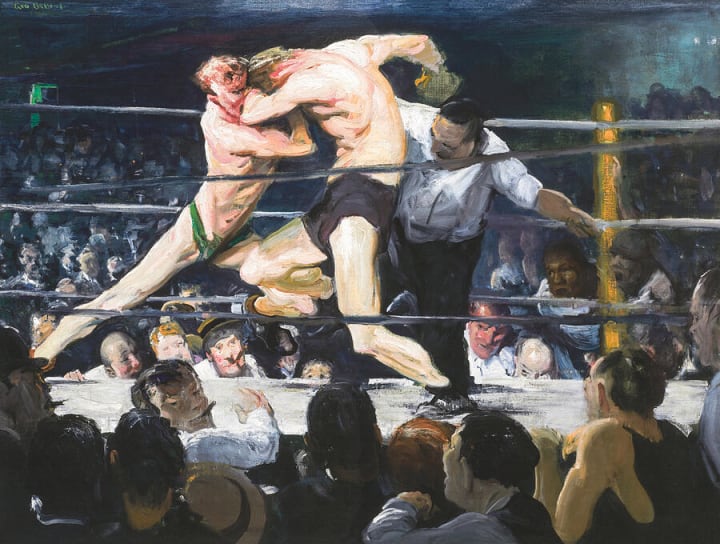
American artist George Bellows created this artwork that depicts Sharkey's Athletic Club, a rowdy bar with a backstage boxing ring. The club was established by Tom “Sailor” Sharkey, a former fighter who had previously worked in the US Navy, and it drew men who wanted to observe or engage in bouts. Since open fighting was banned in New York at the time, a private function was necessary in order for a fight to occur. Attendance was typically restricted to members of a certain organization, but when a foreigner participated, he was granted provisional admission and became characterized as a “stag.”
The Grass Fire (1908) Frederic Remington
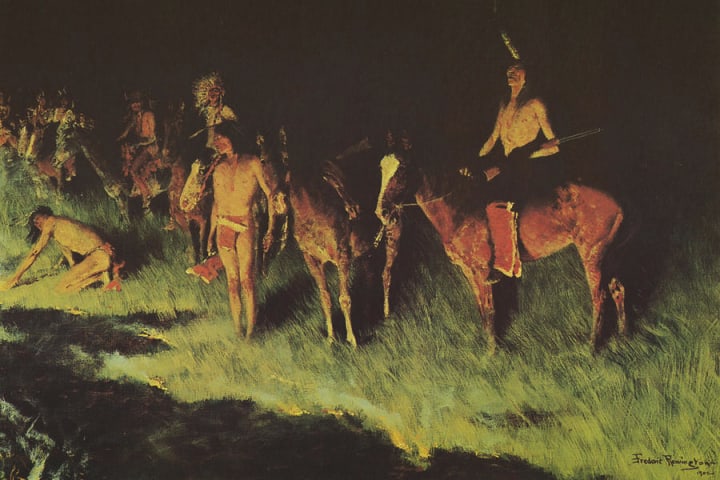
American artist Frederic Remington created this oil-on-canvas of a band of prairie Native Americans using an unconventional warfare method against unseen opponents by setting fire to grasses. Native American used this method believing that if their adversaries were downwind the smoke would obstruct their vision. The dense black field in the distance adds to that seriousness, allowing the viewer to wonder what may be lurking in that blackness, from which additional soldiers appear to arise in the distance.
The Veteran in a New Field (1865) Winslow Homer
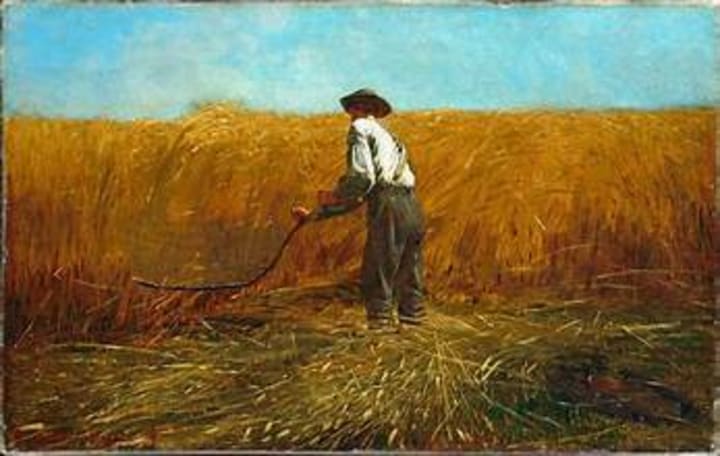
American artist Winslow Homer created this artwork after General Lee's defeat at Appomattox during the Civil War. We see what post-war existence is like as a farmer worked in his wheat field. Once a soldier now he's come home to step into the shoes of a farmer.
About the Creator
Rasma Raisters
My passions are writing and creating poetry. I write for several sites online and have four themed blogs on Wordpress. Please follow me on Twitter.
Keep reading
More stories from Rasma Raisters and writers in Art and other communities.
“What If It Happens?”
Monday, 11 April 2022 Ishrat Jahan One of our friends, Mr. Farooq, is a middle-aged man, yet he has still not been able to free himself from his deeply suspicious and fearful nature. These days, I happened to have some free time, so I thought it would be a good idea to meet him and try to untangle the puzzle of his constant worries. By coincidence, he himself arrived at my humble home, jolting along in a rickshaw.
By Sudais Zakwan3 days ago in Art
Introduction to Organic Solutions
In the realm of fitness, the role of nutrition cannot be overstated, and organic supplements are increasingly recognised as essential components of a well-rounded training regime. Unlike their synthetic counterparts, organic supplements are derived from natural sources, ensuring that fitness trainers can provide their clients with products that are free from harmful additives and chemicals. This not only promotes better health but also supports the body’s natural processes, thereby enhancing overall performance and recovery.
By Organic Products 7 days ago in Art


Comments
There are no comments for this story
Be the first to respond and start the conversation.