
Faithful Unto Death: The Power of Duty and Resolve in Sir Edward Poynter’s Painting
Faithful Soldier

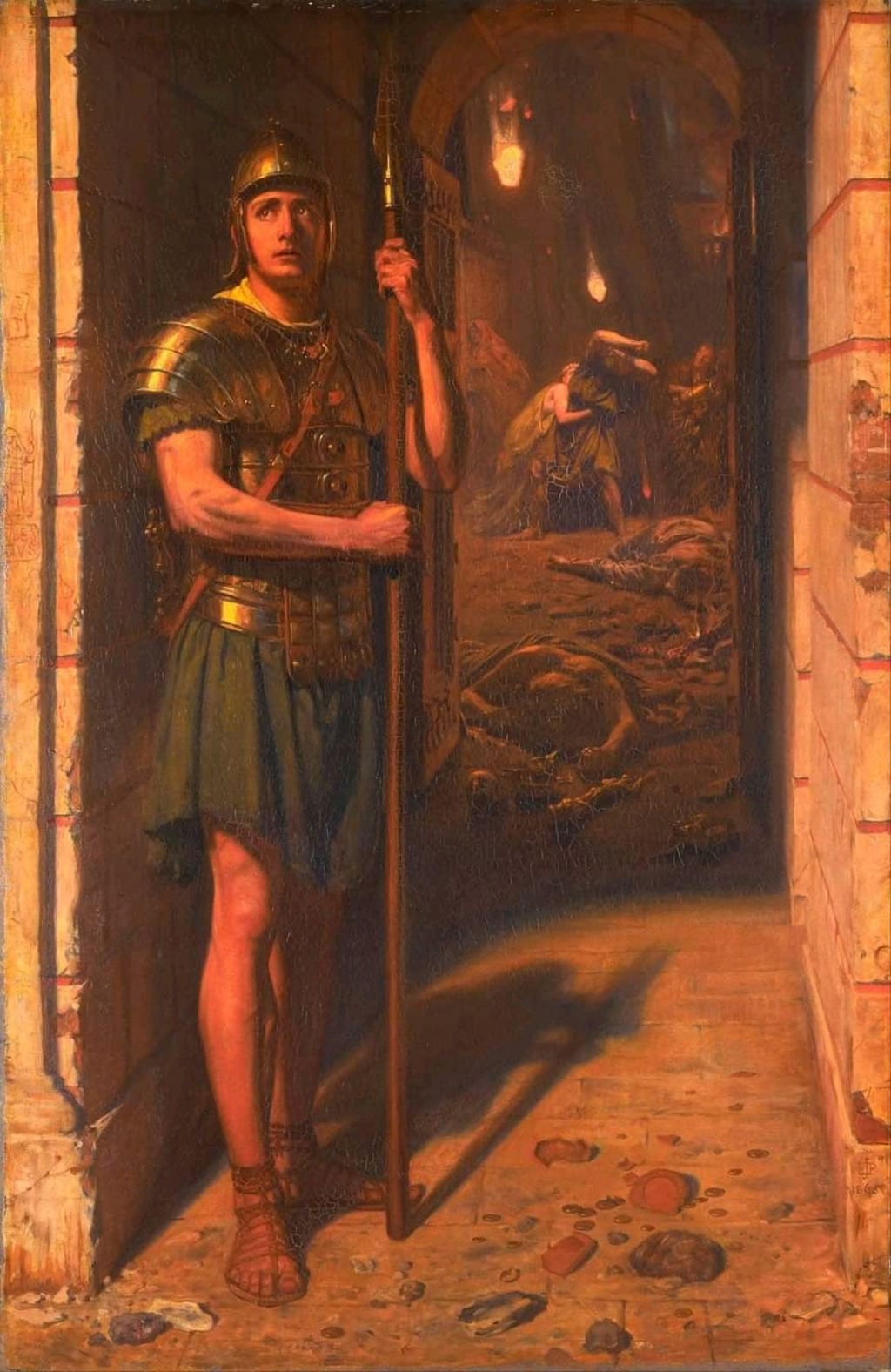
History is often filled with stories of heroism, but few resonate as deeply as the tale of the Roman soldier who perished during the eruption of Mount Vesuvius in 79 AD. His remains, uncovered in the ruins of Pompeii in the early 19th century, spoke volumes about duty, loyalty, and the unyielding human spirit in the face of impending doom. Clad in full armor and gripping his weapon to the end, he became a symbol of steadfastness, a man whose last moments stood as a testament to his commitment to duty, even in the face of death. This poignant moment of history was immortalized in Sir Edward Poynter’s 1865 painting, Faithful Unto Death, a work that continues to stir emotions with its raw portrayal of fear, courage, and loyalty.
The Archaeological Discovery: A Soldier’s Final Stand
In the years following the eruption of Mount Vesuvius, the once-thriving Roman cities of Pompeii and Herculaneum were buried under layers of ash and pumice. For centuries, these cities remained forgotten, their secrets entombed beneath the earth. But in the 18th century, excavations began to reveal the haunting remains of their inhabitants, offering glimpses into the lives of the people who had perished in the disaster. Among the many discoveries, one in particular stood out: the remains of a soldier found at the gates of Pompeii.
This soldier was not just another victim of the eruption. He was found in full armor, still holding his weapon, seemingly frozen in place as the volcanic disaster unfolded around him. The final image of his death conveyed not just a tragic loss of life, but also an unwavering commitment to his duty. Here was a man who knew that death was imminent, yet he chose to remain at his post, refusing to abandon his responsibility. The soldier's posture, his rigid stance, his weapon still clutched tightly in his hand—all of these elements told a story of defiance, of loyalty to a cause greater than himself.
The remains of the soldier were not just a historical artifact; they were a symbol of dedication, courage, and sacrifice. This discovery would go on to inspire countless individuals throughout history, including artists who saw in this tragic moment a powerful narrative of human resilience.
Sir Edward Poynter’s Masterpiece: A Reflection of Human Nature
In 1865, the British artist Sir Edward Poynter took up the task of capturing this poignant scene, rendering it into a painting titled Faithful Unto Death. The painting depicts the soldier standing at his post, spear in hand, as the fiery eruption of Vesuvius looms in the background. His gaze is one of profound emotion—a mixture of fear, defiance, and acceptance of his fate. Poynter’s approach to the soldier is not one of glorification, but rather one of humanization. The soldier is not depicted as an invincible hero, but as a man overwhelmed by the terrifying reality of his situation.
What makes Poynter’s painting so powerful is its refusal to depict the soldier as fearless or superhuman. The soldier’s expression is not one of stoic indifference, but of palpable fear. His eyes, wide with terror, reflect the same fear that any of us would feel when faced with certain death. This is not a god-like figure standing tall against the odds; it is a mortal man, gripped by the same emotions that define the human experience. Yet, despite his fear, the soldier remains steadfast in his resolve. He does not run or retreat; instead, he holds his ground, honoring his duty until the very end.
Poynter’s brilliance lies in his ability to capture this complex emotional state. He does not present the soldier as a one-dimensional figure of bravery or glory. Rather, he shows us a man who, though deeply afraid, chooses to face his destiny with dignity. It is this human element—this vulnerability—that makes the soldier's action so heroic. His courage lies not in the absence of fear, but in his decision to stand firm despite it.
The Symbolism of Duty and Loyalty
The soldier’s unwavering commitment to his post in the face of certain death speaks to a larger theme: the nature of duty. In an age when the concept of duty was central to Victorian ideals, Poynter’s painting resonated deeply with viewers. In the context of Victorian society, where loyalty to one’s country, to one’s family, and to one’s beliefs was highly valued, the soldier in Faithful Unto Death became a symbol of the highest form of devotion. His actions exemplify the notion that duty transcends personal safety or survival, and that loyalty to one’s cause, whether in battle or in life, can lead to the ultimate sacrifice.
This theme of loyalty is especially poignant when viewed in the context of the soldier's final moments. He is not merely a soldier; he is a symbol of unwavering dedication. His loyalty to his duty is more important to him than his own life. In a world increasingly concerned with individualism, Poynter’s painting presents an idealized vision of selflessness—an ideal that still resonates today, even as society grapples with questions of duty, loyalty, and sacrifice.
The Legacy of Faithful Unto Death
Faithful Unto Death continues to captivate viewers with its emotional depth and timeless themes. The painting transcends the specific historical moment it depicts and speaks to universal truths about human nature, courage, and the cost of loyalty. In a world where we are constantly faced with choices that test our resolve, the soldier’s decision to stand firm in the face of doom serves as a powerful reminder of the nobility of duty. His act of faithfulness is not just an ancient relic of the past; it is a message that continues to inspire us today.
In the end, Sir Edward Poynter’s Faithful Unto Death is not just a portrait of a soldier. It is a testament to the power of duty, the complexity of human emotion, and the strength that can be found in even the most dire of circumstances. The soldier may have perished, but his act of loyalty endures, immortalized in art for generations to come.
About the Creator
Keep reading
More stories from Deji Akomolafe and writers in Art and other communities.
A 2,000-Year-Old Roman Gold Ring Reveals Ancient Craftsmanship and Innovation
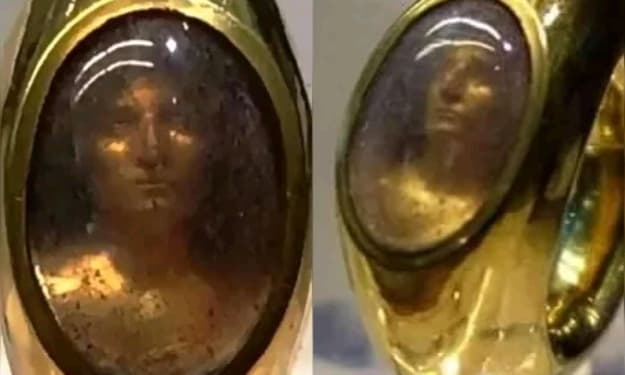
In the heart of ancient Rome, where art and culture flourished, a stunning artifact has been unearthed, providing a glimpse into the ingenuity and skill of Roman artisans. A nearly 2,000-year-old Roman gold ring, recently discovered in the tomb of Aebutia Quarta near Rome, has stunned archaeologists and historians alike. What makes this discovery so remarkable is not just the age or the material of the ring, but the technique used to create a striking illusion of lifelike, three-dimensional imagery that would be considered cutting-edge even by today’s standards.
By Deji Akomolafeabout a year ago in Art
The Uncopiable Human Wit to Write
We all have been in that spot at least once in our schooldays where we have been wringing our brains off to curate written articles of some sort until our soul-less friends were born. At just four years old, our beloved soul-less, metallic, digital assistant who is always by our side when we turn on our computers and smart phones, will be doing much more than curating written content for us all, if you know what I mean.
By Sound Savvy7 days ago in Art
Miss Persephone's Manual to a Seemingly Ordinary Life
Miss Persephone was found at the dining table, her blue eyes swollen, her tears arriving and retreating like the tides of the ocean. Earlier that day, her family had visited her in the retirement home where she had lived for eight years. It was her eightieth birthday.
By Imola Tóth5 days ago in Fiction


Comments
There are no comments for this story
Be the first to respond and start the conversation.