
Eliminate All But Two Social Media Sites If You Aspire to Be an Artist
How to Focus on Your Creativity and Build an Effective Presence on the Right Platforms Only

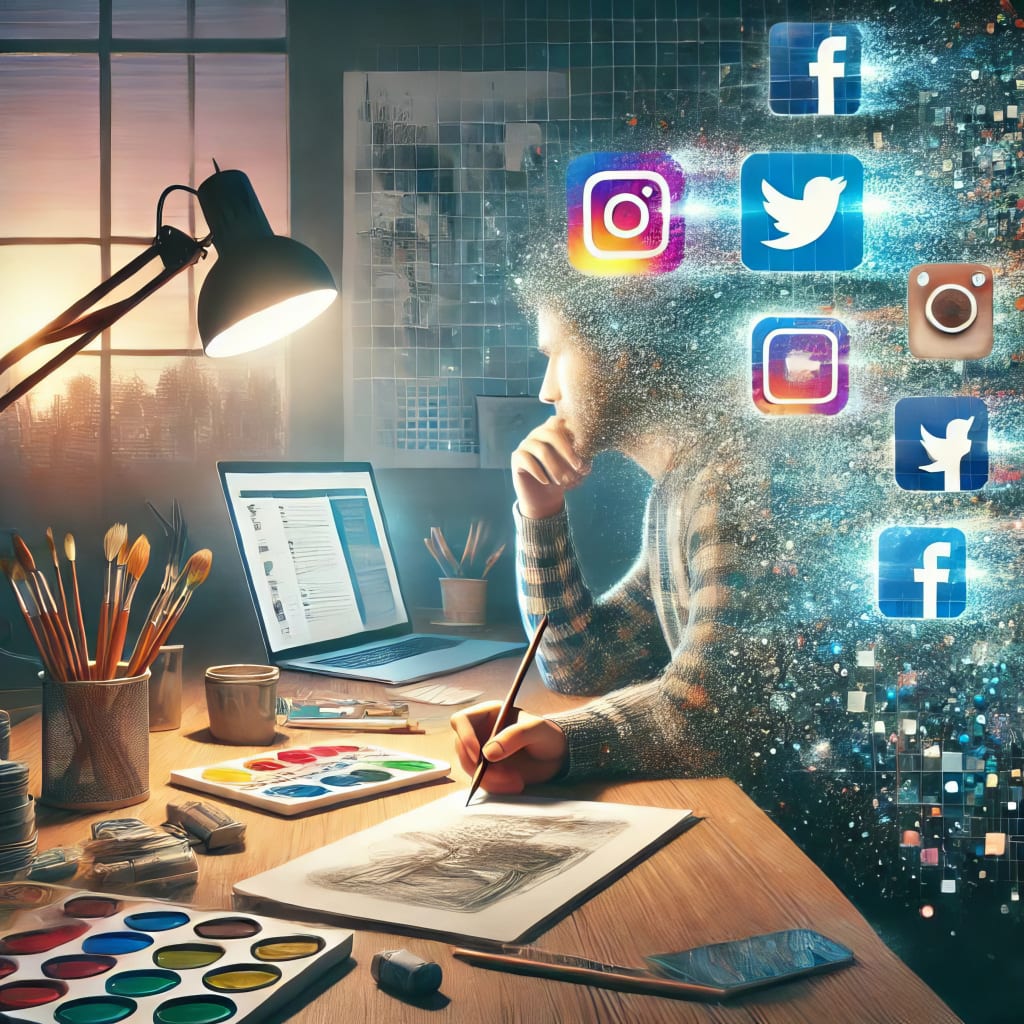
During the Elon Musk scandal in October 2022, I removed Twitter from my mobile device. I also signed out from Facebook and Instagram at around the same time. After wanting to cut ties with these interruptions for some time, Elon's antics finally gave me the push I needed.
It took me six months to come to the realization that goes against almost all creative advice: I am not missing having social accounts.
Personally, I'm not shocked that I don't long for their presence. In today's world, everyone knows that social media is all about making relationships. Without Instagram, Twitter, Facebook, and so on, I have more time, more energy, and greater relationships with my true friends. I read more. I write in my book more.
But I also don’t miss them from a professional viewpoint. I’m not losing out on business possibilities. I’m not losing out on interacting with my readers.
I’m not losing out at all, as far as I can see.
That revelation led me to create this piece. Today, the popular suggestion is to establish a profile almost everywhere and publish incessantly until you acquire traction. But in my experience, that’s lousy counsel. Here’s why.
The folks providing you that advice are gurus who want to lure you to their platform since that’s how they earn money.
(Most) platforms consume time and don’t offer you anything back.
It’s easy to get caught up in the hoopla. Pay attention to your own desires and talents before investing.
Let’s break it down.
Gurus want to lure you to their platform—that's how they generate money.
Two years ago, I started a Pinterest account. Why? Because a nice Pinterest influencer (McKinzie from Moms Make Cents) convinced me that that’s where all the money and views were:
“Pinterest is my FAVORITE way to direct more traffic to your website... and that means more page views, sales, and $! Through this course I want you to develop your Pinterest approach and give you the start you need to expand your business!”
“I’d love more page views, sales, and $!” I thought. So I joined her free email list and took her apparently instructive free course on how to get started with Pinterest.
Ultimately, I created two pins, had middling traffic, and bounced.
The same thing occurred to me with Instagram (thanks Beth Kirby!), Twitter (Nicolas Cole), TikTok (don’t even remember), Mastodon, LinkedIn, and possibly countless more social media networks that don’t even exist anymore.
McKinzie, like the other gurus, had a vested interest in telling me hers was the proper platform to make it big. It’s not malevolent—I do the same thing with blogging. I began blogging, was successful, and now provide suggestions on how others might do it, both for free and for money.
But what worked for her didn’t work for me. All it did was make me feel like there was yet another place to post, another place to keep up with, another source of followers I had to manage and learn about.
Creators want you to test out their platform, since that’s how they generate money. They want you to have FOMO, because that’s how they generate money.
It might be that what McKinzie mentioned about Pinterest was accurate. I’m sure that for many of McKinzie’s readers, Pinterest clicks.
But for me, it didn’t.
Again, it’s not malevolent. Most artists aren’t aiming to deceive you. But they’re prejudiced.
McKinzie wanted me to feel that I needed to learn how to use Pinterest and be on Pinterest since that’s how she persuaded me to sign up for her list, check out her free course, gain value, and eventually purchase her premium course. Our best interests don’t always match for that reason.
So when you hear claims about a platform, take a minute to reflect: Is it a platform you actually like and enjoy? In such a case, feel free to take advantage of the resource.
But it can simply be a biased developer who is attempting to make you experience FOMO even if, deep down, you know it’s not a platform that will work for you.
You should restrict your platforms since the individuals who pushed you to grow in the first place can’t know your circumstances, abilities, or narrative.
Every platform demands time from you.
Instagram was a different story. I persisted on Instagram for a long, long time.
I followed all the “rules.” I updated consistently, I dutifully exploited every new tool IG gave out (who remembers IGTV?), and I always urged people to comment, scroll, like, or whatever.
I earned 2k followers! And… nothing else. I don’t want to think about how much time and energy I spent trying to remain “on top” of Instagram. And for what? I received a number of email subscribers (hello, if that’s you!) and several likes. No clients discovered me via IG. I never received sponsors.
My time on Twitter at least offered fun, but no commercial possibilities or advancement. None of the other platforms ever panned out for me. So far, my two most (and only) successful outlets have been blogging and YouTube.
It’s easy to imagine that it won’t take much time or energy to publish on these platforms, isn’t it? How long does it take to compose a tweet? But this is a mistake for two reasons:
It’s never just one tweet. It takes time, consistency, and effort to stay up with platforms. Look at successful Twitterers, Instagrammers, etc. How many posts have they made? I guess it’s in the 100s or 1000s.
You don’t simply waste time; you lose it. Time is a zero-sum game. Every minute I spent on Instagram, picking a photo, filtering it, writing a caption, and scheduling it out in advance? It’s a minute I wasn’t spending on writing or shooting.
Think about the opportunity cost. You should limit your platforms since you cannot keep up with more than two.
Your talents and interests make you a horrible match for 99% of platforms and a perfect fit for 1%.
I have the luxury of hindsight, of course, but I believe if I had to consciously anticipate which media would be successful for me, I would have picked YouTube and blogging regardless.
Why? Because:
I enjoy and am skilled at writing.
I enjoy and am adept at being on camera.
I enjoy and am skilled at describing difficult subjects in a simple manner.
I am not excellent with LinkedIn broetry (LinkedIn).
I am not excellent at editing photographs (Instagram and Pinterest).
I am not excellent at keeping on top of trendy topics (TikTok).
I dare you, right now, to think about what you’re excellent at and what makes you happy. I guess you probably already know where your talents and interests lie.
Ultimately, it’s the mix of abilities + platform structure that decides your success, not the platform itself.
You should seek platforms that help you highlight those abilities instead of assuming that the platform defines your success.
I fell into the trap of assuming that high outcomes would make up for a lack of aptitude or desire. I thought if I gained traffic on Pinterest, then I would be driven to keep going, even if I didn’t really spend a lot of time there or love using it.
It wasn’t true. I received 400 views on a pin, 10 views on a second pin, and then I quit using Pinterest. I simply couldn’t get myself to care. Maybe if I’d been really successful from the beginning, I could have—but then I would have lacked the enthusiasm to provide the type of consistency you need to be successful. It’s a chicken and egg issue.
You should limit down your platforms since you won’t be a good match for more than a handful anyhow.
What should you do instead?
Being present on +2 platforms in any major sense is a mistake that someone else has encouraged you to undertake. It doesn’t make sense since a) it drains your time and b) you’re not a good match for most platforms owing to your present abilities and hobbies.
I think a lot about success and how to be successful online. There’s this assumption that all you need is consistency. (I’ve written about how that’s not the case). There’s another concept that all you need is to be an early adopter. I used to dread the day in 2019 when I thought about having a TikTok account but didn’t. (I’ve also rejected that theory here.) Then there are some who think it’s all luck.
It’s not down to consistency. It’s not down to chance. It’s not down to being early, so you don’t need to compete.
Those all assist, of course, but what I believe actually makes a difference? Focus and intention.
Want to be successful online? Delete your Instagram, Pinterest, YouTube, and TikTok accounts, or any you believe suck your energy without giving back. Unsubscribe from whatever experts keep offering you advice that isn’t working for you. I won’t be insulted if that’s me! I support your endeavor, with or without me!
Focus on the platforms that work for you. I’d start with simply two. And choose them with purpose.
Do you have the talents to stand out and succeed?
Do you like spending time (REALLY enjoying, not simply finding yourself scrolling because you’re hooked) on the platform regardless?
Do you believe that, if you weren’t successful even after being consistent, you’d still want to post there?
You need yeses to each question for that platform to be worth it.
I dare you to select TWO platforms. Make sure they’re ones that fit the requirements I outlined above. Commit to them. Focus on them. Go all-in on your strengths. Stop pursuing the fantasy of other platforms.
And erase the rest.
(Or you may opt for the less dramatic choice and simply log out.)
I swear—you'll lose out on a lot less than you worry.
About the Creator
Mohammed Abu Jazar
Writer, thinker, curious observer. , PS ...
Keep reading
More stories from Mohammed Abu Jazar and writers in Art and other communities.
I Wrote On LinkedIn for 100 Days. Now I Never Worry About Finding a Job
Introduction In 2020, I read a book called The Power of Habit and pushed myself to try something new. As someone who’s an introvert and felt timid about expressing my ideas, one of the behaviors I wanted to focus on was speaking out more.
By Mohammed Abu Jazarabout a year ago in Education
The Uncopiable Human Wit to Write
We all have been in that spot at least once in our schooldays where we have been wringing our brains off to curate written articles of some sort until our soul-less friends were born. At just four years old, our beloved soul-less, metallic, digital assistant who is always by our side when we turn on our computers and smart phones, will be doing much more than curating written content for us all, if you know what I mean.
By Sound Savvy6 days ago in Art



Comments
There are no comments for this story
Be the first to respond and start the conversation.