
Dissecting History: Uzbekistan Ikats and Jean-Leon Gerome's Work
Finding Commonalities in Seemingly Unrelated Works


The Presence of Islam in Culture
Looking to the Islamic world of culture and art there are many differences within it depending on the specific region you visit or study. As many other cultures became familiar with Islamic religion and art, it was met with appreciation and fascination. Oftentimes this would appear in the Western forms of art as Orientalism, much like “The Snake Charmer” by Jean-Leon Gerome which makes it seem as if the scene of a naked boy holding a snake was a regular occurance in the world of the Middle East and Islam. But despite this, there is another work by Jean-Leon Gerome that seems to take a much different approach, one of admiration and close study of everyday life.

The Carpet Merchant by Jean-Leon Gerome in 1887 is an oil painting done on canvas that is housed in an intricate golden adorned with carved islamic text. This painting depicts something that Gerome was fascinated by; the carpets of the Islamic world. Though The Carpet Merchant could still be looked at through a lens of Orientalism, there is a sense of representing the scene and the many woven fabrics showcased in the work as organically and honestly as possible. The regions of North Africa and the Middle East, where Jean-Leone Gerome grew much inspiration from, were especially dense with Islamic textiles. One such being Woman’s Robe (Munisak) that can be found in the Minneapolis Institute of Art’s Islamic section. It is an intricately patterned textile done by an unknown Uzbekistanian artist dated to have been made between 1850 and 1875.
These works at first glance seem to have nothing in common, but upon further examination it becomes clear that they have much more commonalities than differences especially in their exploration of textiles. While one is represented in a painting by a French artist and the other is a robe made by an Uzbekistanian, there is a celebration and sense of admiration to both of the works of art.
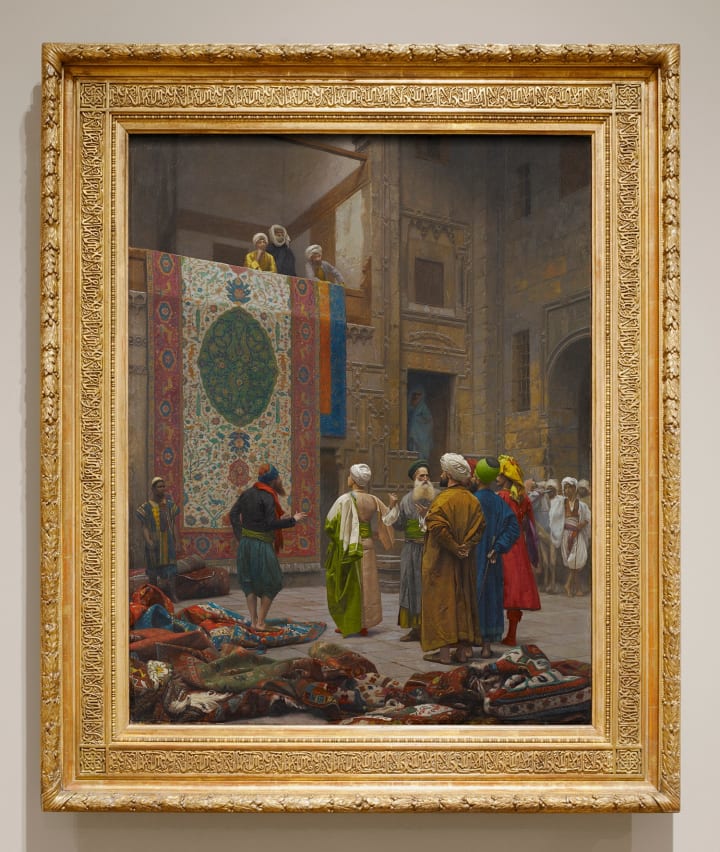
The Carpet Merchant
The Carpet Merchant, by Jean-Leon Gerome was made in France in 1887 after reflecting on his experiences in North Africa and the Middle East, specifically a Rug Market in Cairo he had visited in 1885. This work can also be found in the Islamic section of the Minneapolis Institute of Art (MIA), right across from Womans Robe (Munisak), in fact. The Carpet Merchant was created with oil paint on stretched canvas. Gerome was an academic painter, schooling at the Ecole des Beaux-Arts and participating in Salons. Gerome had many of his paintings copied, which was no surprise seeing as he was a prolific artist.

This painting would have been on view at Salons before being purchased by a patron of Gerome. Hereafter it would have most likely been placed on display in the patron’s house where guests would be able to see it. Owning a Jean-Leon Gerome painting, as with all paintings bought at the Salon, was a symbol of status and wealth. This painting would have been kept after well throughout the years leading up to its current place in the Minneapolis Institute of Art. At some point it was framed, with the golden frame etched in islamic text. Though it is not part of the original presentation, the Minneapolis Institute of Arts has kept it in this frame since obtaining it, possibly to showcase to those who visit how patrons would have displayed such a work in their homes in the past.
Woman's Munisak Ikat
Woman’s Robe (Munisak) is often referred to as an ikat because of the dying technique implemented. This technique originated from the people of Sumatra -found in a Southern Asia region known as Indonesia. Each tribe of the Sumatra had a highly individualized pattern; the act of weaving was seen as a spiritual one that could only be partook by women of a clear meditative mind. The people of Sumatra took weaving so seriously that it was seen as completely reasonable for a wife to divorce her husband if he were to touch a weaving project before it was completed. It is most likely that the craftsmanship of Ikat weaving made its way to Uzbekistan sometime after the thirteenth century, when “Mohammedan Arabs invaded Sumatra.”

The word itself, ‘Ikat’ comes
“from the Malay-Indonesian verb mengIkat meaning to tie or knot, involves the wrapping of unwoven yarns with a material, usually plant fibers, that resists the penetration of dye.”
It is possible that Uzbekistan used similar methods with creating their dyes as well. In Sumatra the red dye was created from the root-bast of a Morinda citrifolia tree. While there is no readily available source to confirm that these trees could be found in Uzbekistan, it is quite possible that when Sumatra was invaded in the thirteenth century that the Arabs would have taken some of these trees for themselves to plant back home.
Ikats would go on to be popular for trading in the South Asian continent in the sixteenth and seventeenth centuries, spreading not only the design of Ikat further but enticing more craftsmen to search out ways to replicate the Ikat.
Similarities Between the Two Works
Gerome’s The Carpet Merchant and Woman’s Robe (Munisak) share many similarities, such as both incorporating a mixture of geometric and organic shapes and the inclusion of pattern. The Robe being made up entirely as a pattern itself, while the painting’s subject matter is focusing on the ornate oriental rugs and their patterns. Both also have the inclusion of the human body- while Gerome’s is visually present in the group of men above and below the terrace, Woman’s Robe (Munisak) is in itself implying the body by being an object that is worn on the body, taking the shape of the arms and torso.
Below you can view a video of how Ikats are made
They also share the commonality of the craftsmanship put into each work. Ikats are extremely laboring, as lining up the wefts with this dye method is difficult and often results in a blurry effect on the garment. While Gerome, being a realist painter put such time, effort and research into his artworks, often employing models to sit for him for hours a day to create his works. Additionally, they have similar palettes made up of blues, reds and yellows.
Gerome’s painting has a wider variety of color, most likely due to the ease of doing so with a painting verses with a woven garment, where you are limited by your access to dyes and pigments that will work into silk fabrics. The process of dying had a precise recipe that had to be followed, and not just for Uzbekistan Ikats.
“In the fifteenth and sixteenth centuries Italian recipes recommend the use of 6 to 14 pounds of the expensive chermisi for one pound of silk in order to obtain a good crimson color.”

Of course there are also differences between the two. Starting with the obvious and where they differ the greatest is their mediums, one being an oil painting on canvas and the other being a woven garb. Additionally, Gerome’s work is much more of a realist style, while Woman’s Robe (Munisak) is abstract and more focused on the elements of design rather than visual storytelling. In order to create interest Gerome had to create a more asymmetrical image, using the rule of thirds to create a compelling composition. With the robe, the great appeal is in its symmetry which would have been difficult to produce with the Ikat weaving method.
Final Thoughts
The tradition of weaving is nearly as old as the tradition of painting, dating as far back as prehistoric times. With such a long, rich history of two arts that are so prolific in everyday life it is no wonder tracking down origins of painting or weaving techniques is not easy to do. Luckily many of those age-old traditions are still around today, like the tradition of Ikat weaving that can be seen in Woman’s Robe (Munisak).
Looking at Gerome’s The Carpet Merchant alongside Womans Robe (Munisak) there are differences but also many similarities, such as was discussed in the previous page. What we should take away from this comparison and visual analysis is that even when we look at artwork that seems to be from a different region or religion, because of the way artists trade and borrow from one another’s work you can always find some sort of commonality between two works of art.
Works Cited
Unknown. “Woman’s Robe (Munisak), Uzbekistan ^ Minneapolis Institute of Art.” M, 2013. https://collections.artsmia.org/art/98743/womans-robe-uzbekistan.
Metsu,Gabriel and Parker, Agnes Miller; Publisher: Gregynog Press. “The Carpet Merchant: Minneapolis Institute of Art.” M, 2013. https://collections.artsmia.org/search/the%20carpet%20merchant.
Totton, Mary-Louise. “A Red Ikat Tapis: Ships and the Lands Beyond.” Bulletin of the Detroit Institute of Arts 68, no. 3 (1994): 4–15. http://www.jstor.org/stable/41504888.
Jacoby, David. “Silk Economics and Cross-Cultural Artistic Interaction: Byzantium, the Muslim World, and the Christian West.” Dumbarton Oaks Papers 58 (2004): 197–240. https://doi.org/10.2307/3591386.
Weibel, Adele Coulin. “EGYPTO-ISLAMIC TEXTILES.” Bulletin of the Detroit Institute of Arts of the City of Detroit12, no. 8 (1931): 93–98. http://www.jstor.org/stable/41501477.
About the Creator
QuirkyMin
Aspiring writer, sharing articles of personal interest as well as original short stories.
https://linktr.ee/quirky.min
'Till Death We Do Art
There would be nothing divine in this world without art. Nature may surpass the divine to all intents and purposes, but like everything it absorbs and is absorbed by, it remains here, stuck on the surface of this world, ever-present, physically bound to the universe.
By Avocado Nunzella BSc (Psych) -- M.A.P 27 days ago in Art
Where Courage Meets the Sunrise
In a small village called Alara, nestled between rolling hills and vast fields, the sun rose each day bringing light to the world. But today was different. Today was the day of the Great Awakening, when the villagers learned of new depths of courage within themselves.
By Hamad Afridi 2 days ago in Art




Comments
There are no comments for this story
Be the first to respond and start the conversation.