
Dissecting History: Minneapolis Institute of Art's 'Claret Jug'
Analyzing Art Without Authorship


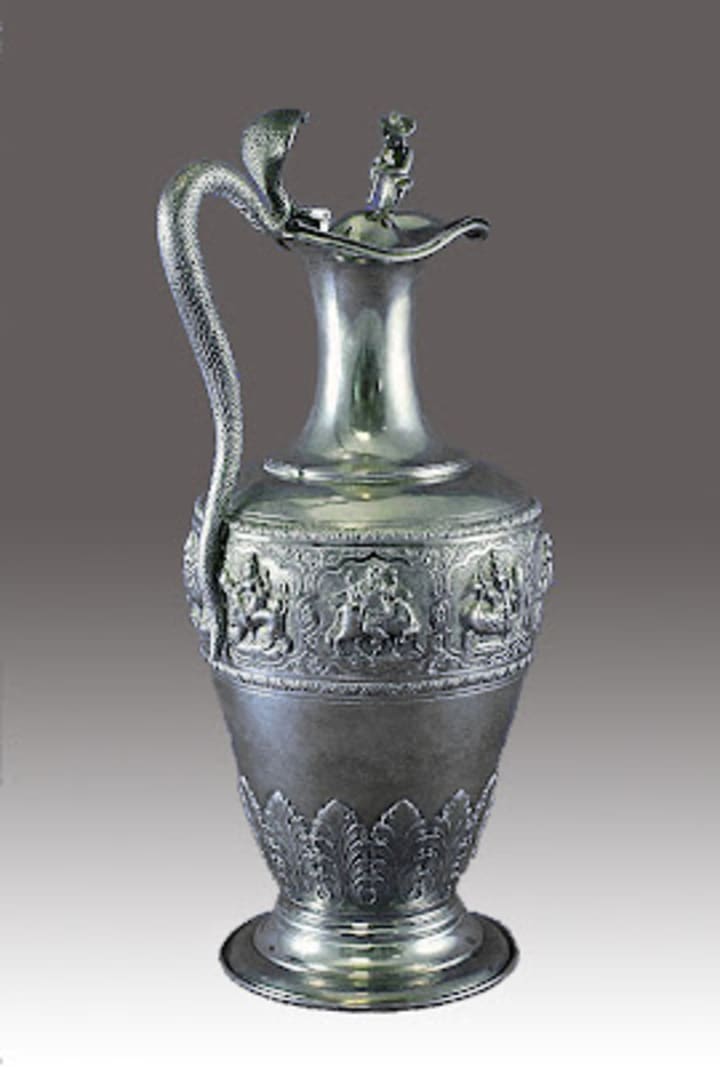
India was a colony of the Great British Empire from 1858 -1947 and is often referred to as the Raj Period or The British Raj Period. During this time, the British took over parliament in India. During this period of Raj that lasted almost 90 years, there was an increased fascination by the Europeans with Indian decorative arts. Through the interminglings of British Empire soldiers and colonized implants with the native East Indians, there came a new form of artistic style known as Anglo-Indian. This art style was a mix of East Indian decor and the influences of the British which were far and wide. This new style of Indian art can be seen in the Minneapolis Institute of Arts’ ‘Asia’ section in Gallery 211 specificall, in the Claret Jug. The influences of Eastern Indian, British and British colonies can all be seen in Minneapolis Institute of Art’s Artifact Claret Jug.

Claret Jug is an intricate silver jug from the late 1800’s that was created in India. This artwork, as many of the metalwork of India, is a utilitarian object created for containing a specific French red wine. The artist is unknown and it bears no signature or identifiable pressing. This jug is specifically made to hold Claret, a French Red Wine. The Anglo-Indian style was rather popular among the British Empire’s India-stationed officers. It is very likely that due to the new and lucrative trade routes created by the colonization of India, that French Claret Wine would have been imported into India for top Officials/Officers stationed there. It is possible that the Jug was created for a Military Official to enjoy his imported French Red Wine. It just as easily could have been created for export, as India quickly became a new and bountiful trading post for the British Empire.

Considering The Paisley
The Jug’s intricate pattern contains 3 Paisley- like mangos hanging from a mango tree. It is encased in an upside down heart shape made up of leaf-like paisleys. The rest of the Jug is covered in small decorative flora and fauna. The paisley motif originates from India and but is named after the town Paisley, which was a textile manufacturing hub by the 1800’s in Scottland, where a majority of paisley rugs were mass produced for European consumption.
Paisleys can be seen in Indian textiles by 1851, such as in the India section of Owen Jones’ “The Grammar of Ornament” which documented design elements/techniques from different regions around the world with the purpose of being a source designers in Europe could use to recreate/ customize certain global styles of work.

One example of this is how paisley -or kaj, as it would have been referred to in India- can be seen in Indian Plate No. 5, Design 2. It features a vertical pattern made up of flowers and vines, with some of the flowers being encased in kaj’s. Another example of East India incorporating global influences of the paisley can be seen in Indian Plate No. 6 in the bottom left pattern. This one is also a vertical pattern, made up of 6 colors. It incorporates the paisleys as also encasing flowers, but this time they are flower buds. Surrounding the kaj’s are the blooming flowers in clusters. There is also a decorative cross in a similar style to Anglo-Saxon Cross iconography found within this pattern.

Scotland had rejoined the British Empire by the 1700’s, so its influence in Claret Jug can be seen as a direct relation to the influence of decorative arts among the other colonies onto the artisans of India. Both India Plates 5 and 6 are listed as “specimens of painted lacquer-work from the Collection at the India House”. But as can be seen through observation of the Claret Jug, the use of the kaj was not tied down by one decorative arts medium.
History of Metals in India
India was conquered as a colony by the British Empire in 1858, just 18 years after the end of the industrial revolution in Britain. For the British Empire, this was seen as a great win after the Indian War of Independence of 1857, in which the British Empire lost many soldiers. But by the First Burma War (1824-26), faith in the Empire’s troops had dropped dramatically. Following it by the staggering losses during the 1857 War left many within the Empire doubting it’s strength and longevity.
The use of metal manipulation via bronze and copper in India predates the Aryan destruction of the Harappan civilization which existed from 3000 to 1500 BC. The use of metal existed for two reasons- religious and household; “metal religious images appear not only in the great temples and in the homes of the wealthy, but also in the simple shrines and humble homes. Metal talismans are worn to ward off evil and disease”. Even after the Raj period, this rule of production remained the same with few exceptions. The production of household metals increased exponentially due to the Empire’s export of goods through India. But as the production increased, the lines between household and industrial became blurred. There are few surviving silver artworks today that were created pre-19th century.
India was not well known for its silversmithing, in part due to its few silver deposits. There was however an abundance of Bronze deposits; due to this, it is very likely that the artist who worked on Claret Jug was a bronzesmith. This transition from bronze to silver would have been easy, as there is only an 88 degree difference in melting points; Silver melting at 1,763 degrees F and Bronze at 1,675 Degrees F. This may seem like a high difference in degree, but when we look at other materials being manufactured at the time, such as glass which has a melting point around 2,500 - 3,000 degrees F, we can see that to a professional the difference in 88 degrees would not have made a large difference.
Silver in India
Though the rarity highlighted of Claret Jug being made of silver, it was by far not the only silver object produced in India. There are many silver Indian artifacts in museums and personal collections. The personal collection of Harish K. Patel, for instance. He has a large collection of Indian Silver specifically from the Raj period.
While viewing his collection, it becomes apparent that despite the lack of Silver deposits, it was still a lucrative craft most likely consisting of imported silver, but produced objects for export. As you look into the details of Claret Jug and Patel’s “Indian Silver During the Raj” collection, it is easy to see the detailed artistry of the native India metalworkers. While browsing Patel’s collection, one item in particular will catch your attention, as it is similar to the MIA’s Claret Jug.
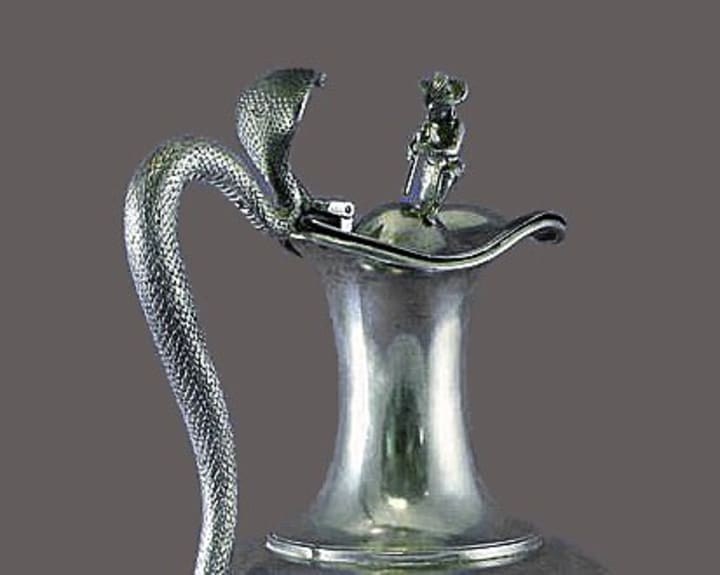

It is titled A Banglore Claret Jug listed as originating from Bangalore, India in 1890. Not only are both objects silver claret jugs, but both are affixed with snake handles, though each was handled artistically with different techniques. Bangalore Claret Jug has much more emphasis on the lid, with a large cobra being charmed by a snake charmer. The body of the Banglore Jug is much differently shaped as well, and instead of an intricate pattern, there are vignettes, leaving a large portion of the object un-decorated. With these being created in the same year and in the same medium, it is possible that whichever artists worked on these artworks were pulling from the same iconography that Europeans loved- the snake charmer.
Educated Assumptions
As can be seen through the cross analysis of Claret Jug and Bangalore Claret Jug, The Anglo-Indian art style did not consist in a vacuum of just India and British influences. Simply by being part of the British Empire’s colonies, the people of India and their artists were influenced by all corners of the world including Scotland and France. Given the time Claret Jug was created and its content we can concur that it is a Modern work of art as it is a blend between white imperialism, it’s colonial influences and traditional Indian decorative detailing.
Additionally, from the production of two similar jugs made for Claret wine we could assume that silver claret jugs were quite popular, requiring a large production for export.
Belifs on Health and How It Impacted Colonization of India
Claret Jug positions itself within the transformations of colonialism by its nature, a melding of cultures and utilitarian objects. It is proof that amongst the extreme violence of colonialism, there was also a beauty in the communication between cultural identities. This in part could be due to the minimal number of soldiers stationed in India.
During the 19th century, the idea of health being dictated by your environment was exploding in Europe. One of the main thoughts about health and environment was that “tropical places displaced Anglo constitutions, and hence bodies and minds.” The Empire had to entice soldiers and possible colony transplants to move to India with promises of changes to landscapes near where they would be stationed.
Even still, by 1880 many of the Empire's troops were pulled from India due to a cholera and plague breakout. This meant that by the time the artwork was created, the whole of India was being controlled and supervised by a handful of the Empire’s Military Officers, who for many months of the year had to stay up in the mountains in hill stations because of the extreme heat.
The Beauty in Cultural Communications Despite Colonialism
Claret Jug potentially could change our way that we understand art from India. Most of the work we see pre-contemporary is objects made during the Raj period. Due to the Empire’s influence and the increase in trade in India, it can be said that most of the objects created in India for export are influenced by Orientalism. But by looking into the history and meaning behind Claret Jug, we can recognize the Orientalism in the object but also the melding of cultures that came from India being colonized by the Empire. By looking at this work of art, we can see both the history of the colonized but also the beauty in the objects they made during their time as colonized Indians.
It is clear through the analysis of Claret Jug that it has multiple influences in it’s design and intended use. It is made in India from Silver, which was mostly imported from Britain. It is intended to hold French Wine for a global audience and its design incorporates Indian and Scottish iconography. We can see that through India’s time being colonized, there was an explosion of culture introduced to the native Indian people and that artists were inspired by these new influences to create Anglo-Indian artwork.
Works Cited
Beattie, James. “Imperial Landscapes of Health: Place, Plants and People between India and Australia, 1800s–1900s.” Health and History 14, no. 1 (2012): 100–120. https://doi.org/10.5401/healthhist.14.1.0100.
Bussabarger, Robert F., and Betty D. Robins. 1968. The Everyday Art of India. New York: Dover Publications Inc.
Cliff, Clarice. “Claret Jug: Minneapolis Institute of Art.” MIA, 2015. https://collections.artsmia.org/search/claret%20jug.
Jones, Owen. 1986. The Grammar of Ornament. 1986th ed. New York: Portland House.
Patel, H. K., & McDavid, V. J. (2011). Indian Silver During the Raj. silverfromindia1850-1920. http://silverfromindia1850-1920.blogspot.com/p/indian-silver-from-rajasthan-and-other.html
Zebrowski, Mark. Gold, silver and bronze from Mughal India. London: L. King, 1997. Alexandria Press
About the Creator
QuirkyMin
Aspiring writer, sharing articles of personal interest as well as original short stories.
https://linktr.ee/quirky.min
Why do all sports balls have their own shape, size, and material?
Why do all sports balls have their own distinct shapes, sizes, and materials? At first glance, this might seem like a simple matter of tradition or aesthetic preference. Yet beneath the surface lies a fascinating interplay of physics, history, human physiology, and the very essence of each sport’s gameplay. The ball is not merely an object to be kicked, thrown, or hit — it is the central actor in a carefully choreographed dance between rules, players, and environment.
By Aizanat Alimova-Umalatova5 days ago in Art
A Failed Artist, A Disillusioned Poet, An Underpaid Game Show Host
I took my son and niece to Gori, a small town in Georgia where Joseph Stalin was born. They talked me into visiting the Stalin's Museum, the largest in the post-Soviet space. I had resisted going there because I just can't stand the monster and know enough about him, or so I thought.
By Lana V Lynx6 days ago in FYI


Comments
There are no comments for this story
Be the first to respond and start the conversation.