
Cupid and Psyche by Canova
Cupid and Psyche by Canova: The Ecstasy of Neoclassicism
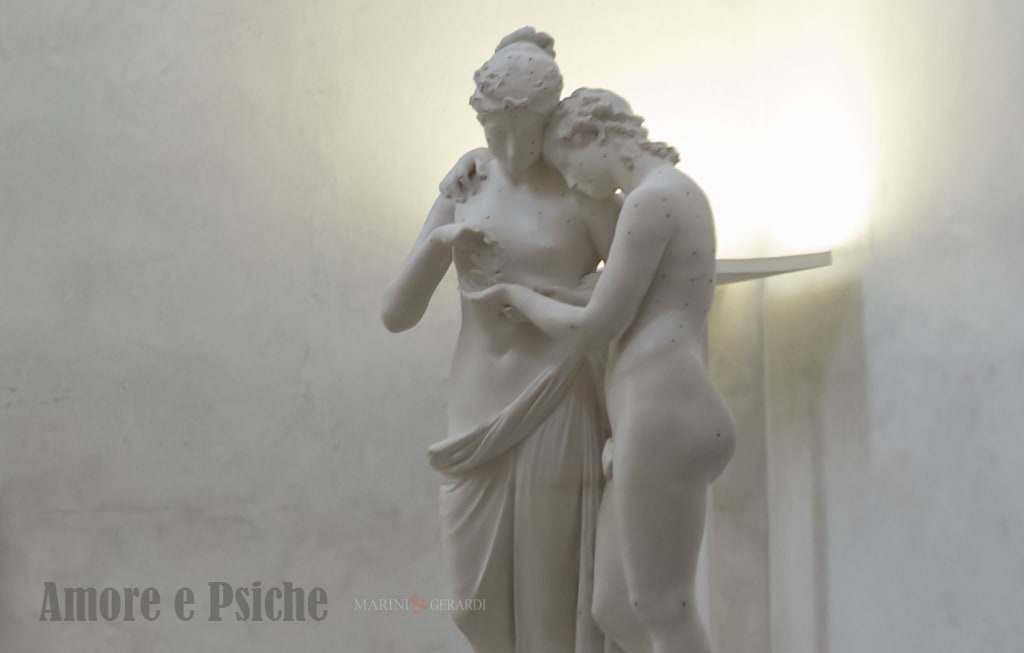
In the eternal embrace of Cupid and Psyche, Antonio Canova sculpted not just two mythological figures, but a timeless feeling: the perfect moment when the soul merges with love. It is one of the most celebrated works of Neoclassical sculpture and continues to enchant the world with its delicacy, harmony, and emotional power. But behind this apparent grace lies a story rich in meanings, journeys, and curiosities.
A Love Born from Myth The story of Cupid and Psyche is rooted in the myth told by Apuleius in the Latin novel Metamorphoses (better known as The Golden Ass). Psyche, a maiden of extraordinary beauty, makes the god Cupid fall in love with her. But their love is tormented, marked by trials and separations, until their final reunion willed by Jupiter himself.
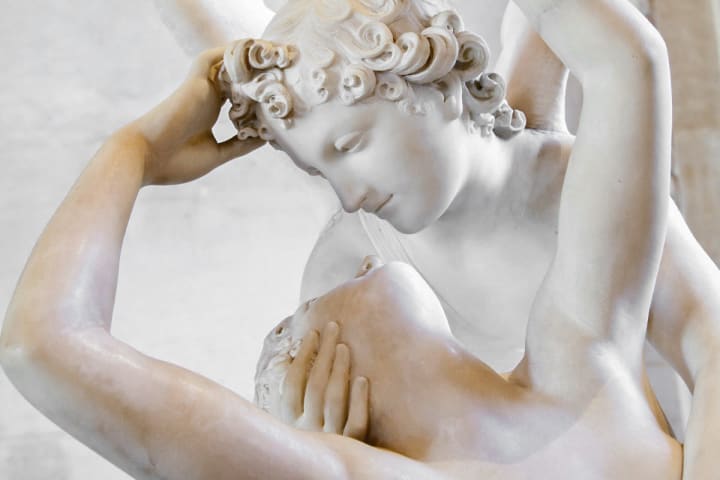
It is precisely the instant of the rebirth of love that Canova sought to freeze in marble: Cupid descends from the sky and kisses the awakened Psyche, in an embrace that is suspension, lightness, and perfectly contained sensuality.
Cupid and Psyche: The Genesis of a Masterpiece

Antonio Canova created two versions of the sculptural group:
The first version (1787–1793) was commissioned by the Scottish collector Sir John Campbell. It is currently housed in the Louvre in Paris, in the Salle des Caryatides. It is the most celebrated version and depicts Psyche lying down while Cupid is kissing her, his wings open, his hands appearing to support and protect her.
The second version (created around 1796) was requested by the Russian prince Yusupov. It is preserved in the Hermitage Museum in St. Petersburg and is similar, but with a more vertical, less "theatrical" and more composed arrangement of the figures.
Both works are sculpted from pristine Carrara marble, with such finesse that the bodies seem to breathe. The fingers touch with an almost fluid delicacy, and Cupid's wings appear to vibrate.

Cupid and Psyche: A Dance of Bodies and Feelings The work is universally celebrated for its compositional balance. The movement of the two figures creates a spiral that guides the viewer's eye in continuous motion, with no dead points. Every detail—from the drapery to the locks of hair—is meticulously chiseled, typical of the classical ideal so dear to Neoclassicism.
But what makes it extraordinary is the restrained emotional charge, that erotic and poetic modesty that brings the myth closer to human feeling. The gesture of the hands—Cupid lifting Psyche by the arms—is the visual signature of an intimacy that transcends the material.
Curiosities: When Sculpture Takes Your Breath Away
- The statue at the Louvre is one of the most photographed pieces in the museum, after the Mona Lisa and the Venus de Milo.
- Goethe was so impressed by Canova that he called him "the new Phidias."
- Canova did not consider the marble finished until it was "veiled" with a secret wax that he personally applied to make the skin more realistic.
- It is said that the inspiration for the figures' posture came from observing a real couple during a masked ball in Venice.
- The original plaster cast of Cupid and Psyche made by Canova is located in the Gypsotheca of Possagno, his birthplace, inside the Canovian Temple. It was acquired by the Italian State and is now national heritage, fundamental for understanding the artist's creative process.
Where to Admire Cupid and Psyche Today
If you wish to have the mystical experience of standing before this masterpiece, there are three essential locations:
- Louvre in Paris: The more famous, horizontal version is exhibited in the splendid setting of the Parisian palace, alongside other Neoclassical masterpieces.
- Hermitage in St. Petersburg: The second, equally refined version is housed in one of the most important art collections in the world.
- Gypsotheca in Possagno (Treviso): The plaster cast copy is preserved here, along with dozens of the sculptor’s original models, in an evocative place nestled in the silence of the Venetian hills. It is a journey into the intimacy of Canova's atelier.
The Artistic Value With Cupid and Psyche, Canova elevated sculpture to the language of the soul. In an era dominated by rationalism and the revival of classical values, this work represents the perfect fusion of ideal and feeling, between formal discipline and emotional vibration.
It is considered not only a supreme example of Neoclassicism but also one of the highest expressions of an ante litteram romanticism. Today, the estimated value of such a work—if it were ever to be put up for sale, which is unthinkable—would be incalculable, both for its historical significance and its cultural impact.
Conclusion: Art that Speaks to the Heart Canova's Cupid and Psyche is much more than a sculpture. It is a hymn to beauty, to the delicacy of feelings, and to the power of mythology that becomes a living emotion. To look at it is like listening to a timeless whisper: that of love that saves, awakens, and transforms.
About the Creator
Keep reading
More stories from Tony Gerard by Marini&Gerardi Italy and writers in Art and other communities.
Giacomo Balla: Universe of Light
Giacomo Balla: Universe of Light - THE EXHIBITION Among the many ventures that 20th-century Italian art has brought forth, few are as fascinating and radical as that of Giacomo Balla (Turin, 1871 – Rome, 1958). His artistic quest, traversing styles, techniques, and aesthetic revolutions, never lost its central theme: light as a living energy, a force that shapes and makes the invisible visible.
By Tony Gerard by Marini&Gerardi Italy5 months ago in Art
'Till Death We Do Art
There would be nothing divine in this world without art. Nature may surpass the divine to all intents and purposes, but like everything it absorbs and is absorbed by, it remains here, stuck on the surface of this world, ever-present, physically bound to the universe.
By Avocado Nunzella BSc (Psych) -- M.A.P 26 days ago in Art
Keto and Kote
This story has been sitting in my drafts for a long time because I didn't have good pictures for it. Murphy's law: I went to the performance with my phone discharged. But then I found the entire performance on YouTube and am now delightfully happy to share it with you.
By Lana V Lynx5 days ago in Art
The First Rainbow Baby
Pitter-patter, pitter-patter. The rain fell in rhythmic splatters, slowly slowing, but still constant. Mira rolled onto her side pulling the blanket tight against her ears, but still she could hear chitter-chatter and scurrying feet of the creatures that refused to sleep in the lower decks.
By A. J. Schoenfelda day ago in Fiction




Comments
There are no comments for this story
Be the first to respond and start the conversation.