
Giacomo Balla: Universe of Light
From Divisionism to Futurism: Light as a Living Form October 10, 2025 to February 1, 2026
Giacomo Balla: Universe of Light - THE EXHIBITION
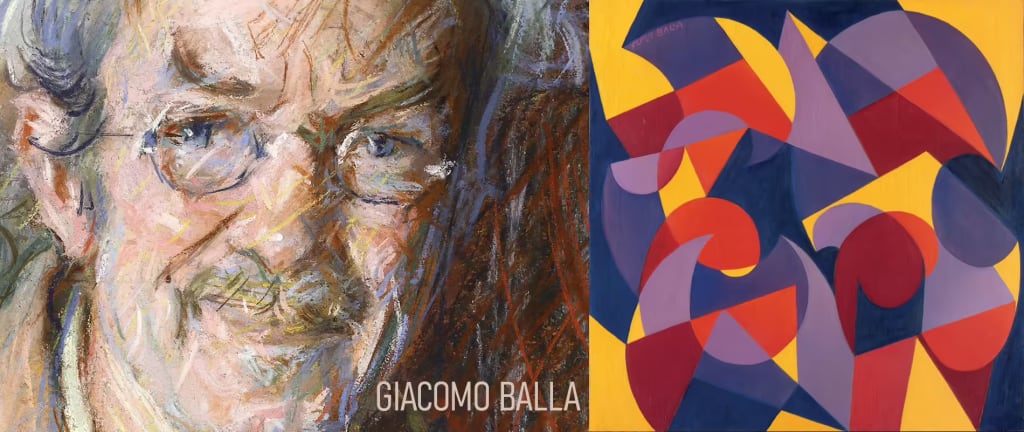
Among the many ventures that 20th-century Italian art has brought forth, few are as fascinating and radical as that of Giacomo Balla (Turin, 1871 – Rome, 1958). His artistic quest, traversing styles, techniques, and aesthetic revolutions, never lost its central theme: light as a living energy, a force that shapes and makes the invisible visible.
It is precisely this "universe of light" that the new retrospective at the Palazzo del Governatore in Parma aims to illuminate. The exhibition features a collection of over 60 works from the Galleria Nazionale d’Arte Moderna e Contemporanea (GNAM) in Rome, presenting them to the public in their full power and vitality.
Giacomo Balla: Biography and Creative Trajectory
Born in Turin in 1871, the only child of Lucia Giannotti and Giovanni, an amateur chemist, Balla was orphaned early by his father. His mother dedicated herself to his education.
From a young age, he showed an artistic inclination, initially studying music before quickly moving on to drawing and painting. He attended the Accademia Albertina and, interestingly, also took courses in anthropology and psychiatry. In 1895, he moved to Rome, where he would live for most of his life.
From Divisionism to Futurism
In his early career, Balla embraced Divisionism, adopting a chromatic language that broke down light into visual fragments. This involved dotted brushstrokes and luminous superimpositions—a sensibility that observed reality but filtered it through an intimately sensitive lens.
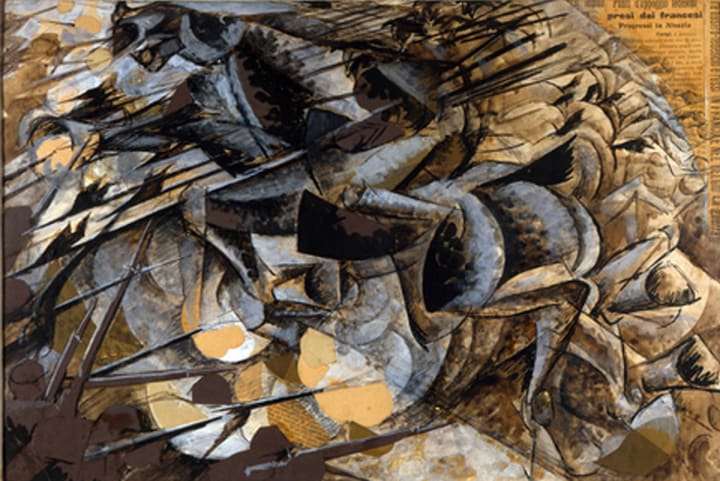
Over time, he became decisively linked to Futurism, signing the Manifesto of the Futurist Painters and Futurist Painting in 1910 alongside Marinetti, Boccioni, Carrà, and Russolo.
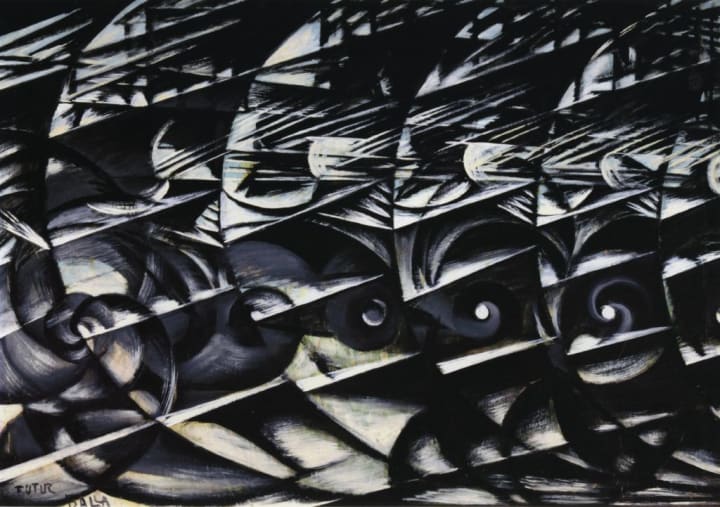
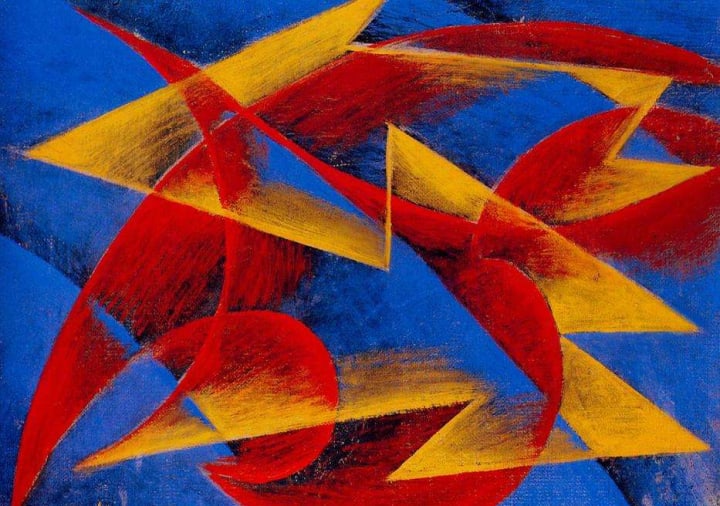
During these years, his work was consumed by the desire to visually express movement, rhythm, and the energy of modern life. Opposed to stasis and inertia, Balla and the Futurists sought a dynamic, Dionysian art that captured the flow—as if light itself could move through time and space.
Later Experimentation
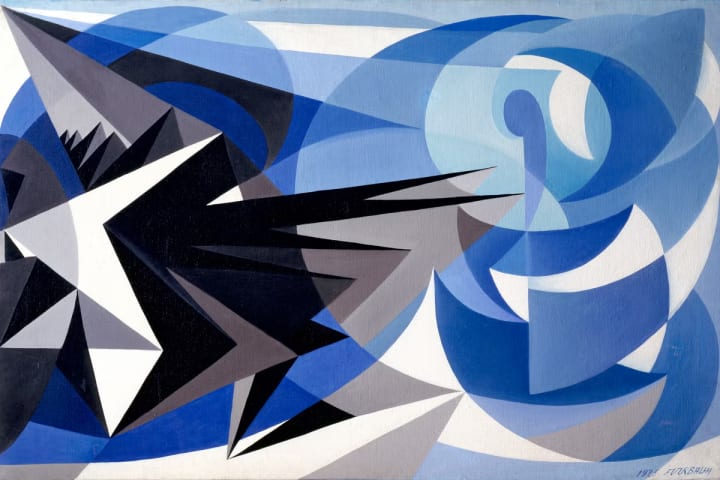
Towards the 1930s and beyond, Balla refused to be constrained by labels. While maintaining his interest in light and movement, he introduced both figurative and geometric elements, experimenting with new ways of seeing and oscillating between abstraction and representation.
Giacomo Balla: The Works that Illuminate the Journey
The Parma exhibition is more than just a display; it's a luminous map tracing every phase of Giacomo Balla's career, from his early painting to Futurism and beyond.
The journey begins with works such as Nello specchio (In the Mirror) (1901–02) and Ritratto della madre (Portrait of the Mother) (c. 1902), which attest to the young Balla's realistic and intimate roots.
The path then crosses through his period of maximum Futurist expression, where masterpieces like Espansione dinamica + velocità N. 9 (Dynamic Expansion + Speed No. 9) (c. 1913) emerge, embodying the pure thrust toward kinetic light.
Visitors will also encounter works donated by his daughters, Elica and Luce Balla, such as La pazza (The Madwoman) (1905), and the triptych Campagna romana (Roman Countryside) (1956). The selection also includes later works from the 20th century, culminating in La fila per l’agnello (The Line for the Lamb) (1942), a symbol of a more meditative and almost lyrical phase.
The exhibition is organized into 13 rooms, following a chronological and thematic order, supplemented by photographic, didactic, and documentary materials from the Gigli Archive.
Futurism in Parma: Giacomo Balla Light, Space, Experience
From October 10, 2025, to February 1, 2026, Parma becomes the stage for an extraordinary artistic operation: Balla's public collection, typically housed in Rome, finally leaves its home museum to dialogue with a new location—a city that transforms into a luminous setting.
This initiative stems from a memorandum of understanding between the Municipality of Parma and the Galleria Nazionale d’Arte Moderna e Contemporanea, with the contribution of the Fondazione Cariparma and the collaboration of Solares Fondazione delle Arti.
The Exhibition Design
The display utilizes the very space of the Palazzo del Governatore as a luminous enclave. The artworks, arranged with balance and rhythm, are paired with elements that contextualize their genesis, ranging from historical-bibliographical documentation to the graphic archive. Every stage of the exhibition invites the visitor to enter a continuum of light, to perceive the sense of movement—not just visual, but almost physical—that runs through Balla’s entire career.
This loan of over 60 works is one of the most significant ever made for the artist outside of the Roman institution. The exhibition is curated by Renata Cristina Mazzantini and Cesare Biasini Selvaggi, with the collaboration of Elena Gigli.
Why the Exhibition is Worth Visiting
This retrospective is not merely a geographical expansion; it's a reaffirmation of meaning. It allows visitors to see Giacomo Balla’s "universe of light" in its entirety, grasping the connections, transformations, continuities, and breaks in his work.
At a time when contemporary art often tends to separate, fragment, and show a piece rather than the whole, the Parma operation restores a unified and powerful narrative. Visiting the exhibition offers a unique opportunity to witness the complete arc of Balla's genius, from his early realism to his radical Futurism and beyond, all through the lens of light as a fundamental, unifying force.
About the Creator
Keep reading
More stories from Tony Gerard by Marini&Gerardi Italy and writers in Art and other communities.
Armani Privé 2005-2025: Elegance on Display at Armani/Silos Milan
Armani Privé 2005-2025: From May 21 – December 28, 2025 Milan is once again confirmed as the world capital of fashion with an unprecedented event: the exhibition “Armani Privé 2005-2025”, set up in the iconic spaces of Armani/Silos Milan. From May 21 to December 28, 2025, the public will have the opportunity to immerse themselves in a unique journey celebrating twenty years of Giorgio Armani High Fashion.
By Tony Gerard by Marini&Gerardi Italy5 months ago in Art
'Till Death We Do Art
There would be nothing divine in this world without art. Nature may surpass the divine to all intents and purposes, but like everything it absorbs and is absorbed by, it remains here, stuck on the surface of this world, ever-present, physically bound to the universe.
By Avocado Nunzella BSc (Psych) -- M.A.P 26 days ago in Art
The Stolen Smile: The True Story Behind the Mona Lisa Theft
In the summer of 1911, the art world experienced one of the most shocking and mysterious events in history when the most famous painting in the Louvre Museum suddenly vanished without anyone noticing until it was already gone. The painting was the Mona Lisa, the masterpiece created by the legendary Renaissance artist Leonardo da Vinci, and at that time it was already admired by artists and historians even though it had not yet achieved the global fame it holds today.
By The Curious Writerabout 18 hours ago in Art



Comments
There are no comments for this story
Be the first to respond and start the conversation.