
Beyond Dreams: The World of AI-Generated Coloring
The Dawn of Personalized Creativity

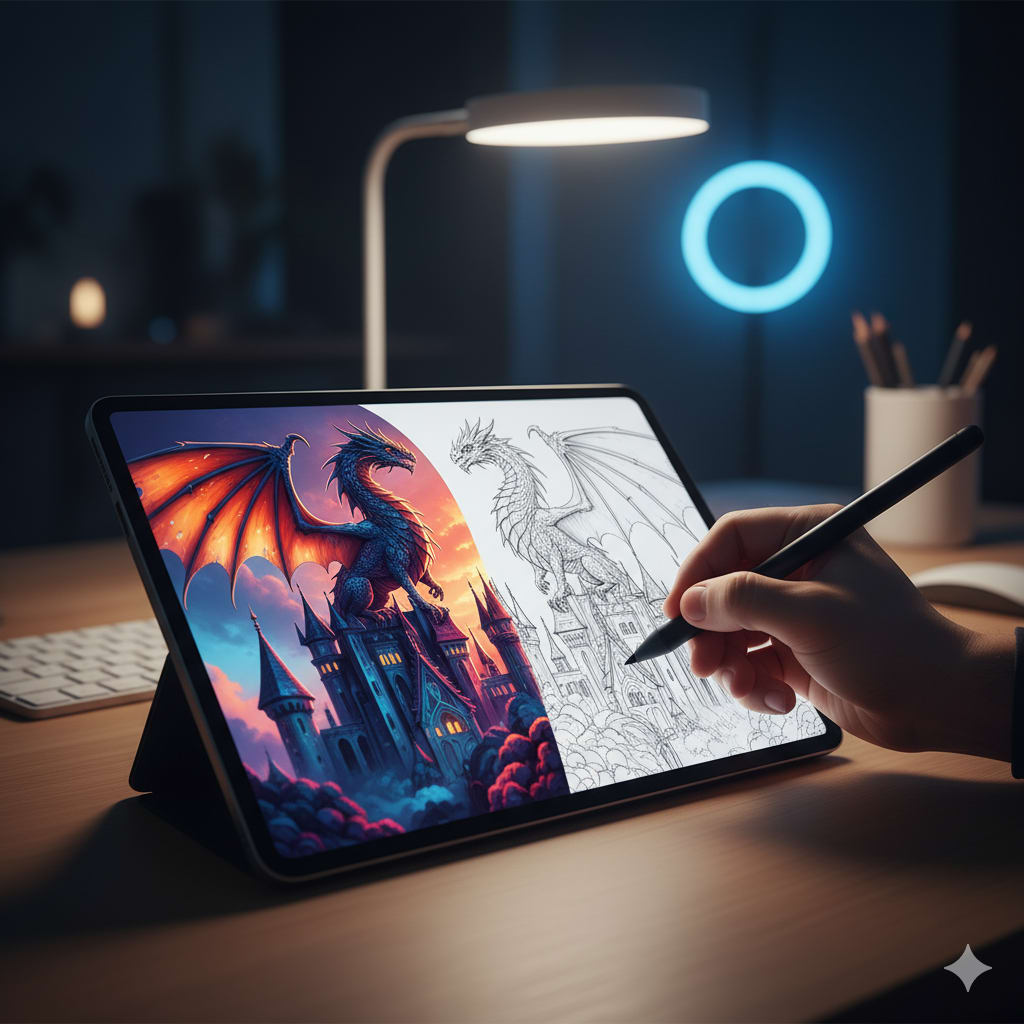
For generations, coloring has been a beloved pastime, a simple act of filling lines with color to bring a static image to life. From classic cartoon characters to intricate mandalas, the world of coloring pages has always been a world of pre-made templates. But what if those templates were no longer fixed? What if you could conjure any image you desired, from the whimsical to the educational, and turn it into a unique coloring page in seconds? This is no longer a futuristic fantasy. We are now in the age of AI-generated coloring, a revolution driven by technology that’s unlocking an unprecedented level of personalized creativity.
The Technology Behind the Magic
At the heart of this revolution are sophisticated artificial intelligence models, specifically those known as "text-to-image generators." These systems are trained on colossal datasets of images and their corresponding text descriptions, allowing them to understand the relationship between written language and visual concepts. When you enter a prompt like "a friendly dragon flying over a medieval castle," the AI doesn't just pull a pre-existing image; it processes the request and uses its training to generate a brand-new, unique drawing from scratch.
This process, while complex, has been distilled into user-friendly tools that make creation accessible to everyone. The AI model identifies key elements—the dragon, its friendly expression, the act of flying, and the castle setting—and then renders them as simple line art, perfect for coloring. It's a testament to how quickly AI has evolved, moving from abstract concepts to practical, creative applications that can be used every day by millions.
From Imagination to Line Art: A Simple Breakdown
Imagine an artist with an almost infinite library of reference images. When you give them a concept, they use their knowledge to sketch a unique scene. AI models work in a similar way, using a technique called latent diffusion. A text prompt is converted into a numerical representation, which then guides the AI as it "denoises" a random field of pixels, gradually forming a coherent image. The final step is to apply a filter that extracts only the core lines and outlines, leaving you with a clean, ready-to-color page. For a deeper dive into the specific AI models that make this possible, you can check out our guide on how AI coloring tools work.
A Tool for Every Creator
The true power of AI-generated coloring lies in its versatility and its ability to serve different audiences. For parents, it’s a way to engage with their children's ever-changing interests. Is your child currently obsessed with dinosaurs in space? No problem. Simply type in the prompt, and in seconds, you have a custom coloring page that's far more personal than anything you could find in a store. This level of personalization makes learning and play more engaging and meaningful.
Educators, too, are discovering the immense potential of this technology. Teachers can create bespoke educational materials for their students, whether it's a diagram of the solar system for a science class, a historical scene for a social studies lesson, or even a personalized storybook for reading practice. A study by the Center for Educational Technology found that customized learning materials can increase student engagement by up to 25%, a figure that highlights the impact of these innovative tools. To see more creative uses for your classroom, explore our resources on AI tools for classroom activities.
For artists and hobbyists, AI-generated pages offer a new form of creative expression. You don’t have to be a drawing expert to bring a complex idea to life. Simply describe your scene, and the AI provides the canvas. You can then focus on the meditative and artistic process of coloring, experimenting with shading, color palettes, and different techniques on a page that is uniquely yours. This accessibility opens up the world of art to anyone, regardless of their skill level.
Overcoming Challenges and Looking Forward
While the benefits are clear, the world of AI-generated coloring isn't without its challenges. The most significant concern revolves around intellectual property. As AI models are trained on vast amounts of data from the internet, the original source of an image can be difficult to trace. This raises questions about copyright and fair use, especially for those creating content for commercial purposes. Reputable AI platforms are actively working on solutions to address these legal and ethical gray areas.
Another challenge is the quality and consistency of the output. While the technology is impressive, the results can sometimes be unpredictable. A prompt might yield a fantastic drawing one time and a distorted, unusable image the next. This means that a human element—curating the best outputs, refining prompts, and making final adjustments—remains crucial. AI is a powerful co-pilot, but it's not yet a fully autonomous artist.
The Next Canvas: The Future of AI Coloring
The current state of AI coloring is just the beginning. The future promises even more exciting developments. We can expect to see AI tools that offer real-time generation, allowing you to see your line art appear on screen as you type. Imagine a seamless integration with graphic design software, where a simple prompt could create a base layer for a larger digital painting.
Beyond static images, we may see the rise of interactive AI coloring experiences. Users might be able to color a character and watch as the AI applies that same color palette and shading to another part of the scene. The possibilities for educational tools are also expanding, with AI potentially able to generate complex, multi-layered diagrams for scientific or engineering fields, complete with annotation capabilities.
As these tools become more intuitive and integrated, they will continue to break down barriers to entry, making high-quality, personalized content creation a reality for everyone, from a child dreaming up a new creature to a professional designing a unique educational tool. The line between imagination and reality is blurring, and AI is providing the digital crayons.
Conclusion
AI-generated coloring represents a major leap forward, transforming a beloved hobby from a passive activity into an active, creative partnership between human and machine. It empowers parents to create personalized learning tools, gives teachers the ability to design engaging, custom materials, and offers a new creative outlet for hobbyists and artists. While challenges around ethics and quality remain, the trajectory of this technology is clear: it’s moving towards a future where creativity is limitless, and the only boundary is our own imagination.
About the Creator
'Till Death We Do Art
There would be nothing divine in this world without art. Nature may surpass the divine to all intents and purposes, but like everything it absorbs and is absorbed by, it remains here, stuck on the surface of this world, ever-present, physically bound to the universe.
By Avocado Nunzella BSc (Psych) -- M.A.P 23 days ago in Art
Heavenly Harmonies and Heavy Criticisms: The Complex Rise of Bethel Music
Heavenly Harmonies and Heavy Criticisms: The Complex Rise of Bethel Music Walk into almost any contemporary Christian church on a Sunday morning—whether in London, Lagos, or Los Angeles—and you are almost guaranteed to hear their music.
By Nivard Anna3 days ago in Art




Comments
There are no comments for this story
Be the first to respond and start the conversation.