

Italian artist Donato di Niccolò di Betto Bardi is recognized as one of the most prolific artists from the Italian Renaissance era. Simply referred to as Donatello, the artist is regarded as one of the most talented sculptors that ever lived.
Cantoria is a sculpture that Donatello was commissioned in 1433 to create for the Duomo in Florence. It involved a lot of intricate detail.

David’s sculpture is regarded as one of Donatello’s best artworks. The artist created two statues of this Biblical hero. One was carved out of marble in 1408 and depicted David as clothed. The other statue was completed sometime in the 1440s. The statue was created in bronze and is the more famous of the two. Here Donatello depicts David nude, wearing a large feathered hat, a style in Italy at the time. The statue of David holds a sword and stands on top of a suit of armor.
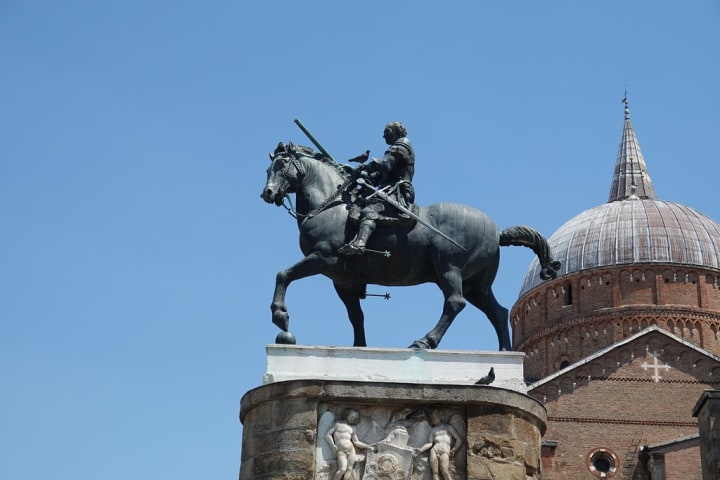
The Equestrian Statue of Gattamelata is an iconic artwork that depicts a military leader on horseback. It has become one of the more celebrated political sculptures created by Donatello. The military leader on the horse is Erasmo da Narni, a prominent leader of mercenary forces during the early 1400s for some papal leaders and other rulers in and around Italy. The mercenary forces were referred to as condottiero. The reason for the title of the sculpture is that Erasmo da Narni had the nickname Gattamelata, which translated to Honeyed Cat. The bronze statue is in Padua, Italy.

Feast of Herod is the depiction of the well-known Bible story of the feast organized by evil King Herod. On this occasion in the Bible, Herod’s daughter, Salome, demanded the head of John the Baptist. King Herod agreed reluctantly to provide it. Donatello’s relief sculpture depicts the moment when John the Baptist is beheaded. It is one of the artist’s earliest relief artworks.
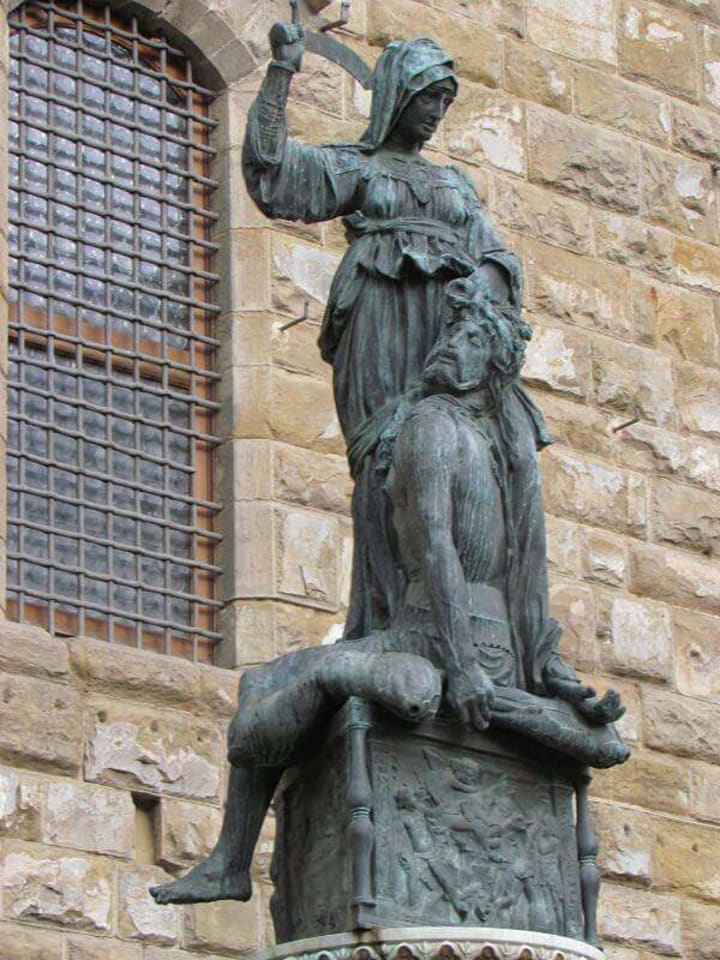
Judith and Holofernes is a depiction of the famous Biblical story of Judith slaying Holofernes. It was completed around 1464 AD. The statue depicts the Old Testament story of the killing of the Assyrian General Holofernes. This scene has been portrayed by other artists as well, like Caravaggio.

Penitent Magdalene is a wooden statue of the Biblical figure Mary Magdalene. Donatello carved the statue out of wood, finishing it around 1455. Mary Magdalene is depicted looking very frail and dressed in tattered clothing. Her hands are clasped in front of her chest in a sign of penance for her sins. It is considered to be a most realistically detailed statue.

Saint George was a famous Christian figure from the early centuries AD. There are legends and stories surrounding this figure as slaying dragons and rescuing princesses. However, his actual claim to fame if his refusal to recant the Christian faith after being captured by the Persians. The year the artist was born, Saint George had become a prominent figure in Christian traditions. In 1415 Donatello created the marble statue of Saint George, depicting him as a muscular young man adorned in clothing and armor characteristic of Christian Crusade soldiers.

Saint Mark was another prominent Biblical figure that Donatello sculpted. He created this artwork for the linen weaver’s guild in Florence. Years later the sculpture became the most famous three-dimensional depiction of Saint Mark, who was one of the twelve apostles of Christ.

The Santa Croce Crucifix is an artwork that the sculptor created in his early life while still studying the art of sculpture in Rome. This is a depiction of the crucified Christ hanging on a cross, his arms outstretched, and nails driven through his hands and feet. The artist carved this artwork from polychrome wood material, and it remains at the Cappella Bardi Di Vernio.

Zuccone is a very detailed statue depicting the famous Bible prophet Habakkuk. The statue is referred to as the Statue of the Prophet Habakkuk and also as Zuccone. Donatello carved the artwork out of marble. What is amusing is that to get the details just right Donatello would shout at the statue while carving it, asking it to speak, and when it did not, referring to it as "Zuccone," or in Italian, "an idiot," and so the statue got this nickname.
About the Creator
Rasma Raisters
My passions are writing and creating poetry. I write for several sites online and have four themed blogs on Wordpress. Please follow me on Twitter.
Keep reading
More stories from Rasma Raisters and writers in Art and other communities.
'Till Death We Do Art
There would be nothing divine in this world without art. Nature may surpass the divine to all intents and purposes, but like everything it absorbs and is absorbed by, it remains here, stuck on the surface of this world, ever-present, physically bound to the universe.
By Avocado Nunzella BSc (Psych) -- M.A.P 20 days ago in Art
The Politics of Playing Dress-Up
Well, to start off I'd like to say a happy world book day to all who celebrate. I know I haven't really posted anything on my socials about it but I'm not a jubilant kind of person. I lay low most of the time. Let's start off with a popular anecdote from the vaults...
By Annie Kapur4 days ago in Geeks




Comments (1)
Wow, other than King David, I am ashamed to say that I'm not familiar with the rest! Thanks for the intro, Rasma!