
Behold the Banksy
What value street art?


A great deal of news coverage has been given to a series of street images recently appearing in London, apparently created by the artist Banksy.
The new works, and media reactions to their appearance, raise many questions about the nature of art, particularly temporary art, how monetary value is placed on works of art, and whether the defacing of public and private property in the name of art should be condoned. None of which questions have formed a part of the coverage, except possibly the last one.
Of these much-vaunted Banksy works, at least one has been stolen, and another defaced. At least one has been given police protection and all have received considerable publicity. If Banksy had mounted a private exhibition of his works prior to sale at auction, he could hardly have achieved more publicity. My question is, why all the fuss?
Why all the fuss?
Certainly the work of this pseudonymous artist is worth looking at. Apart from the many Banksy creations I have seen in print and on TV, I have seen a temporary exhibition of his work, mounted in a series of disused shop fronts in Croydon. I have also seen a stencil painting in a bus shelter in an isolated part of rural Devonshire which might have been his. The distinctive style and approach, the use of what was once called 'graffiti', to create jarring images of social commentary, all add to the mystique surrounding this evasive artist.
I particularly liked the humor of this work, one of the recent London additions.

As can be seen from the photo (itself purporting to be a Banksy) the pelicans have been stencilled on the wall above a typical London fish and chip shop, appearing to be stealing the fish from the shop sign. Unlike many of Banksy's works, there is no political commentary involved. Just a bit of fun. Is Banksy mellowing in his old age?
While writing this piece I took a look at the banksy.co.uk website which could be considered the artist's official site, if there is such a thing. It has a licensing section.
Are you a company looking to licence Banksy art for commercial use? Then you’ve come to the right place – you can’t. Only Pest Control Office have permission to use or license my artwork. If someone else has granted you permission, you don’t have permission. I wrote ‘copyright is for losers’ in my (copyrighted) book and still encourage anybody to take and amend my art for their own personal amusement, but not for profit or making it look like I've endorsed something when I haven’t. Thanks.
Above is the licencing statement, reproduced verbatim. It suggests that, while I do not have actual permission to reproduce any Banksy work, such as the images used in this article, I may be forgiven for doing so, providing it is not for profit. I do so in any case, as I consider it part of the fair dealing principle, in that I am commenting on a popular artist's work in a forum for discussing art.
More importantly, Banksy is clearly questioning the nature of intellectual property rights and this issue is of fundamental importance when considering value in the context of his street art. When I first saw Banksy's stencil of a wolf howling at the sky, sprayed onto a circular satellite dish (look it up why don'tya), I wanted to see it for myself. That I cannot do because the satellite dish was stolen soon after the graffiti was added. It was relatively easy to do so because satellite dishes are generally fixed with nuts and bolts, which are easily removed. Unlike the pelican stencil which would require the removal of a wall to steal and this might be noticed by the residents of the dwelling above the fish bar.
Banksy works are of course known to be highly valuable and it is not unusual for a wall to be demolished in order to protect, relocate, or to steal a Banksy. Estimates of his work vary but some are thought to have been traded in excess of $10 million, while signed prints (which Banksy no longer produces) are thought to be worth many thousands, perhaps hundreds of thousands of dollars in some cases. Why, then, did Banksy add one of his new series of works to something so easy to steal as a satellite dish? Did he want it to be stolen?
Look again at the news image I headlined this article with. It comes from the BBC news story about one of Banksy's new London works being defaced. Who is the young man who defaced it and should we condemn such vandalism? My view is absolutely not. For reasons:
- If the defacing of the Banksy is an act of vandalism, what was the work itself, if not an act of vandalism?
- What does it say in Banksy's 'copyright' statement above about amending his work? "I... still encourage anybody to take and amend my art for their own personal amusement." What was the 'vandal' doing if not amending the wall art for his own amusement? And, I have to say, the spray-can tag doesn't detract at all from the visual appeal of the painting. It was as if the spray-can man had taken great care not to do too much damage to the work as a whole. It is if anything an endorsement and welcome addition to the work. What do you say Banksy?
- More to the point, how do we know that Banksy himself did not graffiti his own work, or arranged for someone else to do so? Or perhaps he just put these works in such places that some at least would be vandalised.
At the risk of making something more of all this than it deserved, the whole thing looks to me like a big publicity stunt on the part of the artist. If it is not publicity he is seeking (a while since I have noticed much talk about Banksy) then it is perhaps an additional bit of self-aggrandisement.
Even if it isn't (and I don't like to be unfair or over-critical to people who have produced such wonderful artistic work) then Banksy, himself, has made it clear that he is happy if people play around with his work and that he has no wish to be precious about it.
Temporary art is... temporary
And this is what street art and temporary art are all about. Temporary art is, well, temporary. The whole point is that it has no permanency. Art lovers will not seek it out in museums in generations to come. Anthropologists will not marvel over it 30,000 years from now.
If a Banksy appears in your locality and you see it. That is the value! If it is removed, stolen, vandalised the next day and you never see it again, that is the value! You can tell your friends you have seen a Banksy. You can remember it, boast about it, hopefully be energised and inspired by it as I know I would be.
Are you inspired by Banksy? Or, for that manner any other artist and their work? If you are, why not use this inspiration to help generate some ideas to write a chapter of a novel? Found out how to enter here: Girl with a Golden Earring and: Inspired by Art
You or someone else may have photographed it. Any such images are just copies and so presumably do not have the value of the 'original' but what does it matter? Although I did not see the original Banksy satellite-dish wolf, the image wasn't that interesting and I can see a copy of it any time I like. Given the 'original' was a stencilled image it was itself only a copy. See what I mean? What is the difference between an original and a copy of something that starts life being copied?
During the SARS-Cov lockdowns of 2020/21, a number of Banksy-like stencil paintings appeared in my locality, the London suburban town of Beckenham. Unlike Banksy paintings these were colorful, cheerful and many were commissioned by the owners of the properties they appeared on. They were intended to boost the spirits of an embattled community, facing the rigours of the cancellation of their regular social life. I think they were very effective and very welcome. Not the intriguing, sometimes obscure, witty works of the real Banksy but still important community and street art, perhaps more so than Banksy's anonymous cynicism. And not as temporary, though certainly they will eventually wash or wear away, if they are not removed by the property owners.
The moving hand writes
To conclude, temporary work derives its value from its transient nature. It appears, then it goes. Some see it, some don't. The artist moves on to the next event, just as we all do in daily life. The moving hand writes and, having writ, moves on. If there is any meaning and value in Banksy's art, and his movement, it is perhaps this.
Would you agree?
Comments, as always welcome.
If you are reading this and are not a Vocal member, you have to register to be able to comment. It is free to do so and also allows you to post your own thoughts, stories, poems, art and what-not.
Thanks for reading mine.
Inspired by Banksy or any other artist and their work?
Why not use this inspiration to help generate some ideas to write a chapter of a novel? Found out how to enter here:
About the Creator
Raymond G. Taylor
Author living in Kent, England. Writer of short stories and poems in a wide range of genres, forms and styles. A non-fiction writer for 40+ years. Subjects include art, history, science, business, law, and the human condition.
Keep reading
More stories from Raymond G. Taylor and writers in Art and other communities.
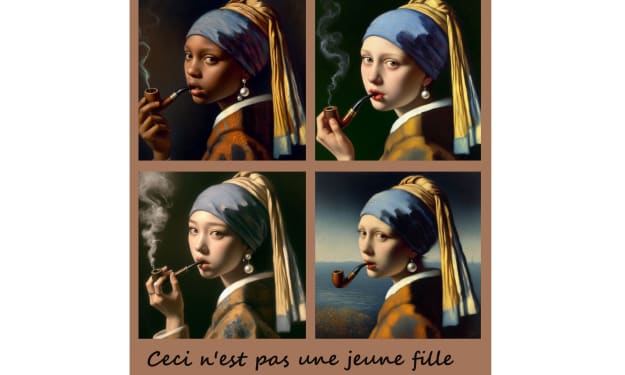
This is not a work of art
When I created this digital image, I was not intending to create a work of art. I was just having a bit of fun with AI. Having created it, though, I think I have inadvertently done just that. Created a work of art! Yes, really! Why, then, have I called this story "This is not a work of art"? The simple reason is that the digital image IS a work of art precisely because it IS NOT a work of art. The artistic value of the work is defined in its own contradiction. Now, this might seem complete nonsense, and perhaps it is, but I will try to explain what I mean.
By Raymond G. Taylor2 years ago in Art
'Till Death We Do Art
There would be nothing divine in this world without art. Nature may surpass the divine to all intents and purposes, but like everything it absorbs and is absorbed by, it remains here, stuck on the surface of this world, ever-present, physically bound to the universe.
By Avocado Nunzella BSc (Psych) -- M.A.P 16 days ago in Art
The Dress That Broke the Internet Was Gold and Nobody Could Agree on Why
She walked into the room and everything stopped. Not because of her confidence or music that was playing, though there was plenty of that. Everything stopped because of the dress. Floor-length, liquid, blazing gold, it caught every light in the room and threw it straight back.
By CurlsAndCommasabout 15 hours ago in Art
Tatt~Master
— Assembly Line Tatt Machine ~ Impressions to Impress — As I begin to understand more about the Tattoo Phenomenon. I've written silly, yet verbatim, dating site anecdotes in 'Frazzled.' So let me ask you: Would you be More attracted to someone slathered with tattoos, or Less?
By Jay Kantor4 days ago in Humor



Comments (6)
I've never enjoyed reading the licensing section of someone's art so much (truth is, I've never ever read a licensing section 'til now.) But really interesting "YAYS" here 😁
Totally agree. This was his way of saying "I was here."
A fascinating read.. thanks😊. I love street murals etc.
Some really interesting questions you pose here, Raymond. To me, and I travel to certain countries because I want to visit a particular museum or a painting, the value of any art is with those who admire it. If people value Banksy’s art they will seek out its digital images and keep them on their phones. I have a ton of pictures of street art in my phone from Sao Paolo and Brussels, two world capitals of street art, and some I sought on purpose instead of taking a city tour. Last year, for example, when I stumbled by a portrait of Mother Theresa and Mahatma Ghandi in Chelsea neighborhood of NYC by the famous Brazilian street artist Kobra, my friend couldn’t believe my excitement. I snapped it, shared it on Facebook and will keep it in my phone and computer forever, after its original is washed away from that bistro wall. It’s pretty much the same as people keeping reproductions of great art in their homes that they will probably never see with their own eyes in a museum or private collection. Temporary or not, street art is accessible and I think that’s the most important point about it.
I think you're right. Maybe this is all just a publicity stunt.
I have mixed feelings about Banksy but whenever he does something, it creates a furore. The difficulty I have with it is graffiti. Banksy's works are art because they have more form, are nicer to look at, I suppose. They have social impact too with what they depict a lot of the time and I like this subversive, anarchic approach. I also like his works. But...he is drawing on other people's property and it is an invitation for others to follow, that any blank wall is fair game. Not all graffitiists are as accomplished as Banksy. Graffiti often looks a mess. So is Banksy art? We've imbued it with meaning and elevated it beyond graffiti but how do you make the distinction? It's arbitrary as all Art is. What is considered Art by one, is not by someone else. Perhaps that's why Banksy does it. Is it an "Emperor's New Clothes" style scenario? Where we're all seeing it as art whereas he sees it as graffiti and he is laughing at us for our blurring of boundaries so thay his flagrant acts of vandalism make us applaud him? Is this a way to hide our hypocrisy? You got me thinking, Ray which is always good.