
This is not a work of art
Or is it?


When I created this digital image, I was not intending to create a work of art. I was just having a bit of fun with AI. Having created it, though, I think I have inadvertently done just that. Created a work of art! Yes, really! Why, then, have I called this story "This is not a work of art"? The simple reason is that the digital image IS a work of art precisely because it IS NOT a work of art. The artistic value of the work is defined in its own contradiction. Now, this might seem complete nonsense, and perhaps it is, but I will try to explain what I mean.
Art can be defined in many different ways and there is no single accepted definition of exactly what art is. I explore the question of the nature of art in another article I have written recently. To explain why I think my digital image is a work of art I will first discuss how I use AI and other digital tools to create digital designs.
Do you like to play around with so called artificial intelligence? I do, as you may be able to guess from looking at the above image. I have been playing around with images derived from Johannes Vermeer's Girl with a Pearl Earring, as well as other art images, quite at lot recently. Why:
- Because it is fun and easy to do
- In the case of images such at this one, it is iconoclastic
- It has helped support a literary competition I have recently launched.
There are other reasons too, but let's not worry about that too much. There is of course some concern around the 'dangers' of using AI, along with the benefits. Some say it steals other people's copyright, infringes privacy and it has even been said the human race is in danger of being made obsolete by AI.
While the last point is something too broad (and scary) to deal with in this discussion, I am not convinced by the other two arguments. Certainly AI can be used to infringe copyright and privacy, just as a camera, a database or a keyboard can. My image of four girls smoking a pipe was of course created with the help of an AI tool, but does it breach anyone's copyright or privacy?
This is a digital copy of Johann Vermeer's Girl with a pearl earring painting:
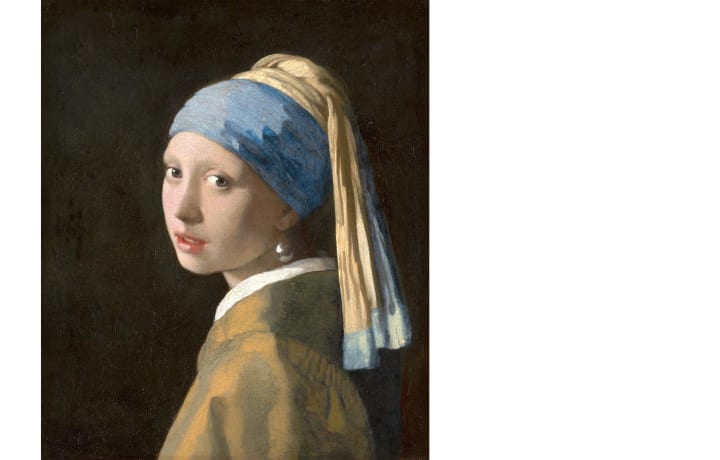
When I prompted the AI tool I used (Dall-E-3) to generate the girl with a pipe images, I specifically mentioned Girl with a pearl and so in this case it is quite clear that the AI made a copy of the Vermeer painting and manipulated it according to my prompt. This is not a breach of copyright, however, as any copyright in this painting (made in 1665) has long since expired and is in the public domain. And it can hardly be a breach of the model's privacy as she will have died centuries ago. Fair game then? It is, unless you think it rude or disrespectful to mess around with so important, and so revered, a work of art. Did I mention that I liked to be iconoclastic with art?
When I was first thinking about how I could use Girl with a pearl to illustrate another article I was writing, I thought about Andy Warhol's pop art paintings involving a portrait of Marilyn Monroe and others that used multiple copies of the Campbell's soup can image. On this basis I used AI to create a multiple image of Girl with a pearl in a Warholesque style. Here's how it looked along with the article I used it to illustrate.
What do you think? Does this image remind you of Warhol's multiple Marilyn paintings? I so liked what I had done with Girl that I wanted to go a step further and create a design that delved deeper into the nature of art in the modern world. This is when I came up with the idea of combining work by Vermeer with work by the Belgian painter Rene Magritte. In particular his work The Treachery of Images. In this painting, Magritte makes the statement "ceci n'est pas une pipe" – this is not a pipe – underneath an image of a pipe.
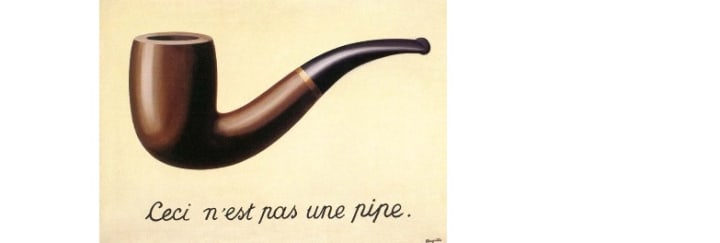
There are various ways of interpreting what appears to be a false statement about a painting of a pipe. You could think of it as a statement of the patently absurd, or you could think it is a statement indicating how images may deceive. What the statement asks us as viewers of the work to do is to look at the image and to understand that we are not looking at a pipe but at the pictorial representation of one. The painting, and therefore the artist, is deceiving us into believing we are looking at a pipe when in fact we are looking at a flat image rendered on canvass or paper (if a print copy). The painting is perhaps saying that art is not reality. Art is not reality, it merely reflects reality, gives an illusion of reality.
Mimicking Magritte's work, my digital creation tells us we are not looking at a girl or young woman, beneath an image of four young women. The fact that each of the four panels has an image of a young women smoking a pipe is of course a intended to parody Magritte. You could say that the message in my design is the same as that in Magritte's work. What you are looking at is not what you think you are looking at. It is not a girl because:
- There are four different girls
- It is an image of four girls, not the real four girls
- It is a parody of a work of art created by AI and therefore cannot itself be art. It is essentially a fraud.
If you think the featured image of four girls, each smoking a pipe, is art you are wrong because the work was not created by an artist it was generated using AI. Actually this is not strictly true, because although the girl with pipe image was created by an AI, using digital copies of the Vermeer painting, the combination of the four images, the rendering of the background and the addition of the lettering (including the choice of typeface) were all done by me, manually, using the Paint application.
So if you think the work is not art, you are also wrong. Yes, I used AI as one of the tools to produce this, just as Magritte and Vermeer used paint and brushes (among other tools and materials) to create their art works. I also used other tools like Paint and a keyboard and mouse. I chose the colors of the background and the type. I decided to use four images, chose which ones of the AI-generated images to use, wrote the text string necessary to generate the image and adapted this when I didn't get the results I wanted. I cut and pasted the girl images, cropped the images to the size I wanted and drew the frames around them. By cutting and pasting other images I was using the same skills that would be used by someone creating a montage image. True I have never trained as an artist, never learnt how to use paint and paintbrushes, pencils or charcoal.
So, you see, the question as to whether my digital creation is art (or indeed is 'mine') is problematic. There is no simple answer to the question "is it art?" People sometimes tell me a work in an art exhibition is not art. How, then, do they define art?
For me, I usually seek simple definitions where I can. To me, a work of art is something created as such by an artist. Created for display in an art gallery or other public (or for that matter private) space that is permanently or temporarily dedicated to art. What is an artist? Surely someone who creates works of art? A circular argument, perhaps, but if a museum or other organisation obtains a work or works of art for display in any kind of exhibition, this strengthens the case. You may or may not like what has been curated and that is your privilege as a person viewing the art. We all have our own taste and anyone can make up their own minds as to whether a work is art or not and whether they like it.
Am I an artist? Not really, in the sense that I have never trained as an artist, do not draw or paint. However, I have previously created a work of art that is (about to be) displayed at a major art museum in London: Tate Modern. The work, known as Culinary Magic, is a digital creation using iPhone photography of a common kitchen utensil on a worktop and adding in an element of typography. No AI was used and nothing was copied (other than the items photographed) or mimicked. Once I had created the digital image, I then had it printed by a digital printer and framed for display (at some expense). The exhibition is a regular event for staff at Tate to exhibit their work, known as the Biennale. I know several talented artists, only one of whom has exhibited at Tate. Given, it is a staff exhibition rather than an event for well-known artists but it is still an exhibition at the Tate and I am rather pleased that they accepted my work, which was produced exclusively for the event. Here is a link to an online copy of the work and an explanation.
This work was created as an artwork, using simple digital tools and the ingenuity of the artist. It was not created for any visual aesthetic appeal but as a means of questioning the nature of art. You could say that about many works of modern and contemporary art including those of Warhol and Magritte. Of course I do not have the talent or understanding of art that either of these artists had. By describing my work as art (and therefore myself as artist) I do not intend to suggest a comparison with these artistic giants of the 20th Century. I merely suggest that there is no qualitative barrier to anything being considered art if it is created for that purpose by a person capable of creating it.
We have such tools available to us now that it becomes possible for many more of us to produce art. We can all be artists if we want to be. Most people, however, do not want to be and do not consider that they have the ability to be artists. I consider myself to be in this same broad category and can only describe myself as an artist by virtue of this one work of art that I created at the end of 2023, that has been accepted for display at an internationally renown art museum. Now that I have created this second work of art, I think it may be considered churlish or falsely modest to say I am definitely not an artist.
In summary I would say that I am not an artist and yet I am an artist. It follows that Ceci n'est pas une jeune fille is not a work of art and yet is a work of art. Such contradictions are part and parcel of the nature, character and, I would argue, essential to the spirit of art throughout its history.
Thanks for reading and please let me know your opinion
About the Creator
Raymond G. Taylor
Author living in Kent, England. Writer of short stories and poems in a wide range of genres, forms and styles. A non-fiction writer for 40+ years. Subjects include art, history, science, business, law, and the human condition.
Keep reading
More stories from Raymond G. Taylor and writers in Art and other communities.
Long-lost Constable painting found in basement
A mystery painting found in a South London basement could be a long lost Constable. The painting, found in a house in Beckenham, South London, is believed to be a long-lost work by John Constable R.A. (1776 – 1837) known as A Summer Meadow. The work is currently under examination by art history academics at the National Gallery in London.
By Raymond G. Taylorabout a year ago in Art


Comments (8)
I always wondered how people decide what can be called art and what can not. In the end, I came to the conclusion that it depends on the individuals personal preference and how we each define things. Anything can be art if we want it to be.
Well-wrought exploration of a contraversial topic! AI might be considered art like a collage of images cut from magazines is art, but I do not believe using AI to create art will ever perform the true sacred function of Art unless AI itself is the conscious creator of its own art, just like I would not say that the random collection of magazines from which a person carefully selected images to make such a collage would be art in itself without the intention of the artist in placing them together. But then, we as artists might ask, what uses us to make art? Is our consciousness, and the apparatus that generate it (our nervous system?), perhaps a tool for something else beyond us? MUST it be? What if we discovered there was a hidden hand and we chose not to follow its dictates and created independently of its designs? Who is the artist? Where is the conscious designer then? Could it be that consciousness itself as the integration of information might be taking on a life of its own through this massive field generator that is the "information superhighway"?
I wanted to cry while reading this because like why are you putting my brain to so much work 🤣🤣🤣🤣🤣🤣🤣🤣🤣
Firstly, yes the image does remind me a bit of Warhol's art. I have never attempted to play around with AI. Perhaps I don't fully understand its premise enough to attempt that endeavor even though I see so much of it on this platform. Good, informative article.
You are an original writer and yes, an artist. I liked the Warhol idea of the lady. This is a very interesting article.
Nice article
Art is in the eye of the beholder are those that are looking on. I see your image as art. AI can be used in different ways. There are those people that will put in a one or two or three word prompt and then let AI do the rest and that is it. To me that is not art. There is an art to using ai. Such as putting in detailed and creative prompts. Maybe starting with a guide image that you drew. Then letting AI take that image and your detailed prompts to come up with a new image. But once you have that AI image you take and do some tweaks. Possibly mask out parts of the AI image and write some new prompts in order to tweak the image a bit and come up with something more of what you are looking to create. AI can be used creatively that way in order to come up with a work of art. But simply putting in one or two words and the prompt field and letting AI do the rest, that is not art. That is basically letting someone else create the art for you.
Excellent work , I actually like playing with Ai sometimes, throwing some hell of unrealistic prompt to it , tho sometimes I get good pictures depending on the prompt and other time I got gabbage images .