
Artwork by Caspar David Friedrich
Romantic artist


German Romantic landscape artist Caspar David Friedrich was part of Swedish Pomerania and studied art at the Art Academy of Copenhagen. In 1798 the artist settled in Dresden, Germany. He was among the most influential Romantic artists of his generation.

The Abbey in the Oakwood was completed around the same time the artist completed his other painting, The Monk by the Sea. These are adjoining paintings. This painting was also bought by King Frederick Wilhelm III. The painting depicts an old abbey in the center, and figures are seen entering the abbey with a coffin. The remains of the abbey have a broken window. What is seen is that nature is there forever, while man's creation is temporary. This lower third of the picture lies in darkness—only the highest part of the ruins and the tips of the leafless oaks are lit by the setting sun.

Chalk Cliffs on Rugen was a painting completed the year the artist married Caroline Bommer. She was twenty years younger than Friedrich, and the couple went on an extended honeymoon to visit family and friends in both Neubrandenburg and Greifswald. The artwork was inspired by an excursion taken by the couple with Friedrich’s brother Christian on the island of Rugen featuring chalk cliffs.
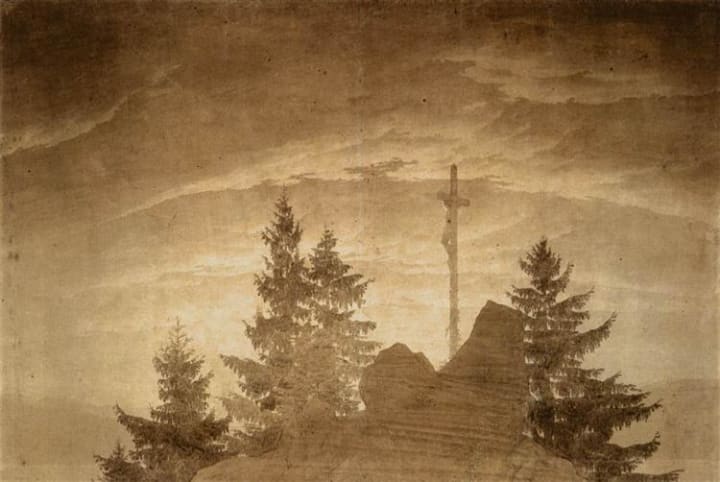
Cross in the Mountains is a painting also referred to as the Tetschen Altar. Friedrich incorporated the Christian symbol of the cross in the landscape, and it was the first time in history this had been done. Christian art and history paintings were still considered to be the highest form of art at the time while landscapes were considered to be pretty ordinary. This made the combination strange for contemporary viewers.

The Lonely Tree is a painting also referred to as The Solitary Tree. It is an artwork dominated by a solitary oak tree in the foreground. The painting was commissioned by a rich German banker and art collector, Joachim Henrich Wilhelm Wagener.

The Monk by the Sea is a dark painting showing a seascape beneath a gloomy sky. A figure can be distinguished in the foreground and appears to be a monk by the long garment he wears. This painting is described as an allegory of the vastness of nature and is among the artist’s major artworks. After the exhibition, the painting was bought by King Frederick Wilhelm III for his collection and today hangs in the Alte Nationalgalerie in Berlin, Germany.
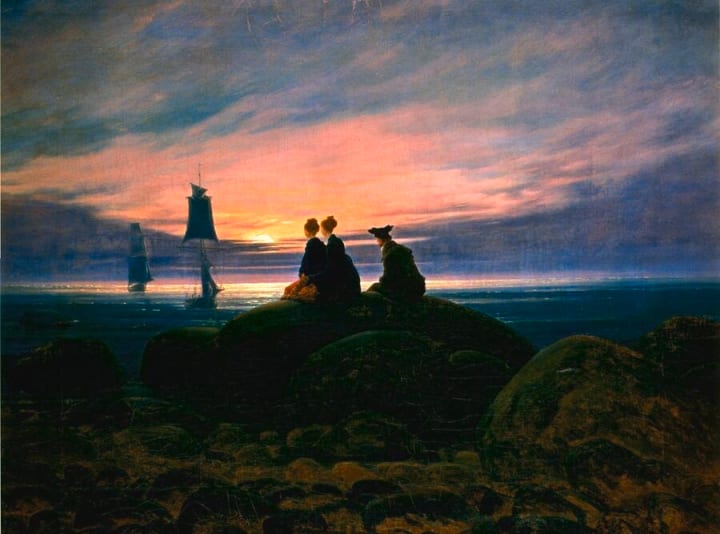
Moonrise Over the Sea was the second painting that Wagener commissioned from Friedrich in the early 1820s. The painting depicts three people, two women with a man behind them sitting on a rock. They are looking at the shimmering sea in front of them as the moon rises above the clouds in the distance. Art historians seem to think that this artwork depicts Stubbenkammer beach near the island of Rugen.
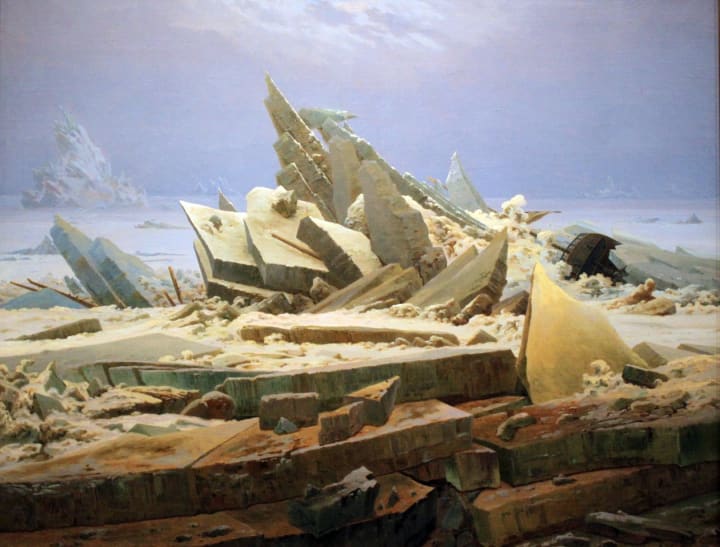
The Sea of Ice is an artwork depicting a shipwreck in the Arctic Sea. This is a complex painting depicted in great detail and is considered one of his most influential masterpieces. The painting represents what Friedrich believed the Arctic looked like. In the background the icebergs are crushed together to form a tower of ice. Next to this massive ice tower is a shipwreck.

The Stages of Life is a painting that the artist completed during the final decade of his life. It depicts an old man with his back to the viewer walking toward two adults and two children. The scene has been painted in an elevated position overlooking a harbor, and five ships can be seen in the background. The location is “Utkiek,” located near the artist’s home city of Greifswald.

Woman at the Window is a painting depicting an interior scene. The viewer sees a woman looking through an opened window. Seeing a mast, it appears that she is looking at a ship passing by. The woman at the window is the artist’s wife, Caroline Bommer, whom the artist married four years before completing this painting in 1818. The interior space is Friedrich’s studio in Dresden, overlooking the Elbe River.
Wanderer Above the Sea Fog is a painting depicting a man standing on top of a rocky outcrop, his back facing the viewer. (pictured above) He is overlooking a foggy landscape. The name for a figure that is seen from behind is “Ruckenfigur” or “Rear-Facing Figure.” The figure in the painting is wearing a traditional German costume, which was banned by the German Confederation in 1819, a year after this painting was completed.
About the Creator
Rasma Raisters
My passions are writing and creating poetry. I write for several sites online and have four themed blogs on Wordpress. Please follow me on Twitter.
Keep reading
More stories from Rasma Raisters and writers in Art and other communities.
Impressive Art Museums in the US
Boston, Massachusetts The Museum of Fine Arts in Boston is among the oldest institutions in the US. The museum features over 50,000 artworks, among them Korean art, Egyptian artifacts, works by old masters, and a huge John Singer Sargent collection. One of the favorite exhibits features iconic artworks by various indigenous cultures in North, Central, and South America. Visitors can also enjoy contemporary art displays.
By Rasma Raisters3 months ago in Art
'Till Death We Do Art
There would be nothing divine in this world without art. Nature may surpass the divine to all intents and purposes, but like everything it absorbs and is absorbed by, it remains here, stuck on the surface of this world, ever-present, physically bound to the universe.
By Avocado Nunzella BSc (Psych) -- M.A.P 22 days ago in Art
How Andreas Szakacs Turned Into a Leading Film Podcast
Bringing the Theater Experience Online Streaming may dominate modern viewing habits, but Szakacs and his co-hosts believed something was missing: the conversation that begins the moment you leave a theater. That post-film discussion — emotional, analytical, spontaneous — became the foundation of their podcast.
By Andreas Szakacs7 days ago in Art



Comments
There are no comments for this story
Be the first to respond and start the conversation.