
Art & Science: Powers of Ten by Charles and Ray Eames
A Rollercoaster Ride Across the Universe

This short film, Powers of Ten, a 1977 non-fiction documentary work by innovative and influential American designers Charles and Ray Eames was commissioned by IBM. First released in 1966, it was produced before drones and Google Earth existed, and during the era of the “race to space”, a period when there were also many space-travel and moon related themes in popular culture, hugely influenced by the many successful missions by NASA.
The important scene was where two people having a picnic, whom were (almost) in the centre of this film, being the intermediary of two separate worlds and/ or films. (I mentioned almost, because, in obvious comparison to the vastness and the deep mysteries of space, we are not in the middle (that depends on what you determine as a start or end point, and finding the middle ground but that is another thought by itself)). It makes you think because, as much as we think of how big the earth is, it is tiny, in relation to the universe. What if we were atoms for another universe?
The verbal and visual techniques used to show this - were the guided narration and a thin white square that frames the focal point of the story, zooming in within and out in great magnitudes almost like looking through a viewfinder of an extremely powerful telescope/ camera/ microscope.
The film is one where I found to be mesmerising, albeit the primitiveness of it, of something which speaks to me on many levels across art, science, mathematics, the abstract, the precise, the close up, the infinity, the contemporary, and of time, and scale, of stillness and change, of something we recognise in the everyday, and of course, the mystery of the universe.
So what is the film about?
Firstly, it was about illustrating the powers of ten, zooming out from where the picnickers were sitting, till you can see the size of the state, which according to the narrator is Chicago, then the size of the country, then further, and further, until one then can see the view of the earth, the solar system, all the way out to the vastness of space in billions of lightyears away. The last frame was a picture of a cosmic web.
Secondly the creators of the film used a square frame as a focal point, a viewfinder to emphasise a single object on the centre of the screen.
Thirdly, it then stopped, and then it fast-forwarded like a rollercoaster ride on turbo speed, with the powers of ten decreasing, towards the direction of the earth, back to where the picnickers were sitting down again. It didn't just stop there. The scene is now focusing on the man’s hands.
Finally it then zoomed in at normal speed, all the way, the indices now decreasing in the negatives - ten to the power of minus one metre, ten to the power of minus two metre, and so on. One can now see the helix, and and then further and further in, till down to one single proton in an atom.
I was completely blown away.
In case if you haven’t seen it, it is here. It is only a 9-minute film, but it gets you thinking for much longer than that. At least it did, for me. Therefore writing this blog post.
So I was doing a computing mathematics class and was first introduced to the topic of Indices or Exponents. Years later I was introduced to this short film when I was doing a video art elective class. Back to Indices. What are they? Indices are where an index number is a number raised to a power. Essentially, they are actually repeated multiplication. In this case, it explains the exponential values of the powers of ten. The base number being ten to the power of eight for example, that is, 10^8 in computer programming would mean 10 x 10 x 10 x 10 x 10 = 100 000 000.
I remember the film of course, but didn’t make note of the title, kept it at the back of my mind after I left school. I have completely forgotten about it until one day I stumbled upon it again when I was looking up on the internet for something else. Of course I decided to watch it again.
This film was still intriguing to me, due to the artistry of it. Yes, I was introduced to this film in an art class, not a maths or a physics class as you might first think. I would say it is still applicable today. In fact, actually there is a 2018 version, called the "Cosmic Eye", but I very much prefer this particular version made in 1977. The video looked simple. The film was like a craft, as they had to reproduce and handmade some of the shots. In case if you’re curious about how it was done, this article explains it.
One is put through on a roller coaster ride across cities, planets and bodies of galaxies, experiencing a world that is so vast yet subtle, poignant and beautiful, complex and elegant at the same time.
There was also another unnarrated film, “Cosmic Zoom”, by Eva Szasz, made around 1968, that was inspired by the same book that the Eames team have adopted it from. It showed the same magnified progression of the universe, and then also the reverse to the microscopic view, but this time the subject is different, it is that of a boy rowing a boat with his dog. His hands were not the focal point, but of a mosquito that was resting on his hand, zooming in onto a mosquito, magnifying everything that was inside.
The original book that inspired the two films mentioned above, “Cosmic View, The Universe In 40 Jumps”, was written by Kees Boeke in 1957. A digitised version of the book is available here. Original work was actually a graphic novel in which the author has developed it for years, perfecting the drawings and adding more information to them over a period of time. Unfortunately Mr Boeke passed away in 1966 and did not had the chance to see the film made by the Eames or by Eva Szasz.
In case if you are curious, the “Cosmic Eye” mentioned earlier, is the 2018 version. Designed by astrophysicist Danail Obreschkow, the difference about this version is that Cosmic Eye showed real photographs taken with telescopes, microscopes, and modern detectors where possible. Other views in the film were the created from computer models. The seamless zoom was created by using vector-based blending techniques are used to create a seamless zoom.
All in all, using art to teach other subjects and to connect with big ideas can enhance our understanding of the world around us. These ideas just scratch the surface of the ways arts can illustrate ideas in other subject matters. Please feel free to share any thoughts in the comments :)
About the Creator
Keep reading
More stories from writers in Art and other communities.
'Till Death We Do Art
There would be nothing divine in this world without art. Nature may surpass the divine to all intents and purposes, but like everything it absorbs and is absorbed by, it remains here, stuck on the surface of this world, ever-present, physically bound to the universe.
By Avocado Nunzella BSc (Psych) -- M.A.P 26 days ago in Art
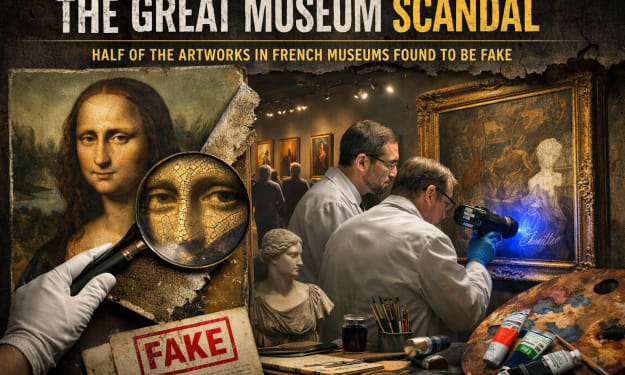
The Great Museum Scandal: Half of the Artworks in French Museums Found to Be Fake
France is home to some of the most famous museums in the world, attracting millions of visitors each year who come to admire priceless works of art and historical artifacts. However, a recent investigation has sent shockwaves through the art world after suggesting that a significant number of artworks displayed in certain French museums may actually be fake.
By Irshad Abbasi 4 days ago in Art
A Transparent Look at Vocal Challenges and Top Stories
Almost three years ago, we shared a resource article that served as a place for people to suggest new challenge prompts. We thought it would be a good idea to refresh that thread, and take the opportunity to answer a few common questions about top stories, how challenges are judged and how submissions are reviewed.
By Vocal Curation Team2 days ago in Resources



Comments
There are no comments for this story
Be the first to respond and start the conversation.