
A Norman Rockwell Christmas: The Saturday Evening Post, December 25, 1948
Christmas portrait

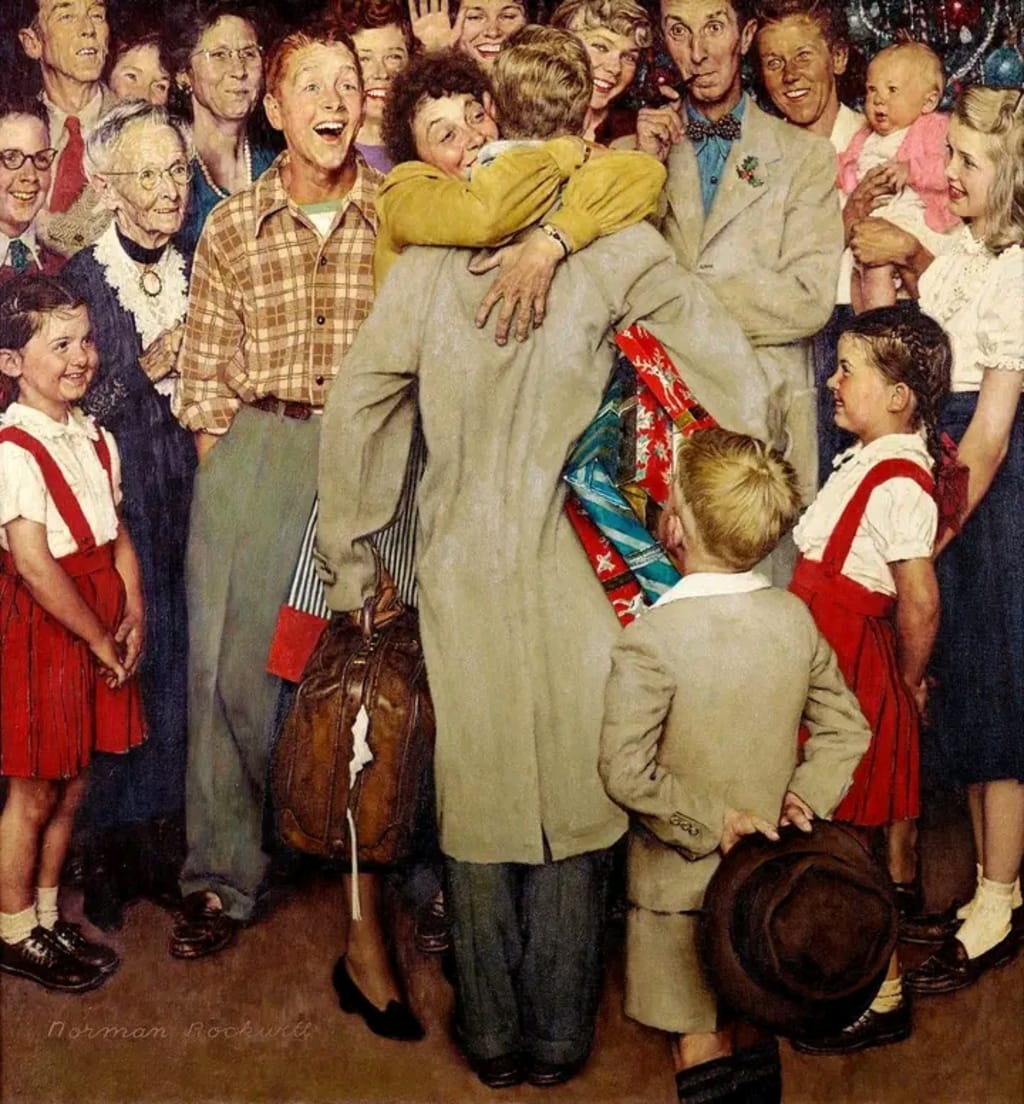
Few artists have captured the spirit of American life quite like Norman Rockwell. His illustrations for The Saturday Evening Post remain iconic, offering heartwarming glimpses into mid-20th century America. One of his most beloved works graced the cover of the December 25, 1948 issue of the Post, a festive scene that tells a story of family, joy, and the warmth of Christmas without the need for obvious holiday symbols.
In this painting, Rockwell's genius lies in his ability to evoke the magic of Christmas through human connection, vibrant emotion, and subtle details.
The Scene: A Homecoming Full of Cheer
At first glance, the artwork may not immediately scream "Christmas." There are no Christmas trees, ornaments, or overt holiday decorations. Instead, Rockwell uses the smiles and expressions of his characters, coupled with a few splashes of bright red paint, to create a festive atmosphere.
The focal point of the painting is a joyous family reunion. Son Jarvis, fresh from school, has just arrived home and is enveloped in the loving embrace of his mother, Mary. The warmth of her hug speaks volumes, conveying the deep bond of family and the excitement of the season.
To the right of them, Rockwell himself appears, adding a personal touch to the painting. His presence as both the creator and participant makes this work uniquely intimate. Meanwhile, the rest of the family and friends gather around, their faces glowing with happiness.
Meet the Cast: Family and Friends
Rockwell's works often feature real-life individuals, and this painting is no exception. Each character in the scene has a story and a connection to the artist:
- Peter Rockwell: Rockwell’s eldest son, Peter, stands in the left corner, easily recognizable by his eyeglasses. His expression is one of quiet contentment, embodying the calm joy of being surrounded by loved ones.
- Tom Rockwell: The second son, Tom, stands out in his plaid shirt, a youthful figure adding energy to the composition.
- Jarvis Rockwell: The youngest son, Jarvis, takes center stage in the arms of his mother, Mary. His arrival is the catalyst for the joyous celebration depicted in the scene.
- Mary Rockwell: Norman Rockwell's wife, Mary, radiates warmth and love, her embrace becoming the heart of the painting.
- Norman Rockwell: Standing to the right of Mary and Jarvis, Rockwell inserts himself into the scene, smiling and engaging in the shared joy of the moment.
In the upper left corner, two notable figures observe the scene:
- Mead Schaeffer: A fellow Post illustrator and Rockwell’s close friend, Schaeffer appears as an admiring guest. His inclusion hints at the camaraderie shared between artists during this golden age of illustration.
- Grandma Moses: The famed folk artist Grandma Moses adds another layer of charm and authenticity to the painting. Her quiet, observational presence connects the scene to a broader sense of tradition and artistic community.
The Subtle Magic of Rockwell’s Composition
Rockwell was a master of detail, and every element in this painting is carefully chosen to enhance the story. The bright red paint—a scarf here, a ribbon there—acts as a visual cue, subtly reminding viewers that this is a Christmas scene. These small touches are balanced with the warm tones of the clothing, faces, and background, creating a harmonious composition.
The arrangement of the figures draws the eye to the central embrace between Mary and Jarvis. The semi-circular grouping of characters around them mirrors the shape of a wreath, reinforcing the theme of togetherness and celebration.
Rockwell’s trademark realism is evident in the lifelike expressions of each individual. He captures not just their faces but their personalities and emotions, making the painting feel alive. The viewer can almost hear the laughter and feel the warmth of the gathering.
A Universal Message
This illustration transcends its time, resonating with audiences decades later. The focus on family, love, and human connection is timeless, reminding us that the true essence of Christmas lies in the joy of being with those we hold dear.
Rockwell's ability to depict a scene that is both personal and universal is what makes this painting so enduring. It’s not just a snapshot of his own family but a mirror in which viewers can see their own traditions and loved ones.
The Legacy of Rockwell’s Holiday Art
The December 25, 1948 cover of The Saturday Evening Post is just one example of how Norman Rockwell captured the spirit of American holidays. Over the years, his Christmas illustrations have become synonymous with the warmth, nostalgia, and joy of the season.
Rockwell’s art invites us to slow down and savor the simple moments: a mother’s embrace, a father’s smile, the laughter of siblings reunited. It reminds us that these moments are the true gifts of the season.
Conclusion
Norman Rockwell’s December 25, 1948 painting for The Saturday Evening Post is a masterclass in storytelling through art. With no need for extravagant decorations or clichés, Rockwell brings the magic of Christmas to life through genuine emotion and thoughtful composition.
As we look at this artwork today, we are reminded that the true beauty of Christmas lies not in the gifts or decorations but in the love and joy we share with those closest to us. In this timeless painting, Rockwell has given us a gift that continues to inspire and uplift, year after year.
About the Creator
Keep reading
More stories from Deji Akomolafe and writers in Art and other communities.
The Mud Maid: The Living Sculpture of the Lost Gardens of Heligan
The Mud Maid: The Living Sculpture of the Lost Gardens of Heligan Nestled within the enchanting Lost Gardens of Heligan in Cornwall, England, lies a sleeping figure whose beauty evolves with the seasons. Known as the Mud Maid, this remarkable living sculpture captivates visitors with her dynamic connection to nature. Unlike traditional statues crafted from stone or bronze, the Mud Maid is a creation of living plants, moss, and earth, seamlessly blending art with the natural world. Her changing attire, formed by seasonal foliage, makes her an ever-changing masterpiece and a testament to the creative ingenuity behind the Lost Gardens.
By Deji Akomolafeabout a year ago in Art
Wild Card Weekend Recap: What Happens Now?
I think I figured out why I love Wild Card Weekend so much. It's because it's the first playoff anything of the calendar year. The NFL season starts in the fall, and once upon a time, the champion was crowned either on or slightly before New Year's. The evolution of the NFL schedule has resulted in the playoffs starting just into the New Year, and currently, the final week of the season falls on the first weekend of the New Year, with Wild Card Weekend coming a week after that. So yes, chronologically, the NFL's Wild Card Weekend serves as the first playoff anything of the calendar year.
By Clyde E. Dawkins6 days ago in Unbalanced




Comments
There are no comments for this story
Be the first to respond and start the conversation.