
Why It Really Sucks to Be a Python Developer in 2025-26
Is Python relevant in2025-26?

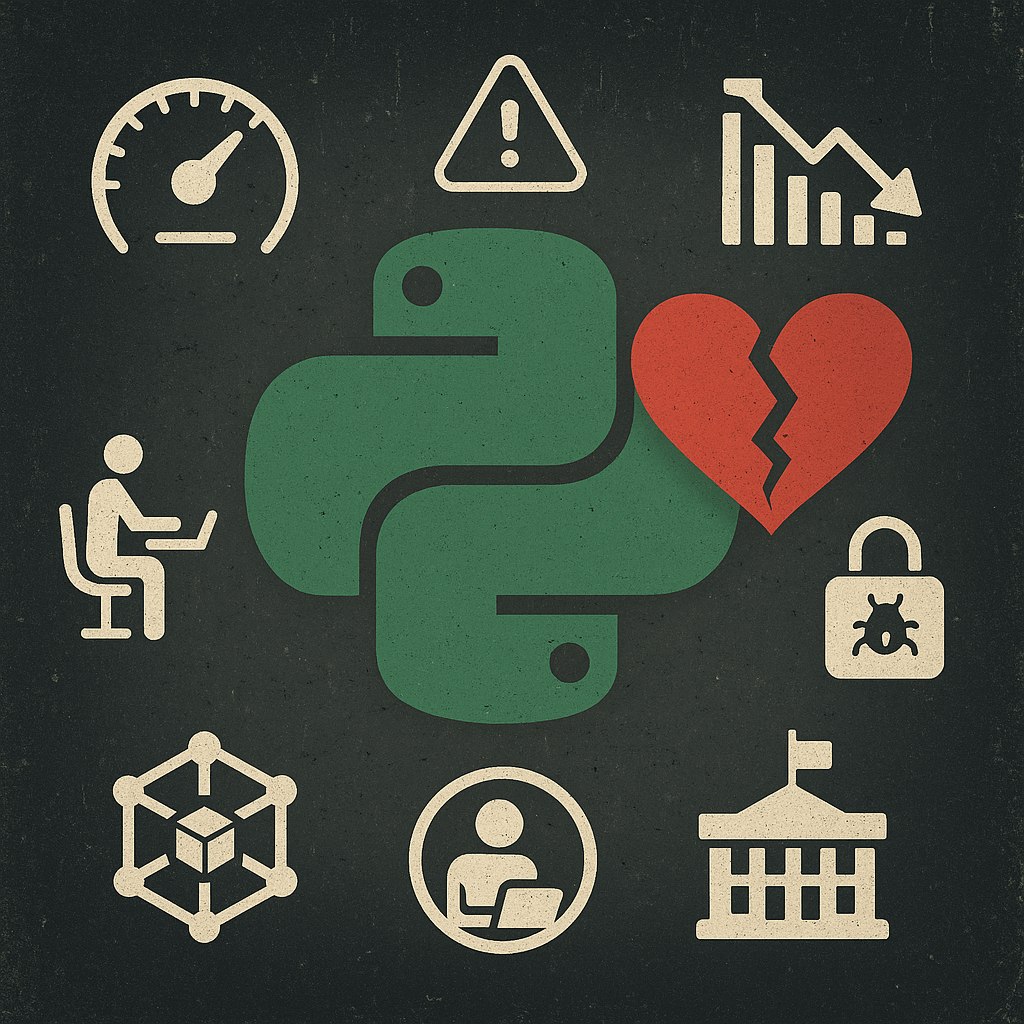
Python is still one of the most loved languages in the world—but being a Python developer in 2025? It’s… complicated. Beneath the surface of elegant syntax and powerful libraries lies a minefield of annoyances, limitations, and growing pains. Python might be great, but sometimes it really feels like being in a toxic relationship: you love it, but you’re exhausted.
Let’s break down why, in 2025, it kind of sucks to be a Python developer.
1. The Async/Await Hellscape
Python tried to be asynchronous, bless its heart. But let’s be honest—async in Python still feels like duct taping a rocket to a bicycle.
In 2025, with high-performance applications dominating everything from AI pipelines to edge computing, Python’s half-baked async support is downright painful. You’re still juggling asyncio, trio, and curio, debugging cryptic stack traces, and praying third-party libraries don’t block the event loop.
Meanwhile, JavaScript and Rust developers are sipping lattes and enjoying their sleek, well-integrated async runtimes. You? You’re wondering why await is still somehow slower than a for-loop in C.
2. Python is Slow. Still. Forever.
Yes, yes, we all know Python was never meant to be fast. But damn, it’s 2025.
We have AI that writes code, robots delivering pizzas, and quantum computing prototypes. And yet your Pandas dataframe still takes 10 seconds to load on a MacBook with 64GB RAM. Why? Because Python is still chained to the sluggish CPython interpreter.
Sure, there’s PyPy, Cython, Numba, and Mojo. But let’s face it: if you need speed, you're bolting on a Frankenstein’s monster of hacks, wrappers, and compiled extensions. It’s duct-tape engineering, not elegance.
3. The Dependency Jungle
Nothing screams developer burnout like debugging a pip install issue that leads to a six-hour rabbit hole. In 2025, Python’s package ecosystem is still a fragile mess.
You’ve got pip, pipx, pipenv, poetry, conda, venv, and some guy on Stack Overflow insisting you install everything globally. Half the packages are poorly maintained, and the other half break your entire environment the second you update them.
Oh, and don't forget the wheel vs source install issue. Or the infamous "can't build wheels for XYZ" error message with zero actionable insight.
4. Python is Great for Prototyping… and Only Prototyping
Python is the duct tape of programming. It’s great for MVPs, quick scripts, and AI prototypes. But production? Not so much.
By the time your Python project grows past 10k lines, you're dealing with:
- No type safety (unless you enforce mypy, which still misses stuff),
- Awful performance under load,
- Inconsistent logging and error handling,
- And a growing desire to rewrite the whole thing in Go or Rust.
It's like building a house out of LEGO: cute at first, until someone leans on a wall and the whole thing collapses.
5. Typing: An Identity Crisis in Progress
Static typing in Python is like an awkward teenager trying to grow a beard—it’s patchy, inconsistent, and just plain weird.
In 2025, Python 3.12 and beyond have improved type hinting… a bit. But developers are still forced to work with a mixture of old-school duck typing and barely-supported modern typing. Third-party libraries ignore types. You’re still Googling the difference between TypeVar, Generic, and Protocol, and nothing ever works the first time with mypy.
Meanwhile, TypeScript and Kotlin laugh from the sidelines, offering real developer ergonomics.
6. Global Interpreter Lock (GIL): The Ball and Chain
Let’s not forget Python’s GIL. Yes, they’ve talked about removing it. Yes, there’s a GIL-less fork. But most of the world still runs on the GIL like it’s a core dependency.
If you're trying to do anything CPU-bound in parallel, you're out of luck. Python laughs in your face and spins up multiple processes instead. Good luck debugging those.
So while other languages are squeezing every ounce of performance out of multicore systems, you’re here writing yet another multiprocessing wrapper.
7. AI Is Replacing the Easy Wins
One of the main reasons Python exploded in the 2010s and 2020s was its dominance in machine learning. But in 2025, that edge is fading.
AutoML platforms, low-code AI builders, and ChatGPT plugins have automated most of what junior Python ML engineers used to do. You don't write your own sklearn pipelines anymore—your product manager clicks a button and gets an API.
The Python job market? Still healthy, but you’d better be doing something more than just “gluing together some Jupyter notebooks.” You need devops skills, MLOps knowledge, and the ability to deploy scalable infrastructure—or you're just an expensive notebook babysitter.
8. Python Web Dev Is the Third-Class Citizen Now
Django and Flask were great. Were.
In 2025, backend dev is dominated by Node (with Deno), Rust (with Axum), and even Go. Python frameworks are clunky, outdated, and slow in comparison. Every other language gets sleek modern dev tools; you get... a 600-line settings.py file that nobody understands.
You spend more time fighting deployment configurations than writing actual features. And yes, async Django is a thing now—but try explaining asgiref to a new hire and watch their soul leave their body.
9. You're Not a Real Dev (To Some People)
It’s 2025, and the “Python is not a real programming language” jokes are still here.
Because it’s readable. Because it uses whitespace. Because you can learn it in two weeks. Because TikTok tutorials show people scraping websites with three lines of code. Python developers still get treated like script kiddies compared to their C++ or Rust counterparts.
Want to feel respected? Better learn a language that throws segmentation faults just to prove it’s “serious.”
10. You Love It… But You Hate It
Here's the real kicker.
Despite everything—despite the broken environments, the GIL, the speed issues, and the ugly deployment pipelines—you still use Python. You still love the syntax. You still reach for it when you need to build something fast.
That’s what makes it hurt the most.
Python is the toxic ex you keep coming back to. Because nothing else feels quite as good in the moment. But after every crash, every crash, every cryptic error message—you ask yourself: why do I keep doing this?
Also read: How Top Agencies Nail Onboarding
Final Thoughts
Being a Python developer in 2025 is like being a chef in a kitchen full of amazing ingredients—but the oven only works at 100 degrees, the knives are dull, and every time you slice something, the lights flicker.
Yes, you can still build incredible things with Python. But compared to what’s possible now with other languages and stacks, you’re working twice as hard for half the result.
So does it suck to be a Python developer in 2025? Maybe not completely. But it sure ain’t what it used to be.
Thank you for reading this article. If you're looking for a professional software company in USA then leave a message in comment box!
About the Creator
Alicia Black
Alicia Black is a dynamic digital marketing professional with a strong foundation in web and app development, email marketing, content creation, and AI-driven strategy.
Keep reading
More stories from Alicia Black and writers in 01 and other communities.
Jeff Bezos' head-turning then-and-now photos from high schooler to Amazon billionaire
The businessman and entrepreneur has undergone a huge transformation over the years Looking at Jeff Bezos today, with his $252 billion fortune and life of luxury, it's difficult to imagine him as a regular child, let alone as a short-order cook at McDonald's.
By Dena Falken Esq7 days ago in 01
Winter Clothing: Purpose, Materials, and Modern Use
Winter clothing plays an essential role in human adaptation to cold environments. Across history, people have relied on specialized garments to protect themselves from low temperatures, wind, and moisture. While early winter clothing focused almost entirely on survival, modern cold-weather wear has developed into a balance of function, comfort, and everyday practicality. Today, winter clothing is shaped by advances in materials, changes in lifestyle, and evolving expectations of durability and versatility.
By charliesamuel7 days ago in 01
Silver Screen Magic with Mae West
American actress and singer Mae West became a popular film actress during the Great Depression. She started entertaining in vaudeville, then performed on Broadway, and finally went to Hollywood. She signed up with Paramount Pictures and made her debut in the 1932 film “Night After Night.” She also starred in musicals, comedies, and crime dramas. The American Film Institute named her one of the best classic Hollywood actresses.
By Rasma Raisters6 days ago in Geeks




Comments
There are no comments for this story
Be the first to respond and start the conversation.