
The Global Neuromorphic Chip Market: Architecting the Future of Cognitive Computing
Advancements in Brain-Inspired Processors Driving Energy-Efficient AI and Intelligent Systems

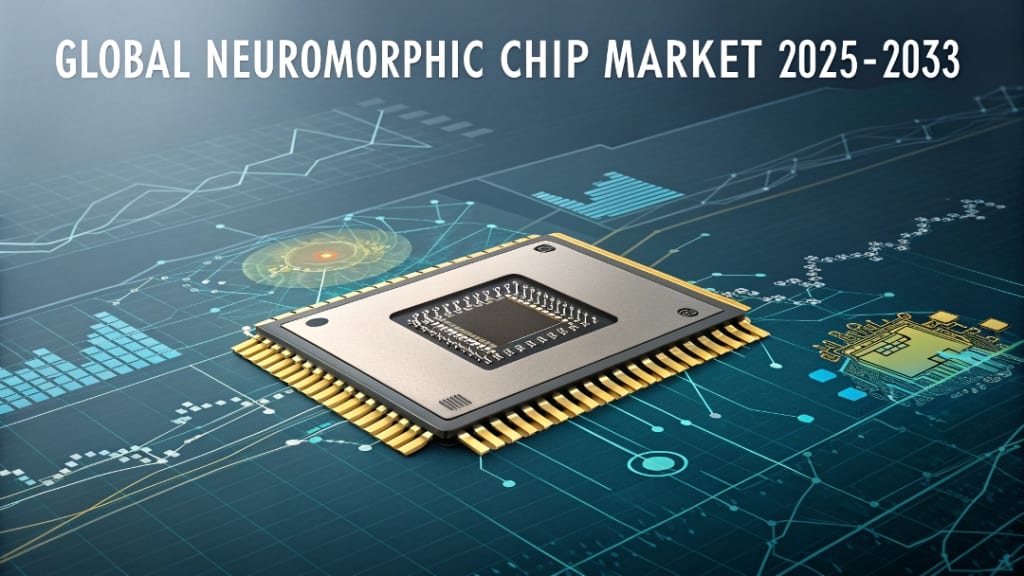
The trajectory of modern computing is currently hitting a physical and thermodynamic wall. For over seven decades, the semiconductor industry has been governed by the Von Neumann architecture—a system where processing and memory are separate entities connected by a bus. As we enter the era of ubiquitous Artificial Intelligence (AI) and the Internet of Things (IoT), this "bottleneck" is becoming unsustainable. The Neuromorphic Chip Market has emerged as the most promising solution to this crisis, offering a radical departure from traditional binary logic in favor of "brain-inspired" silicon.
By mimicking the biological structures of the human brain—specifically neurons and synapses—neuromorphic engineering seeks to create hardware that is not only faster but orders of magnitude more energy-efficient than current GPUs and TPUs. This report explores the technological foundations, market dynamics, and future outlook of this transformative industry.
1. The Technological Paradigm: From Bits to Spikes
At the heart of the neuromorphic revolution is a shift in how information is encoded. Traditional processors use a global clock to synchronize operations, processing data in continuous streams of ones and zeros. In contrast, neuromorphic systems utilize Spiking Neural Networks (SNNs).
Event-Based Processing
Unlike standard chips that are "always on," neuromorphic circuits are event-driven. A "silicon neuron" only fires when it receives a specific signal, or "spike," from another neuron. This mirrors the human brain’s efficiency; our brains do not consume maximum power to perform a simple task. They only activate the specific neural pathways required for the input.
In-Memory Computing
One of the greatest drains on energy in modern data centers is the movement of data between the RAM and the CPU. Neuromorphic designs integrate memory and processing within the same physical architecture. By using technologies like ReRAM (Resistive Random Access Memory) or Memristors, these chips can store "weights" (the strength of a connection) directly within the processing element, effectively eliminating the Von Neumann bottleneck.
2. Market Drivers: Why Now?
The surge in interest and investment in this sector is driven by three converging trends: the explosion of Edge AI, the sustainability crisis in data centers, and the limitations of Moore’s Law.
The Rise of Edge Intelligence
As we deploy billions of sensors in smart cities, autonomous vehicles, and wearable medical devices, we cannot rely on the cloud for real-time decision-making. Latency—the time it takes for data to travel to a server and back—can be a matter of life and death in an autonomous car. Neuromorphic chips allow for complex AI inference to happen locally on the device with a power budget measured in milliwatts rather than watts.
The Energy Imperative
Training a single large language model (LLM) can consume as much electricity as several hundred households use in a year. As AI scales, the carbon footprint of traditional silicon becomes a geopolitical and environmental liability. Neuromorphic hardware offers a path toward "Green AI," potentially reducing the energy cost of neural network inference by a factor of $100\times$ to $1000\times$.
3. Competitive Landscape and Key Players
The market is currently a blend of legacy semiconductor giants, academic spin-offs, and venture-backed startups. Each is taking a slightly different approach to "silicon brain" design.
Intel (Loihi 2): Intel has been a pioneer with its Loihi research chips. Loihi 2 features up to 128 million neurons per cluster and supports programmable "learning rules," allowing the chip to adapt to new data after it has been deployed.
IBM (TrueNorth & NorthPole): IBM’s TrueNorth was one of the first large-scale neuromorphic systems. Their newer NorthPole architecture further blurs the line between memory and logic, achieving record-breaking efficiency in image recognition tasks.
BrainChip (Akida): As one of the few publicly traded neuromorphic companies, BrainChip has focused on commercializing the technology for the "Edge." Their Akida processor is designed for sensor-level AI, such as keyword spotting or gustatory (smell) sensing.
SynSense: Focusing on ultra-low-power vision and audio processing, SynSense targets the consumer electronics and IoT markets, where battery life is the primary constraint.
4. Sector-Specific Applications
The versatility of brain-inspired computing allows it to penetrate various high-growth industries.
Autonomous Systems and Robotics
In robotics, the "Sense-Act" loop must be as tight as possible. Neuromorphic chips, paired with event-based cameras (Dynamic Vision Sensors), allow robots to perceive motion and react to obstacles with microsecond latency. Because these cameras only record changes in light rather than full frames, the data load is significantly reduced, allowing for faster processing.
Healthcare and Bio-Sensing
Wearable devices that monitor EEGs or EKGs require continuous, low-power analysis. A neuromorphic co-processor can "listen" for anomalies in heart rhythms or brain waves while the rest of the system sleeps, drastically extending the device's battery life and providing instant alerts to users.
Aerospace and Defense
In satellite technology, power is the most precious resource. Neuromorphic systems can perform sophisticated image analysis for Earth observation or debris tracking on-orbit, reducing the need to beam massive amounts of raw data back to ground stations.
5. Challenges and Roadblocks
Despite the clear advantages, the path to mass-market adoption is fraught with challenges.
The Software Gap
The most significant hurdle is the lack of a mature software ecosystem. Most AI developers are trained in frameworks like PyTorch or TensorFlow, which are designed for traditional backpropagation on GPUs. Programming a Spiking Neural Network (SNN) requires a different mathematical approach. Until there are seamless "compilers" that can convert standard deep learning models into spiking models, adoption will be limited to specialists.
Scalability and Manufacturing
Fabricating chips that use non-traditional components like memristors at scale is difficult. While standard CMOS (Complementary Metal-Oxide-Semiconductor) processes can be used to simulate neuromorphic functions, the true efficiency gains will come from "Beyond CMOS" materials that are still largely in the R&D phase.
6. The Road Ahead: 2025-2030
The next five years will likely see the transition of neuromorphic technology from research labs to specialized commercial niches. We anticipate the following milestones:
Hybrid Architectures: The first wave of consumer adoption will likely involve "hybrid" chips—where a traditional CPU manages general logic and a neuromorphic core handles "always-on" sensory tasks (vision, voice, touch).
Standardization of SNNs: As organizations like the Neurotech Alliance work on standardizing APIs, we will see a surge in third-party software tools, lowering the barrier to entry for developers.
Expansion into LLM Inference: Research is already underway to see if the "attention" mechanisms of Transformers can be mapped onto spiking architectures. If successful, this could revolutionize how we interact with mobile AI assistants.
7. Conclusion
The Neuromorphic Chip Market is not just a sub-sector of the semiconductor industry; it is the vanguard of a new era in cognitive engineering. By looking to the human brain—the most efficient computer in the known universe—as a blueprint, engineers are building the foundation for an autonomous, intelligent, and energy-conscious future. While the transition from binary to spiking logic will take time, the economic and environmental pressures of the AI age make the success of neuromorphic computing not just a possibility, but a necessity. The "silicon brain" is no longer a matter of science fiction; it is the next logical step in the evolution of machine intelligence.
About the Creator
Rahul Pal
Market research professional with expertise in analyzing trends, consumer behavior, and market dynamics. Skilled in delivering actionable insights to support strategic decision-making and drive business growth across diverse industries.
From Requests to Risk: How Modern API Threat Detection Finds What Scanners Miss
APIs are the backbone of modern applications, powering cloud services, mobile apps, and partner integrations. They enable seamless data exchange, automated workflows, and real-time communication across systems. However, this connectivity also expands the attack surface, making APIs a prime target for malicious actors. Traditional security scanners, which rely heavily on signatures and static checks, often fail to detect sophisticated or subtle API threats.
By Sam Bishop3 days ago in 01
Latest iPhone Rumors Explained: iPhone 18 Pro and Pro Max Leaks Breakdown
A lot of recent iPhone chatter has drifted away from what most people actually buy: the Pro Max. Instead, we’ve been buried in talk about the next-gen iPhone Air or the long-rumored folding iPhone. And look, those devices are interesting… but let’s be honest. Most people either won’t buy them, or won’t stick with them long term.
By Info Post Gateabout 7 hours ago in 01



Comments
There are no comments for this story
Be the first to respond and start the conversation.