


There are moments in life when writing stops being an art and becomes a necessity. Not something you choose to do, but something you do because the alternative—silence—is unbearable. In those moments, writing is not about grammar, structure, or audience. It is about survival.
This kind of writing does not begin with inspiration. It begins with pressure.
It begins when emotions pile up with nowhere to go. When thoughts circle the mind like trapped birds. When pain has no visible wound, yet feels heavier than anything physical. Writing, then, becomes a release valve—a way to let something escape before it consumes you from the inside.
Long before writing became a profession or a platform, it was a tool for endurance. Humans have always written in order to survive what they could not escape. Prisoners carved words into walls. Exiles carried stories across borders when they could carry nothing else. Survivors of wars, plagues, and personal tragedies wrote to remind themselves they were still human.
Writing has always been a quiet form of resistance against disappearing.
In everyday life, survival writing often looks ordinary. A journal hidden in a drawer. Notes typed late at night when sleep refuses to come. Poems written on a phone and deleted moments later. These words are rarely meant for readers. They exist for the writer alone. Yet they may be the most honest words a person ever writes.
Because when no one is watching, the truth finally speaks.
The blank page has a rare quality: it does not judge. It does not interrupt. It does not tell you to be strong or grateful or patient. It does not compare your pain to someone else’s. It waits. And in that waiting, it gives permission—to be angry, afraid, confused, broken, hopeful, all at once.
Many people believe writing requires clarity. In reality, writing creates clarity. You don’t write because you understand what you’re feeling. You write because you don’t.
Trauma, anxiety, grief, and depression often live in fragments. Images without context. Emotions without names. Memories that surface at inconvenient times. Writing gathers those fragments and gives them shape. It turns chaos into narrative, and narrative into something the mind can hold.
This shift is powerful.
Psychologists often note that trauma keeps people trapped in the present tense—reliving rather than remembering. Writing changes that tense. When you write, this happened to me, instead of this is happening to me, you reclaim a small but vital sense of control. You move from being trapped inside the experience to standing just outside it, observing.
That distance can be the difference between drowning and staying afloat.
Throughout history, some of the most enduring texts were never intended to endure. Anne Frank did not write for fame or legacy; she wrote to survive confinement and fear. Soldiers wrote letters home not knowing if they would be read, but needing to remember who they were beyond the battlefield. Enslaved people preserved identity and memory through stories when writing was forbidden, proving that survival writing does not always need ink—it only needs voice.
Even now, in quieter forms of suffering, writing continues this work.
People write through invisible battles: panic attacks that arrive without warning, grief that lingers long after condolences fade, loneliness that exists even in crowded rooms. They write through illness, heartbreak, displacement, and identity crises. Sometimes the writing is repetitive. Sometimes it is angry. Sometimes it makes no sense at all.
That doesn’t mean it’s bad writing. It means it’s honest writing.
There is a dangerous myth that pain must be transformed into something beautiful to be meaningful. But survival writing is not obligated to be elegant. It does not exist to impress. It exists to hold—to hold memory, fear, confusion, and the fragile version of the self that is trying to make it through another day.
Some days, survival writing is nothing more than a list: I woke up. I ate something. I went outside. I survived.
That counts.
Other days, it is rage without punctuation, sentences that collapse under their own weight, words that repeat because the feeling refuses to leave. That counts too. Survival writing is not about polish; it is about permission.
Permission to be unfinished. Permission to be honest. Permission to exist without explanation.
And sometimes—often unexpectedly—survival writing becomes connection. A private pain, once shared, becomes a mirror for someone else. A stranger reads your words and thinks, I thought I was alone. In that moment, writing transcends the page. One person’s survival becomes another person’s hope.
This is why platforms like Vocal.media matter. They allow personal stories—once hidden in notebooks or notes apps—to find community. Not every story will go viral. Not every piece will trend. But impact is not measured only in numbers. Sometimes impact is a single reader feeling seen.
Writing as survival also evolves. What begins as a cry can become reflection. What begins as a wound can become a map. Years later, you may reread something you once wrote in darkness and realize it carried you further than you knew.
But even if no transformation occurs—even if the pain remains—writing has still done its job. It has said: I was here. I felt this. I did not vanish quietly.
In a world that moves too fast, forgets too easily, and often demands resilience without rest, writing is a way to slow time. To say, Wait. Listen. This matters.
If you are writing because you don’t know what else to do, that is enough. You don’t need to call yourself a writer. You don’t need confidence or discipline or an audience. You are practicing one of the oldest human survival skills.
And sometimes, surviving—one word at a time—is the bravest story anyone can tell.
About the Creator
Early March 2026: 4 Goals Accomplished
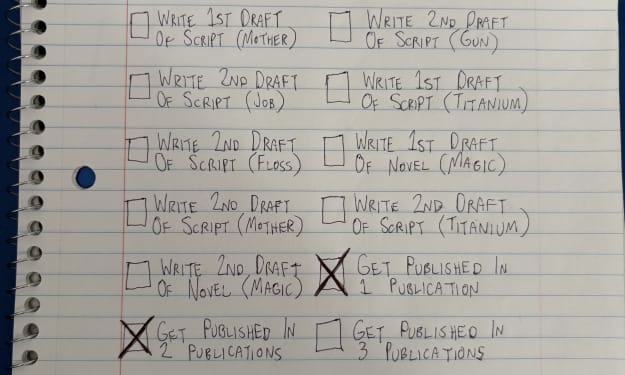
It's early March and I've now accomplished my 4th writing goal for the year of 2026. Before diving into the behind-the-scenes of it... why not tell you up front what that accomplishment was? I was published in a 2nd publication for this year. Published in Helix Literary Magazine out of Central Connecticut State University. You can read it for free right now!
By Stephen Kramer Avitabile7 days ago in Writers
100 Top Stories and Other Accidents
On March 9th, an entry I published for the "Everyone Is Acting Normally" Challenge, Silken Chains, was awarded a Top Story. I was delighted. For various reasons. It is one of my best-written stories, and it helped me achieve another Vocal milestone.
By Paul Stewartabout 13 hours ago in Writers



Comments
There are no comments for this story
Be the first to respond and start the conversation.