
What Innovations Are Available in Locking Variable Angle Plate Designs?
Innovations For Variable Angle Plate

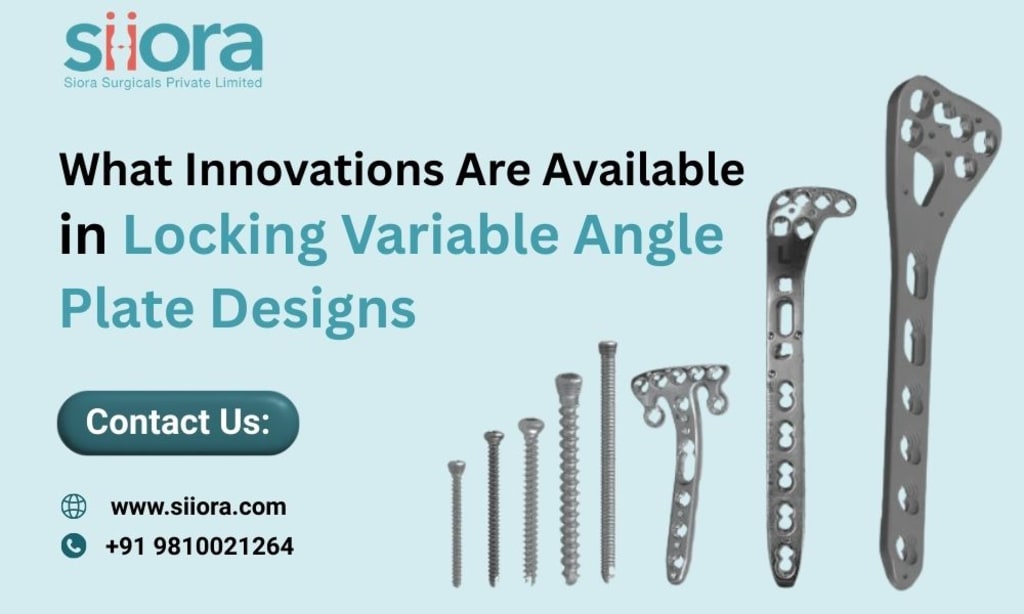
Orthopedic implants have come a long way over the past few decades, and one area seeing remarkable progress is the design of variable angle locking plates. These plates play a crucial role in the surgical fixation of bone fractures, especially in complex or anatomically challenging locations. What’s new and exciting is how recent innovations are making these devices smarter, more adaptable, and more surgeon-friendly than ever.
The Evolution of Locking Plates
Locking plates aren't new. They’ve been used for years to stabilize broken bones, particularly when traditional screw-and-plate systems fall short. Unlike conventional plates, locking plates don't rely solely on the friction between the bone and the plate for stability. Instead, screws lock into the plate itself, forming a rigid fixed-angle construct. This allows better performance in osteoporotic bone and comminuted fractures.
The real innovation came when engineers introduced variable-angle technology. This allowed surgeons to insert screws at different angles, typically within a 15° to 30° cone instead of being locked into a fixed trajectory. This flexibility has been a game-changer, especially for fractures in areas with complex anatomy like the distal radius, proximal humerus, or pelvis.
Precision Meets Flexibility
Recent designs have significantly enhanced the mechanical interface between the screw head and the plate. One key advancement is the development of threaded cone or helical locking mechanisms, which provide strong angular stability while allowing for adjustable screw direction. These mechanisms ensure that once the screw is set within the chosen angle, it remains securely locked, even under mechanical stress.
Another critical improvement is the hybrid hole design. Newer plates often feature a combination of locking and compression holes, giving surgeons the ability to use both techniques in one construct. This means they can compress the fracture line while still locking the screws at variable angles, which improves healing outcomes and structural integrity.
Materials Matter
Material science has also contributed to the latest innovations. Titanium and titanium alloys are still popular for their biocompatibility and strength-to-weight ratio. However, more attention is being given to surface treatments and coatings that reduce the risk of infection and improve osseointegration. Some designs now include anodized surfaces or antimicrobial coatings, enhancing the implant’s interaction with biological tissue and reducing complications.
Surgeon-Centered Design
Innovations aren’t just about the hardware; they’re also about usability. New locking VA plates often come with intuitive targeting guides and instrument sets that streamline the surgical workflow. This is critical in high-stress operating environments where time and precision matter. By reducing intraoperative guesswork, these designs minimize the risk of misplacement and post-op complications.
Some systems also incorporate radiolucent targeting arms or navigation compatibility, enabling better alignment and real-time imaging support. This has been particularly valuable in minimally invasive procedures, where visibility is limited.
Customization and Patient-Specific Solutions
One of the most forward-thinking trends in VA plate design is the push toward customization. With advances in 3D printing and pre-operative imaging, patient-specific plates are becoming more common. These are tailored to an individual’s anatomy, providing a better fit, reducing soft tissue irritation, and potentially improving outcomes. While not yet mainstream for all procedures, this approach is gaining traction, especially in reconstructive or revision surgeries.
Closing Thoughts
Locking variable-angle plate designs are evolving fast, driven by a blend of biomechanical insight, material science, and surgical ergonomics. The focus is shifting from one-size-fits-all to systems that adapt to the unique challenges of each fracture and patient. These innovations aren’t just technical upgrades, they represent a smarter, more responsive approach to fracture fixation that puts patient recovery and surgeon performance at the center of the design.
The next wave? Expect to see more integration of digital technologies, including smart orthopedic implants capable of monitoring load, healing progress, or even infection markers. The future of orthopedic hardware isn’t just solid, it’s intelligent.
About the Creator
Siora Surgicals
With over 3 decades of experience and a global presence in 50+ countries, Siora Surgicals Pvt. Ltd. is proud to be counted among the leading orthopedic device manufacturing companies.
Keep reading
More stories from Siora Surgicals and writers in Writers and other communities.
The Future of Fixation: Exploring Advanced Maxillofacial Implants
Maxillofacial surgery has changed significantly over the last two decades. Earlier, fracture management and reconstructive procedures were more invasive, recovery was longer, and implant options were limited. Today, surgeons have access to advanced maxillofacial implants that are more precise, lighter, and biologically friendly. These developments are shaping the future of fixation in facial trauma and reconstructive surgery.
By Siora Surgicals about 14 hours ago in Writers
Difficulties Of Holidays On Vocal
Introduction Last week I had a wonderful week in Alnwick, but tried to keep up on Vocal, although my time was less than I normally have, plus a little more difficult because I was using a ten-year-old laptop with a faulty keyboard (the space bar does not always register, meaning I have to keep going back to separate words).
By Mike Singleton 💜 Mikeydred 2 days ago in Writers
The BAFTA Awards
By now, in a stunning departure from recent years, most of the world is aware of what happened at the BAFTA film awards. Social Media Headlines will tell you the bare bones: that John Davidson, a Tourette's Syndrome advocate, shouted a racial slur at two Actors of Colour, Michael B Jordan and Delroy Lindo.
By Natasja Rose6 days ago in Psyche




Comments
There are no comments for this story
Be the first to respond and start the conversation.