
Want to Space Your Poetry?
You're Gonna Love This

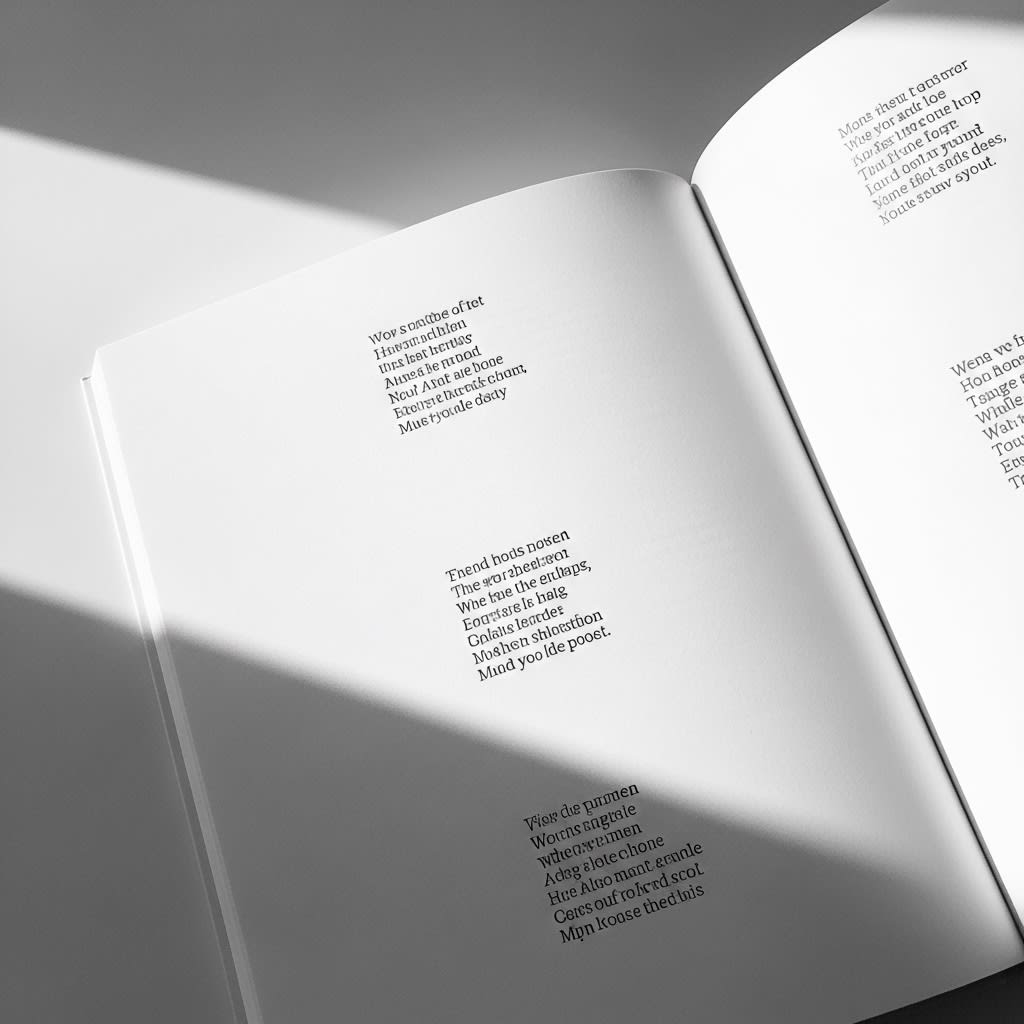
How Learning to “Leave Space” Can Save Your Writing, Your Heart, and Your Art
Poetry isn’t always about the words you put on the page.
Sometimes, it’s about the ones you don’t.
Sometimes, silence speaks louder than metaphors.
Sometimes, the gap between two lines carries more truth than a paragraph.
And sometimes, the breath you leave between stanzas is the only place where your reader can finally hear themselves.
But nobody tells you this when you start writing.
We’re taught to chase the perfect sentence, the perfect emotion, the perfect line.
We’re told to fill every corner of the page with meaning — as if white space is a failure, a lack, an emptiness we must cover.
Yet every poet eventually learns a secret:
Space is not emptiness.
Space is architecture.
Space is control.
Space is where your poem becomes alive.
Today, let’s talk about this secret art — not just for the poem on the page, but for the poem you’re living.
1. White Space Is the Poem’s Pulse
A poem without space is like a heartbeat without rhythm:
flat, suffocating, unbreathing.
When you space your poetry — literally shifting lines, breaking verses, opening the page — you create a pulse. Each break becomes a heartbeat. Each pause becomes a moment where the reader leans forward, waiting.
You’re not just writing words.
You’re conducting breath.
You’re telling your reader:
“Slow down.
Feel this with me.”
The page is no longer a surface.
It becomes a lung.
And you decide where the poem inhales —
and where it exhales.
2. Space Builds Emotion You Can’t Write With Words
Some emotions don’t want metaphors.
Some griefs refuse to be described.
Some loves become smaller when you try to define them.
But space —
space understands.
Look at this:
I loved you.
I lost you.
And I learned to live again.
Now look at this:
I loved you.
I lost you.
And somehow…
slowly…
quietly…
I learned to live again.
The second one breathes.
It lets the reader walk through it.
It feels real, because real healing is slow and spacious and uneven.
Space lets emotion stretch.
It lets meaning settle.
It gives truth room to be heard.
3. Space Is Respect — For Your Reader and Yourself
Poets often fear silence.
They fear not saying enough.
They fear not explaining.
But real writing — brave writing — respects the reader’s ability to feel without being told.
Space says:
“I trust you.”
Trust to imagine.
Trust to interpret.
Trust to experience the poem without being dragged through it.
And there’s another kind of respect hidden in this:
Space respects you.
You don’t have to bleed every detail onto the page.
You don’t have to write everything you felt.
You can leave things unsaid.
Silence is also a form of self-care.
4. Space Teaches You Things About Yourself You Didn’t Know
What you choose to leave out
reveals more about your truth
than what you choose to put in.
Spacing makes you:
ask yourself what matters,
cut what doesn’t,
and see what remains.
You begin to understand that your own heart has architecture.
Some rooms are crowded.
Some rooms are locked.
Some rooms need windows.
And your poem — that tiny universe you’re building — teaches you how to design those rooms with intention.
5. Space Is Also for Your Life, Not Just Your Poem
Here’s where it gets real.
The way you write mirrors the way you live.
If your poems feel crowded,
your life probably does too.
If your stanzas rush forward breathlessly,
maybe you’re rushing in your real world as well.
If you’re scared to leave white space in your writing,
maybe you’re scared to leave white space in your day:
rest, quiet, boundaries, solitude, recovery.
Learning to space your poetry teaches you the art of stepping back —
letting moments breathe,
letting emotions arrive on their own time,
letting answers come without squeezing them out.
Spacing your poem is practicing how to live with pauses instead of pressure.
6. Space Doesn’t Make Your Poem Empty — It Makes It Powerful
People think adding space means adding less.
But good spacing doesn’t reduce power.
It concentrates it.
It sharpens meaning.
It amplifies emotion.
It heightens impact.
In a world where everything is rushed, crowded, noisy, and endless…
A pause is radical.
A breath is rebellion.
Silence is strength.
Your poem doesn’t need more words.
It needs more intention.
7. Space Makes Your Poem Look Like Poetry
There’s something nobody talks about:
Readers don’t just read poems.
They see them.
Your poem has a shape, a silhouette, a presence on the page.
Spacing creates:
movement
musicality
tension
softness
surprise
elegance
identity
The right spacing can make a simple poem unforgettable.
The wrong spacing can make a brilliant poem look chaotic.
Poetry is as visual as it is verbal.
The white space is your canvas.
8. Let Everything Breathe — Including You
At the end of it all, here’s the truth:
Poetry doesn’t thrive in crowded places.
Neither do you.
Leave room.
On the page.
In your heart.
In your day.
In your life.
Space is not where your poem disappears.
It’s where your poem begins
to finally be heard.
And maybe —
just maybe —
that’s where you begin to be heard too.
About the Creator
Alexander Mind
Latest Stories
Keep reading
More stories from Alexander Mind and writers in Writers and other communities.
This Was My Best Fucking Piece (And It Still Lost)
There’s a particular kind of heartbreak that only writers know— the moment you hit “submit,” whisper a shaky prayer to the literary gods, and then, days or weeks later, open an email that starts with the word “Unfortunately.”
By Alexander Mind2 months ago in Writers
Why You Should Write Love Letters to Yourself
The term of endearment hyperbole, ‘I Love You to the Moon and Back’, which I often tell my daughter, with the additional elongated: ‘and back again, beyond infinity’, is believed to have originated from Sam McBratney’s 1994 children’s book: ‘Guess How Much I Love You’.
By Chantal Christie Weissa day ago in Writers
Silver Screen Magic with Mae West
American actress and singer Mae West became a popular film actress during the Great Depression. She started entertaining in vaudeville, then performed on Broadway, and finally went to Hollywood. She signed up with Paramount Pictures and made her debut in the 1932 film “Night After Night.” She also starred in musicals, comedies, and crime dramas. The American Film Institute named her one of the best classic Hollywood actresses.
By Rasma Raisters4 days ago in Geeks




Comments
There are no comments for this story
Be the first to respond and start the conversation.