

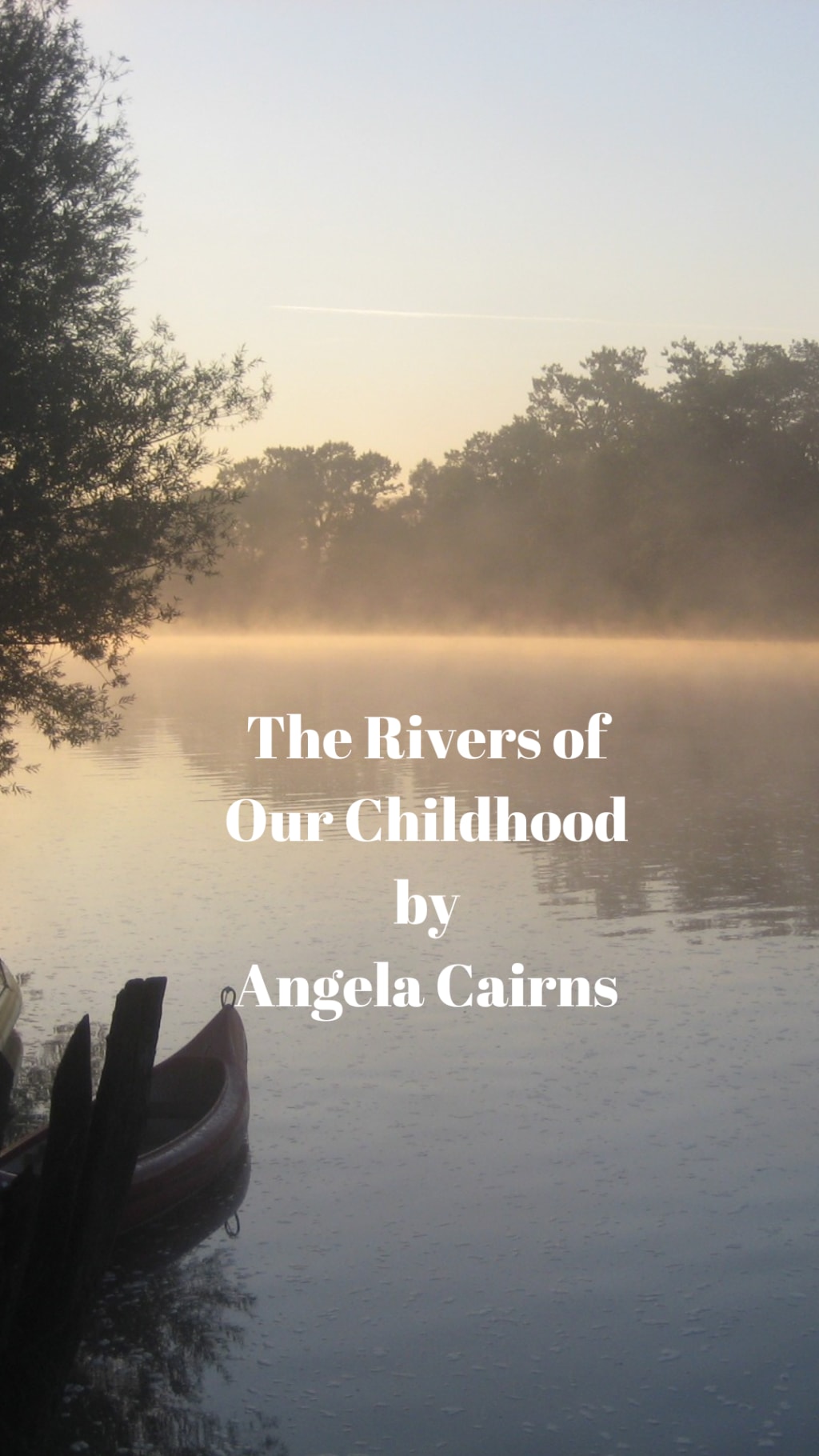
The Rivers of Our Childhood
It is not his death that causes me pain, far from it. I find his demise and the manner of it rather satisfying.
I remember that evening, sultry and sticky. The oak-panelled ballroom was full of people, his unquestioning acolytes - braying, self-satisfied men and their complacent women.
The fiddler played a rising, frenzied reel. My father, red-faced and sweating, hair plastered to his forehead, made a comical gesture, arms flung out, shock writ large on his florid face. The dancers in his set laughed along, then realised that death had come for him and threw his earthly remains onto the floor with a resounding thud.
Contorted, pathetic, and defeated, his kilt revealed his leaden tree trunk thighs and more.
Music faltered raggedly, and dancing ceased in slow motion as if stopped by a spreading wave of paralysis. Husbands averted their spouses’ gaze and hugged them into itchy, suit-clad shoulders. Hushed whispers began, accompanied by futile, coy screams, as hands flew to mouths. His body lay a gaudy gash on the wooden floor.
I slipped quietly into the velvet night to my special place, and the child inside me sighed with relief.
That same red face had reared over me in anger, an engorged artery pulsing in his neck and spittle landing on my cheeks many times as he berated me, “Liar, thief, weakling. I’m ashamed of you.”
Tiny and blonde, I backed away, but he would grab my hand, and his riding crop slashed my pink hand viciously, tattooing the soft skin with angry red welts.
“Don’t cry!” He warned. “Take your punishment like a man.”
I held my tears and fled to my special place by the lake, amongst the forgotten waders and perished catch nets in the old boat shed. I wept at the injustice, and the sting of the shame burnt through me.
The child inside crouched, broken.
Mounted on a terrifying horse, I followed the hunt. His red-coated back was only visible far in the distance as he and his lathered mount flew over the ground and obstacles without check. I chose the gates and pathways, slipping into obscurity. Drawn to the front, he blooded me with a ravaged fox tail, and I was violently sick to the chorus of laughs from the pack as the warm blood dripped down my neck.
‘He's no son of mine.'
The child inside paled and withdrew.
I remember that Summer afternoon. Pastel women in hats decorated our stone terrace with their linen-suited men. I stood outside the impressionist scene in my tight-collared shirt, stifling boredom and the simmering rage of youth warring behind my passive façade.
My father clapped me on the back and said, "Come now, Juliet is waiting to speak to you."
But what did I have to say?
His arm around my shoulders compelled me, so my reluctant feet moved forward. "Take Juliet for a stroll. Show her the park. He's not much of an escort, M’dear. If only I were a few years younger."
Acquiescing, she stood, and we strolled across the rolling parkland. Her hand, glacial with indifference, froze my arm and my tongue. Chestnut hair swept off her face, showed a white neck and rounded shoulder, complexion protected by a lace parasol.
"Well?" She demanded. "Have you nothing to say for yourself? You must entertain me better than that if you wish to win my affections."
"What is there left to say? Surely everything’s agreed. The beauty of the day must speak in my place."
"Papa says you're a pale shadow of your father."
"Yes."
The child inside curled away from her casual cruelty and lacerating words.
I stared appraisingly at the well-bred lines of her profile, longing for the chiselled lines of my lover's face and his hard-muscled torso, not this conceited pink confection beside me.
"You’re staring with your mouth open!”
She waited expectantly, feeling entitled to what, I wondered.
“I could take you to my secret place.”
A well-schooled, musical trill that did not displace the peaches and cream skin disturbed only the peace.
I led her through a copse to my small blue fishing shack. Dappled sunlight reflected from the lake cast moving shadows across her dress like rents in the fabric, and chips of paint blistering from the shabby boards of my sanctuary were comforting in their familiarity.
She snapped shut her parasol and stared aghast. “This is your special place? You really are hopeless.”
Stepping forward, she twisted the catch and pulled open the door, staining the tip of her white-gloved fingers with rust and wrinkled her nose with disdain.
“Mama says I may allow you to kiss me once.”
I acknowledged my mistake; Juliet would desecrate my only sacred place.
An unexpected surge of my father’s fury washed over me.
Juliet stepped back into the gloom as I walked towards her, closing the door. Her mocking expression changed to one of uncertainty as she glanced nervously beyond my shoulder to her only escape.
I felt a satisfying rip of fabric and her futile fluttering as the carefully nurtured white neck snapped like the poor, blameless, wounded pheasants on shoot days.
I remember the sweet smell of perfume on my clothes as I discarded her and walked to my lake.
The child inside died.
It is not, after all, blood which flows through our veins. It is the river of our childhood.
About the Creator
Angela Cairns
I write books for people who love life.
The Ellie Rose Series (Touch- Amazon best-seller)
Song for Kitty-historical fiction
My shorts are published in ‘Yours’ and feature on the radio.
I regularly guest on radio, podcasts and summits.
Keep reading
More stories from writers in Writers and other communities.
Why You Should Write Love Letters to Yourself
The term of endearment hyperbole, ‘I Love You to the Moon and Back’, which I often tell my daughter, with the additional elongated: ‘and back again, beyond infinity’, is believed to have originated from Sam McBratney’s 1994 children’s book: ‘Guess How Much I Love You’.
By Chantal Christie Weissabout 23 hours ago in Writers
Silver Screen Magic with Mae West
American actress and singer Mae West became a popular film actress during the Great Depression. She started entertaining in vaudeville, then performed on Broadway, and finally went to Hollywood. She signed up with Paramount Pictures and made her debut in the 1932 film “Night After Night.” She also starred in musicals, comedies, and crime dramas. The American Film Institute named her one of the best classic Hollywood actresses.
By Rasma Raisters4 days ago in Geeks



Comments
There are no comments for this story
Be the first to respond and start the conversation.