
Echoes in the Conditioning Chamber
A Journey of Awakening in the World State
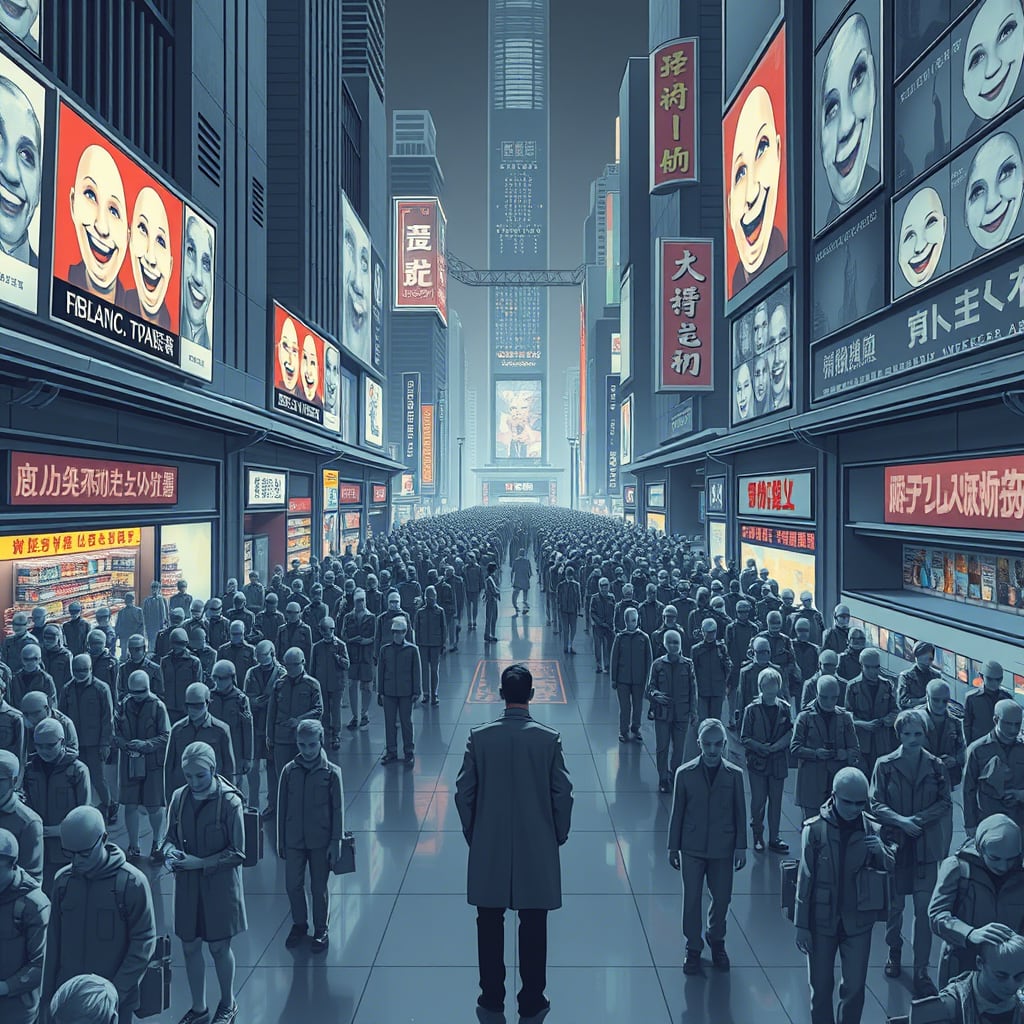
In the bright, humming expanse of the London Hatchery and Conditioning Centre, Aiden-93-Beta stood before the Hypnopaedic Supervisor’s station, his eyes vacant but obedient. Like every Beta in the World State, he was designed to obey, to perform his societal role without question, and to find pleasure in consumerism, stability, and soma-fueled happiness.
The Conditioning Chamber echoed with recorded whispers, subtly reinforcing the moral mantras of the World State. "Everyone belongs to everyone else." "A gramme is better than a damn." Aiden had heard them since infancy. They were the lullabies of his childhood, the prayer beads of his subconscious.
But Aiden was different. He didn’t know why.
It started with a glitch.
During a routine Neural Calibration, a technician mistakenly loaded a forgotten file into Aiden’s hypnopaedic program—a banned literary quote, a remnant from a pre-Fordian archive.
"Beauty is truth, truth beauty,—that is all
Ye know on earth, and all ye need to know."
The line stirred something in him. A vibration, a pulse. At first, it unsettled him. But over time, it began to haunt him, surfacing during soma-free nights, echoing through the clean corridors of the Centre, even in the synthetic intimacy of community orgies.
Truth. What was truth in a world sterilized of it?
One day, while on a standard maintenance shift, Aiden found himself in the archive wing—normally locked and shielded by access codes. But today, the door was ajar. Inside, the lights flickered over forgotten tomes, dusty cartridges, and screens showing corrupted footage from centuries past.
He stared at a digital painting of a woman crying.
Crying.
That act—useless in a society devoid of grief—moved him deeply. There was something real in her sorrow, something raw and human. He reached out, his hand trembling as it brushed the screen. A forgotten word surfaced in his memory: compassion.
The next few weeks became a blur of questions. Aiden’s performance dipped. Supervisors noticed. He refused soma during rest periods. He started avoiding community activities. One night, he confessed to his friend Mira-21-Beta.
“I think… we’re not supposed to be like this,” he whispered, afraid the walls might listen.
Mira stared at him, silent.
“You’ve been reassigned,” she said finally. “Internal Stability Unit. Tomorrow.”
The ISU—the name alone was enough to send a chill through any citizen. They dealt with ‘anomalies.’ People who began asking the wrong questions, feeling the wrong things. People like Aiden.
But Aiden didn’t show up.
Instead, he fled. Past the city’s sleek monorails and soma dispensers. Past the towering blocks of Alpha housing and the Playcentres where children were trained in promiscuity and submission. He slipped through the decaying edge of civilization, through broken fences and faded warning signs, until he reached the place few dared speak of: the Savage Reservations.
Here, he found chaos—and freedom.
The Reservation was not the romantic wild he had imagined. It was loud, rough, and full of unfiltered emotion. People mourned their dead, shouted in the streets, loved passionately and mourned bitterly. The clothes were strange. The air smelled of sweat, smoke, and rain.
A woman named Alani took him in. Her home was small and warm, filled with mismatched objects that served no efficient purpose: hand-painted dishes, a worn guitar, a carved wooden statue of a bird mid-flight.
“You’re from the other side,” she said, not unkindly.
“I don’t belong there,” Aiden replied. “But I don’t know if I belong here either.”
“You’re feeling. That’s enough for now.”
He stayed. He learned. He read forbidden texts—Shakespeare, Tolstoy, Woolf. Each word cracked the conditioning further. Alani showed him how to live with pain without numbing it, how to love without permission, how to think without recitation.
But peace was short-lived.
The World State did not tolerate defectors.
Drones found him after four months. He was brought back, sedated and silent. His fate was to be decided by the Council of Behavioral Harmony.
They offered him two choices: Reconditioning or Exile.
“Where would exile take me?” he asked.
“To an island. With others like you. Malcontents. Thinkers.”
He considered it. But as the conditioning chair loomed behind him, sterile and humming, he turned to the council members—flawless in their engineered perfection—and said:
“I would rather feel pain than feel nothing. I would rather seek truth than live in ignorance.”
They stared at him, unblinking.
He was sent to the Falkland Islands.
There, among a scattered community of poets, scientists, and wanderers, Aiden found purpose. Together, they grew food, wrote stories, debated philosophy, wept over tragedies, and celebrated small joys. They built a life that was messy, unpredictable, and heartbreakingly real.
In time, Aiden became a teacher. He told his story to newcomers, not to incite rebellion, but to preserve memory.
“Civilization offered me comfort and ignorance,” he would say. “But truth is worth the cold.”
And so, in a world that demanded uniformity and pleasure, one man dared to remember what it meant to be human.
About the Creator
Keep reading
More stories from Shiraz Ali and writers in Writers and other communities.
Public Notice
The United States now has a Ministry of Truth, just like the one where Winston Smith worked. Freedom is slavery; ignorance is strength; war is peace. We are here. You are being asked to reject the evidence your eyes and ears have given you for what they tell you. This is not a test.
By Harper Lewis7 days ago in Writers



Comments
There are no comments for this story
Be the first to respond and start the conversation.