
The Future of IT in Healthcare: Top 5 Trends That Will Transform Healthcare in 2025
The integration of AI, blockchain, IoMT, and 5G will not only improve patient outcomes but also make healthcare more accessible, secure, and efficient.

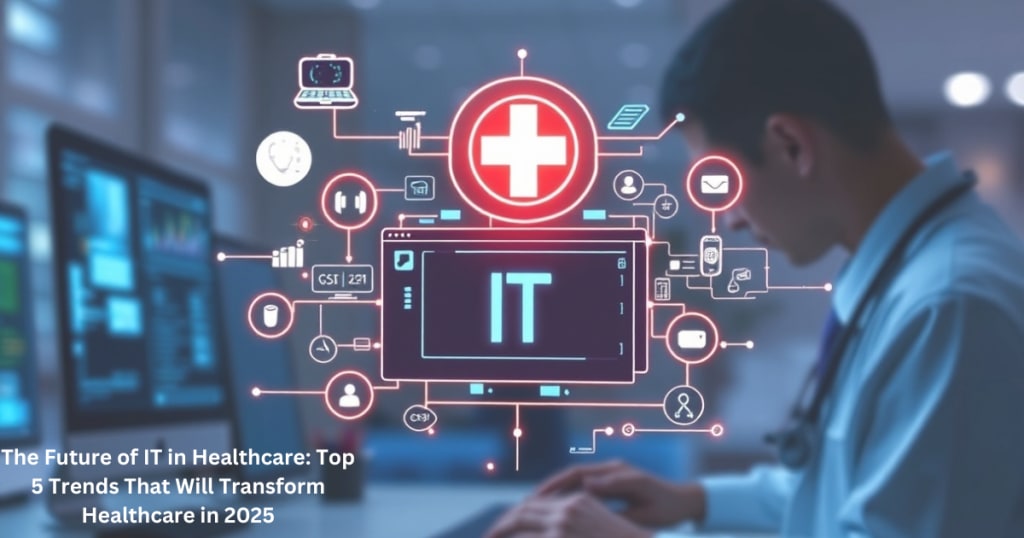
Integrating Information Technology (IT) into healthcare has steadily revolutionized the industry, improving patient outcomes, enhancing operational efficiency, and reducing costs. As we look ahead to 2025, several IT trends are poised to transform the healthcare landscape further.
Here are the top five trends that will shape the future of healthcare:
1. Artificial Intelligence (AI) and Machine Learning (ML)
AI and ML are becoming integral in healthcare for diagnostics, treatment planning, and predictive analytics. By 2025, these technologies will enhance personalized medicine, enabling more accurate diagnoses and treatment recommendations based on individual patient data. AI-driven tools will also streamline administrative tasks, allowing healthcare professionals to focus more on patient care.
Key Impact: Improved diagnostic accuracy, personalized treatment plans, and reduced administrative burden.
2. Telemedicine and Remote Care
The COVID-19 pandemic accelerated the adoption of telemedicine, and this trend will continue to grow in 2025. Advances in telehealth platforms, remote monitoring devices, and wearable technology will enable continuous patient care beyond the hospital setting. This shift will be crucial in managing chronic diseases and providing care to remote or underserved populations.
Key Impact: Increased access to healthcare, especially for chronic disease management and remote populations.
3. Blockchain for Health Data Security
The need for secure and transparent data management solutions grows. Blockchain technology, with its decentralized and tamper-proof ledger, is set to play a critical role in securing patient data, managing health records, and ensuring compliance with data protection regulations by 2025.
Key Impact: Enhanced data security, improved patient privacy, and streamlined health data management.
4. Internet of Medical Things (IoMT)
The Internet of Medical Things (IoMT) refers to the interconnected network of medical devices and healthcare systems. By 2025, IoMT will be central to real-time health monitoring and data collection, leading to more proactive healthcare delivery. Devices like smart inhalers, connected contact lenses, and wearable ECG monitors will provide continuous health insights, allowing early intervention.
Key Impact: Proactive health management, continuous patient monitoring, and early disease detection.
5. 5G and Advanced Connectivity
The rollout of 5G networks will revolutionize healthcare by enabling faster and more reliable data transmission. This will enhance telemedicine capabilities, support the deployment of advanced IoT devices, and facilitate real-time, high-definition medical imaging and remote surgeries. By 2025, healthcare providers will leverage 5G to deliver faster, more efficient, and more responsive care.
Key Impact: Enhanced telemedicine, real-time remote surgeries, and improved IoT device performance.
Conclusion
The future of IT in healthcare by 2025 will be defined by these transformative trends. The integration of AI, blockchain, IoMT, and 5G will not only improve patient outcomes but also make healthcare more accessible, secure, and efficient. As these technologies continue to evolve, they will play an increasingly vital role in shaping the healthcare industry's future.
Source: https://medium.com/@mahajanmini22/the-future-of-it-in-healthcare-top-5-trends-that-will-transform-healthcare-in-2025-a7b2b472c166?sk=78701c7aaf16208070b1232365ab4980
About the Creator
Mrinalini Mahajan
Content developer with 7 years of industry exposure, offers expertise in content creation, writing, & editing for diverse niches- tech, healthcare, lifestyle, wellness, more. I create impactful content for websites, blogs, social media etc.
Keep reading
More stories from Mrinalini Mahajan and writers in Writers and other communities.
A Forecast to 2025: Health Tech trends and Innovations
Health tech world is changing fast, with the emergence of new ideas and tools improving how we care for our health. From numerous apps tracking our fitness to devices monitoring serious health conditions, technology is making it easier for us to stay healthy and get better care. But what’s next?
By Mrinalini Mahajanabout a year ago in Writers
It's Winter
Anne Bernays and Pamela Painter — What If? Writing Exercise for Fiction Writers prompts The Exercise —Write a scene involving two characters. Have the point-of-view character presume something entirely different about the situation from what the other character's overt behavior seems to imply. For example, a landlord comes to visit, and the tenant suspects that it isn't a visit but an inspection. Make up several situations in which one character can fantasize or project or suspect or even fear what another character is thinking. The Objective - To show how your characters can use their imaginations to interpret the behavior and dialogue of other characters.
By Denise E Lindquist18 days ago in Writers
Understanding Prototype PCB Assembly and Its Role in Modern Electronics Development
In the fast-evolving electronics industry, prototype PCB assembly plays a central role in turning design concepts into functional hardware. Before any electronic product reaches large-scale manufacturing, it must pass through a critical testing and validation phase. This is where prototype printed circuit boards (PCBs) become essential.
By Abbasi Publisher6 days ago in Writers


Comments
There are no comments for this story
Be the first to respond and start the conversation.