


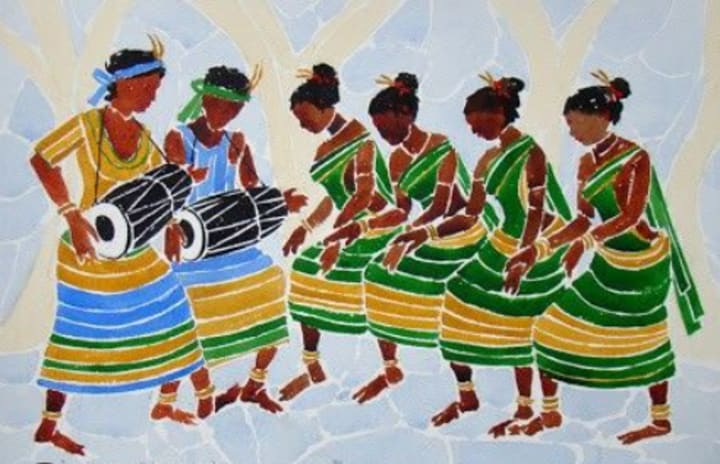
I'm always enthusiastic about learning about diverse communities, delving into their rich histories, cultures, and traditions. Today, I'd like to introduce you to a fascinating tribal community known as the "Adivasi." There are countless intriguing aspects to their way of life, and I'll share some of the most captivating details with you.
The term "Adibasi" is derived from the Sanskrit words "adi," meaning original or earliest, and "basi," meaning inhabitant or resident. Therefore, "Adibasi" can be loosely translated as "original inhabitants" or "indigenous people."
Adivasis are the native and often marginalized communities in India who have their distinct cultures, languages, and traditions. They are spread across various states in India and have a rich and diverse cultural heritage. Some of the prominent Adivasi communities in India include the Gonds, Santhals, Bhils, Oraons, and many others.
The Adivasis are one of the most marginalized groups in India. According to the 2011 census, the community constitutes 8.6% of the total Indian population, making them a minority group. They lead a traditional lifestyle that is intrinsically tied to the forest areas of India.
The Adivasi community has historically been the subject of state-inflicted oppression, trapping them in a vicious cycle of poverty and violence.
Adivasi communities in India are incredibly diverse in terms of language, culture, and customs. Each community has its unique way of life, art forms, music, and tradition.
Adivasis are often closely connected to the land and its resources, relying on agriculture, forest resources, and traditional livelihoods. Land rights and resource access have been significant issues for many Adivasi communities.
Historically, Adivasi communities have faced marginalization and exploitation. They have often been subjected to displacement due to development projects, land encroachments, and other forms of discrimination.
Adivasi communities have been actively involved in movements and struggles to protect their land rights, cultural heritage, and livelihoods. Organizations and activists work to address their concerns and promote their rights.
The Indian government has implemented various policies and programs aimed at improving the socio-economic conditions of Adivasi communities. These policies include reservations in education and government jobs and the Panchayats (Extension to Scheduled Areas) Act, 1996 (PESA) to grant autonomy to Adivasi areas.
Despite efforts to uplift Adivasi communities, challenges like poverty, lack of access to education and healthcare, and displacement due to industrialization and infrastructure projects persist.
Adivasi communities have a rich tradition of art and culture. They are known for their intricate craftsmanship, tribal dances, and oral traditions.
Adivasi communities often have their own languages, which are distinct from mainstream Indian languages. Many of these languages are endangered, and efforts are being made to document and preserve them.
Adivasis consume boiled food like rice, pulses, herbs or &lsquosaag&rsquo and meat and, on some occasions, animal or bird meat is roasted on a fire. Because of these consistent food habits that are based on locally available resources, instances of serious diseases are considerably lower among Adivasis.
It's important to recognize and respect the diversity and cultural richness of Adivasi communities and work towards their empowerment and protection of their rights. They play a vital role in India's cultural tapestry and have a unique and valuable contribution to society.
In 1994, the United Nations General Assembly established World Indigenous Day to be celebrated on August 9 every year. The date August 9 was chosen in accordance with the first meeting of the UN Working Group on Indigenous Populations that was held in Geneva.
You know how I know this basic things about them.. Because I belong from this community. And I am proud to be an “Adivasi” …….Thank you…
About the Creator
Gouri Murmu
Hii this is Gouri Murmu. I belong from a native village in India. I love to write stories, poem and article from my childhood. At my school time i wrote many poem and stories and i got prizes for that. Join me to enjoy my stories.
Keep reading
More stories from Gouri Murmu and writers in Writers and other communities.
The unbreakable bond
Morning at 4:00 AM: Kathleen stirred from her slumber, roused by the plaintive cries of Shivli's calf. Shivli, her faithful cow, seemed to have an insomniac calf who made it a nightly ritual to disrupt their peaceful sleep. Kathleen muttered in frustration, "This shivli and her calf never lets us sleep in peace. Soon, my own child will be awake because of this racket." She glanced at her son, Jack, nestled contentedly beside his father.
By Gouri Murmu2 years ago in Writers
Bigger Screen, Bigger Freedom: Play ARC Raiders on iPad and Download StarDesk Remote
Bigger Screens and Mobile Freedom: How Tablets Are Redefining Gaming and Remote Work Mobile technology has undergone a quiet transformation over the past decade. What once served primarily as a platform for casual browsing and media consumption has evolved into a powerful tool for both entertainment and productivity. Tablets, particularly larger-screen models, now sit at the center of this shift.
By Abbasi Publisherabout 23 hours ago in Writers




Comments
There are no comments for this story
Be the first to respond and start the conversation.