
Seven deadly virtues
Conclave provides a valuable lesson in how to handle sub plots and build dramatic tension


Not only is Conclave a superbly entertaining movie to watch, it also provides a timely example of how to make the most of subplot and byplay. I can’t begin to explain exactly how this was achieved but am delighted to know that writer Peter Straughan has been nominated for the best adaption Oscar. The story is based on the book by Robert Harris, which I have not read.
Rather than try to explain what I don't know, I thought I would list some of the dramatic highlights, as I saw them.
SPOILER ALERT: Read no further if you have yet to see the film
Virtue the first
Watching Conclave for the second time, I saw something that relegates another much-loved movie to second place. Previously, I considered the best depiction in film of the presence of God (Judaeo-Christian) to be the burning bush scene in the 1998 movie: The Prince of Egypt. Now I think the top slot has to go to the point in Conclave at which the committee of Cardinals finally makes its choice. You remember it? They all write the name at exactly the same instant.
In each case, the scene gathers some of its strength from breath. When Moses hears the gentle command of God's voice as the bush burns with a cold blue flame, it leaves him breathless. Immediately before the Conclave speaks almost as one, the Cardinals look up and receive inspiration, but not from the painted ceiling of their Sistine Chapel. They see the window that has been blown out by a suicide bomber, with the wind blowing, like the breath of God, and light of the heavens radiating through the gap in the security shutters. You have to see it to know what I mean... and to believe.
TWO: Isabel necessary?
Much vaunted appearance by Isabel Rossellini seemed to be overplayed on first viewing. Call it prejudice, if you will, but I thought first time around that Rossellini and her sisters of the Order of St Joseph (I think) were just there as a token female presence. A box ticking exercise if you will. Much the same way as a strong female support role might appear in a characteristically machismo film. More so in this case, as women are banned from Catholic priesthood, leaving the story otherwise without any female leads. The role of the nuns, it seemed to me the first time around, was to serve the food and do the photocopying. As Rossellini's character put it, they are invisible and it seems I wasn't paying enough attention to her real role when I saw the film for the first time.
The second time around, the role seemed to me to have greater depth. In contrast to Fiennes and his over-acting, Rossellini's performance is powerfully understated. Her Sister Agnes makes a speech to the assembled Cardinals that marks a turning point in the story. She also appears at other critical points in the dramatic action. She shows up as Cardinal Lawrence (Fiennes) has broken into the sealed Papal apartments, discovering a critical report that had been concealed by the late Pope before his death. Standing on either side of the forbidden door, the pair are like would-be lovers not quite able to take the plunge of that nervous first kiss. In the end, the moment passes, Lawrence is afraid to come out and Sister Agnes not quite prepared to open the door to see who is hiding behind it.
Although much of the good Sister's work is domestic, playing chief housekeeper to the Cardinals, her symbolic role goes way beyond. As she plays the head waiter, tidying up the silver settings before service, she could also be seen as being the symbolic guardian of standards of behaviour and presentation in the Vatican. A constant vigil against sinful slippage. She of course goes largely unnoticed by the Cardinals, except one, who gives thanks to the nuns, in his benediction, for preparing their meals. Rosselini's reaction? A slight warm smile to break the otherwise grim stoniness of her expression.
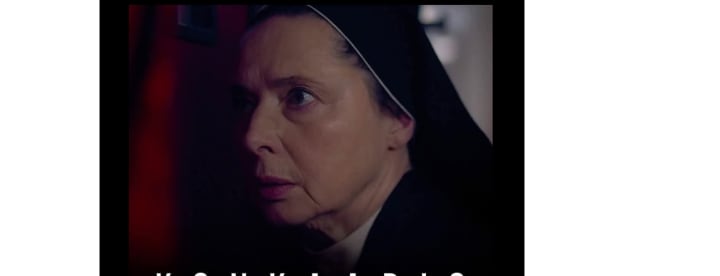
Most important of all, during one of the intimate discussions between Fiennes and Rosselini, Sister Agnes raises her eye to something Lawrence says. To me, her open eye is the all-seeing eye of God, looking in judgement upon the straying Lawrence. Straying, that is, into the territory of ambition, seeking the Papal role he so denies he covets. A much understated act, but one that is pivotal to the crisis of conscience, and of faith in the church, that underpins the whole story.
THREE: Devil you know
If Sister Rossellini provides the eye of God, then Stanley Tucci has the Devil’s tongue. For it is his Cardinal Bellini who is constantly tempting Lawrence to admit ambition and eventually to go for the top job. To me, Tucci's acting in the film is workmanlike but uninspiring. It is a convincing, but not edifying, performance.

Get thee behind me Tucci
On the subject of inspirational performance, I thought that Lucian Msamati's support role as the erring Cardinal Adeyemi outplayed all of the lead actors, hence:
FOUR: The fall of man
Discovery of Adeyemi's past sin brings down, not just Adeyemi's candidacy, but that of his apparent accuser, Cardinal Tremblay. Against Msmati's powerful portrayal of a man facing an unexpected crisis in his career and life's mission, I found John Lithgo's performance as Tremblay disappointing. Having seen a totally convincing performance as The Crown's Churchill, I was perhaps expecting too much of this substory. Then again, was there not a hidden byplay to Tremblay's denial of any knowledge of Adeyemi's adultery? Which leads us to:
FIVE: Pope, tempter, plotter or redeemer?
We could say that Bruno Novelli's Pope was dead... to begin with! (look the quote up if you don't recognise it). Conclave begins with the frantic march of a mystery figure, soon revealed as top man Cardinal Lawrence, to deal with the sudden death of the Pope. We see Novelli as a convincing corpse, not just once. The second time he appears, in reawakened form, as dream/vision and witness to Lawrence's crisis of conscience. As in the ghost of his partner in crime, Jacob Marley, who is both tormentor and redeemer to the errant Scrooge.

Ralph Fiennes, Dean of the Roger Moore School of eyebrow raising.
In the story, Lawrence is disappointed that the Pope refused his resignation, having been told he is a 'good manager' (thus being damned by faint praise). Did the Pope anticipate the need for a strong man to guide the Conclave? Was this part of a wider plot by the dying Pontiff to put in place his own choice for Pope? Did this devil/angel head of the world's church, plan to bring down every other candidate with any kind of chance of being elected Pope? Did he tell Tremblay to order the nun who was mother of Adeyemi's illegitimate child, to Rome as Tremblay claimed? Did the Pope thus sacrifice Adeyemi and Tremblay in one grand piece of chess mastery? Considering these questions also opens the issue as to whether the Pope was also directly responsible for the failing campaigns of every candidate other than his own choice.
SIX: The certainty of uncertainty
Cardinal Lawrence sets out his stall with a powerful speech about uncertainty.
“If there was only certainty and no doubt, there would be no mystery and therefore no need for faith... Let us pray that God will grant us a pope who doubts.”
This particular comment struck a chord with me, as it reflected a time a few years ago when I was pondering the nature of the laws of outer space for my Master of Laws dissertation. When my proposal was being assessed, it was apparent that some aspects of the subject could not be clearly defined, having never been tested in any international or national court. The advice I got back from my supervisor was to embrace the uncertainty in my dissertation, which I did.
In the case of the speech by Fiennes, his character was sending a clear message that to have views that were too clearly defined risked being mere prejudice. At this point I think the debate was as much about the Trump v Biden battles, as about the papacy. Fiennes was inviting the movie's audience, as much as his fellow Cardinals, not to have too prescriptive a viewpoint. Accept with humility that you could be wrong, that there may be merit in the other person's viewpoint. If you can accept that there is doubt then there is room for prayer, meditation and consideration. There is room to ask God for guidance. Or, to the atheist, there is food for thought.
This point, philosophical though it may be, is pivotal to the dramatic action of the film, but also makes the debate relevant to wider, real world issues. The crisis of certainty versus uncertainty is the whole crux of the matter. Cardinal Lawrence exhorts the Cardinals to seek God's guidance in their quest to find the true Pope. The speech can also be seen, I think, as a plea not to fall prey to social media misinformation, or promotion of bigotry and extreme views.
This point about the virtue of uncertainty leads directly into the dramatic climax of the movie and the final resolution of the story.
SEVEN: Love conquers all
Remember the movies you watched as a child, where the good guy wins in the end, the good wizards and witches triumph over Slitherans, there's no place like home... ? One of the reasons this movie works is that it ends on a positive, a moral victory.
If you are still reading and have not yet seen the film, these last few paragraphs really will give the game away.
Once you know which of the Cardinals wins the vote to be the new Pope, it seems so obvious. It is a testament to the quality of the scriptwriting that there could have been any doubt. The dramatic action was tied up in such strong sub-plots that it kept our attention away from the real candidate, the one who was the least obvious of the Cardinals and therefore the most obvious outcome. But there was more to it than that. That little hospital appointment that was mentioned during the story but largely dismissed until Lawrence realises how important it may be.
Firstly, we all know that daft story of Pope Joan, beloved of the nerdy conspiracy theorist, yes? If you don't, please look it up, as this rambling article of mine has rambled on for long enough without disappearing down that particular wormhole.
Well, once we have discovered what type of clinic is in play, the final crisis of the story unfolds. Is the as-yet-unrobed pope a man or a woman… or… (Oh sorry, there is no other possibility, now that His Holiness, POTUS Donald, has so decreed). No matter, as the pope in our story tells us, for he did not go through with the surgery.
At this point, newly elected Pope Innocent reminds Cardinal Lawrence of the uncertainty speech. He then explains that he grew up as a man before the unexpected discovery that he has a vagina. He booked an appointment for surgery but then decided that God had made him what he was for a reason.
So, the conclusion is that God made the Pope a man with a vagina? I wouldn’t like to see the point tested in the Supreme Court right now.
Thanks for reading
About the Creator
Raymond G. Taylor
Author living in Kent, England. Writer of short stories and poems in a wide range of genres, forms and styles. A non-fiction writer for 40+ years. Subjects include art, history, science, business, law, and the human condition.
Keep reading
More stories from Raymond G. Taylor and writers in Writers and other communities.
Wordle wonder
Why has this article about an online puzzle been put in the Writers community? Good question. I put the story here in Writers to make a point: playing this game can help a writer's word choice. Really? Only one way to find out if this is true and that is to give it a go.
By Raymond G. Taylorabout a year ago in Writers
Unofficial Challenge: Black History Celebration
Forward: February 28th, 10:53 PM, EST... The final hour of Black History Month, 2026. Hello fellow writers. I've had this challenge waiting in my drafts for most of the month. But I held off on publishing it, until now.
By Sam Spinelli3 days ago in Writers
Best URL Shorteners
Long URLs filled with tracking codes and parameters can look messy and difficult to share. URL shorteners help transform these lengthy, cluttered links into shorter, cleaner versions that are easier to manage and share. Not only do they make URLs more user-friendly, but they also come with additional features like custom branding, tracking, and performance analytics.
By Backlinks Cart6 days ago in Writers


Comments (4)
The title of the movie kinda ringed a bell. Have you already written an article on this? I found your musings here very fascinating!
What a well-written and detailed movie review. Great job.
I had to stop reading because I haven't seen Conclave yet....I know you are really impressed with it, so as soon as it comes out on Hulu or Netflix, I'll jump on it.
This is on my list to watch, I havent read the whole of this but will return after I have seen the film