
Wordle wonder
One author's learning love affair


Why has this article about an online puzzle been put in the Writers community? Good question. I put the story here in Writers to make a point: playing this game can help a writer's word choice. Really? Only one way to find out if this is true and that is to give it a go.
Here are some suggestions about how to play the game in order to learn the most and to be able to improve your writing capability.
Wordle has been described as a word guessing game. It isn't. At least, not the way I play it.
Wordle is a free word-guessing game available online: guess the five-letter word in six tries or fewer: theguardian.com
To me, Wordle is a word choice game based on selecting alternative five-letter words and then refining the choice based on hints provided. The hints tell you which letters you have chosen that are correct and which of these are correctly positioned.
Cracking the code word in the maximum six attempts is simple enough to do. Players may indeed attempt to guess the word at each successive stage, informed by the clues. As writers, however, there must be a better way of solving the problem and one that can help us build writing skills.
For writers there is a much much better way
There is and this is it. Take a completely opposite approach to solving this puzzle. It's an approach that can help with other puzzles too, like Sudoku. This approach can also, perhaps, help to solve some of the mysteries of life? Surely not? Surely yes, as you may discover if you only give it a try.
The alternative is this. Instead of trying to guess the correct word, try taking the opposite approach, choose words that will help to eliminate the wrong words by ruling out as many incorrect letters as possible. Before demonstrating how this approach may help solve life's mysteries, or specifically the job of writing great stories, let's first try to solve a simple Wordle problem using this method. Here's what an opening game looks like when you load it up in your device's browser. It is today's problem, as I write: Sunday January 5, 2025.
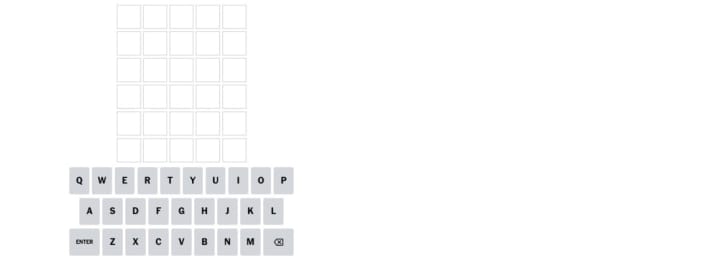
A beautiful blank screen, not unlike a fresh sheet of clean, white paper or a newly-opened Word document, all ready to start writing your next brilliant story. To play the game you simply have to choose a word. You could just make a guess and see if you are right first time. It does happen and in three years of playing the game it has happened to me at least once. But you learn nothing by guessing right and you learn nothing by cheating, which estimates say up to 20% of players do. Why?
Anyway, I neither cheat, nor guess. What I do is use the same two word combination every day:
SHORT and ADIEU
I am grateful to Dharrsheena Raja Segarran for suggesting ADIEU. It is a word that includes four of the five vowels. By using this and SHORT, I have covered all five vowels in two words and added several popular consonants. The reason is not so that you can be sure of discovering at least one correct vowel. Quite the opposite. The method is to eliminate as many incorrect vowels and popular consonants as possible, leaving the board with fewer options left, and therefore a greater chance of being able to select the correct word in the remaining number of moves. Before using this combination I used SHIRE and TONAL and you might want to try out your own two-word combination. Here's what the grid looks like when you try out, first, SHORT:

The result indicates that R is correct but in the wrong place. If you had tried ADIEU before midnight January 5 you would have found that E was in the correct position, leaving you now with two correct letters E and R. More importantly, this two-word combination has eliminated four vowels, leaving E as the only one to be found in the solution. Great work!
My next choice was REFER which, as you can see, used two Es and two Rs. I chose this word deliberately, not to guess the correct word, but to eliminate further options. In this case positional. Selecting REFER left me with two correct letters both in the correct position.

We now know for certain that there are no double Rs and no double Es. There is only a single vowel. Had there been a double in the wrong position, it would have eliminated two more positions for that letter in a single go. Now, if you look at the three letter gap you will know that it is going to be difficult to fill it without a vowel. But let’s not forget our friend the letter Y which can, of course, take the place of a vowel if need be. That's enough boring puzzle talk. Work the rest out if you care to, and if you are reading this on the day of publication. If not, why not try out the day's Wordle and see how you get on.
Now, the question of how this is helping our writing. Well, there is the obvious point about exercising our knowledge of words, word construction and giving us some practice choosing words to meet a particular requirement.
I sometimes think, when reading another writer's work, that insufficient care has been taken over choice of words. That may be the result of reading a lot of writing that has not passed the desk of a professional editor. Come to think of it this applies to most of my own writing these days.
Was a time, when I was a journalist, that not a word of mine was published without being passed for press (in the dark days before online) by one or more editors. It gave me a great deal of comfort. Even when I was the editor in chief of a weekly trade magazine, I had at least one desk editor verify my prose before it was presented to an unsuspecting readership.
These days I have to rely on my own self-editing, as most of us do. And of course we can all be lazy at times and rely on our first choice of words rather than thinking about more elegant, lyrical, funny, sharp, witty, insightful, delightful, nourishing or otherwise BETTER WORD CHOICES.
'Scuse the shouting but you surely know what I am on about.
So, playing games like Wordle can help our word choice. More than this, I would say that, by approaching Wordle from a different, more considered, dare I say more philosophical perspective can also help us solve bigger problems we have with our writing. How so? That's another story for another day.
Happy Wordling and please tell me if it does indeed help your word choices when writing.
About the Creator
Raymond G. Taylor
Author living in Kent, England. Writer of short stories and poems in a wide range of genres, forms and styles. A non-fiction writer for 40+ years. Subjects include art, history, science, business, law, and the human condition.
Keep reading
More stories from Raymond G. Taylor and writers in Writers and other communities.
Unofficial Challenge: Black History Celebration
Forward: February 28th, 10:53 PM, EST... The final hour of Black History Month, 2026. Hello fellow writers. I've had this challenge waiting in my drafts for most of the month. But I held off on publishing it, until now.
By Sam Spinelli3 days ago in Writers
Writing About Writing: The End
A lot of people say that the hardest thing about writing a book (or script, or comic) is starting it. Choosing where to begin, not to mention how the story should start, picking a good opening line to hook the readers, and of course the process of writing an entire story from start to finish. It's a daunting challenge. However, in my opinion there is something even more important: How to end it.
By Natasja Roseabout 23 hours ago in Writers
When the Shelter Closes
Across the street from my house, a man slept under a tree, his dog by his side. My first, naive thought: he must be traveling through. But he kept coming back, often sleeping there during the day. Then it hit me—that person might not have a home.
By Bride of Sound6 days ago in Humans


Comments (5)
I remember the answer to 5th January's one but I forgot what I used after ADIEU 😅 I think I got it in 4 tries
Fantastic piece! I don’t play Wordle, but now I want to give it a go as well as pump up my word choice game when writing!
This is so good! My husband loves Wordle and plays every day. Great article!
WOW! this is wonderful, Title is impressive! thank you Ray for sharing this. Thank you Dharrsheena Raja Segarran for ADIEU.
I do Wordle every day too! My first word choice is always SPARE then if that yields little, I use CLOUD. Usually, that's enough to give me some fodder but if not I choose NIGHT. Fun article, Ray!