
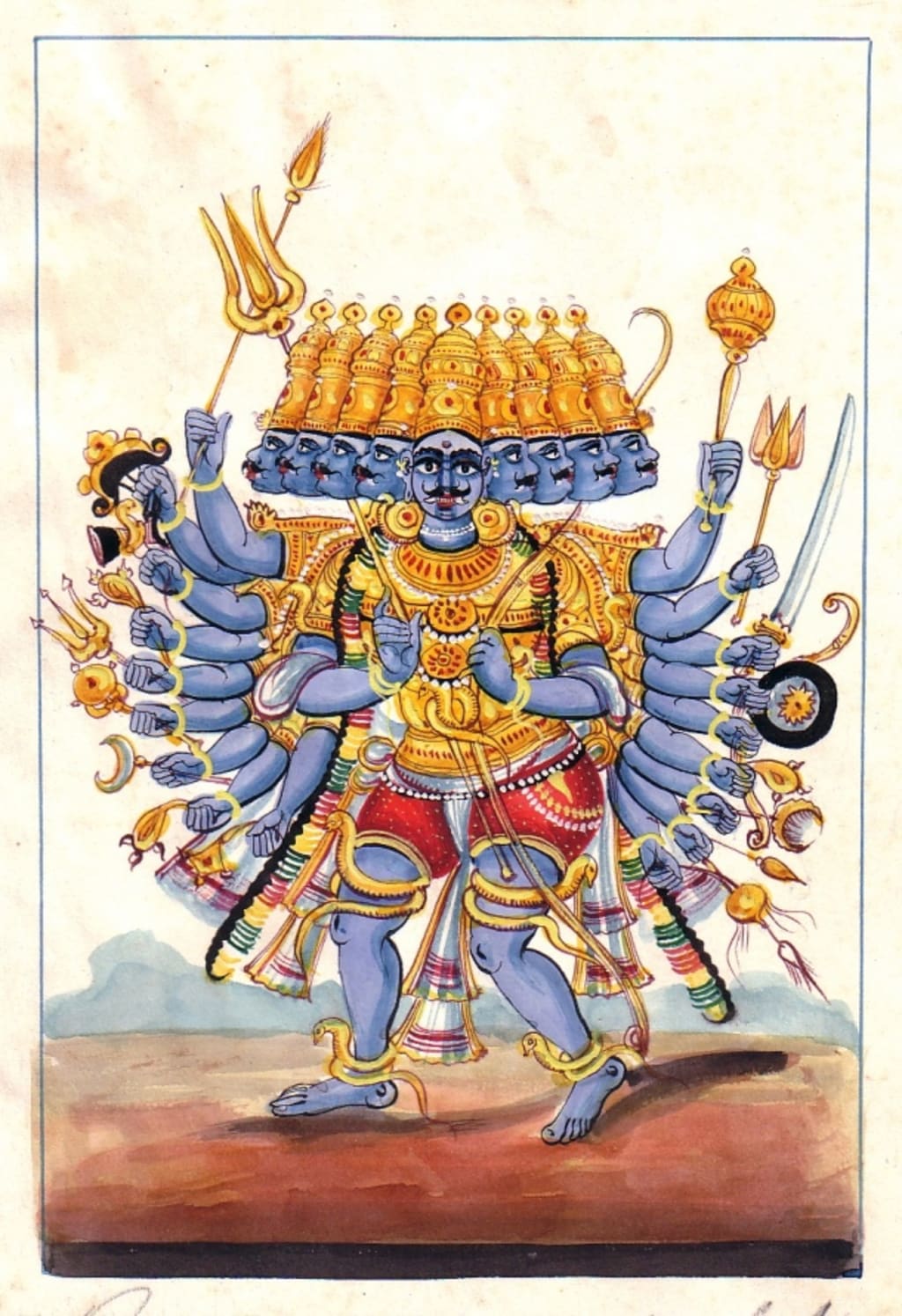
Ravana history
Ravana was an Asura king who ruled Sri Lanka in the epic Ramayana written by sage Valmiki.[1] Ravana has many names like Dashagrivan, Ilangeswaran, Ravaneswaran, Lord of Triloka. He is also known as Dasamugan because he has ten faces.
Ravana, Kumbhakarna, Veedana and Surpanagai were born to Sage Vishrava, son of Sage Pulastya, one of the ten Prajapatis, and Kaikesi, daughter of Sumali, leader of the demon clan.
And the epic Ramayana says that he wears water as a devotee of Shiva, and died in a battle with Rama because he seduced Sita.
When Lord Shiva comes for a street stroll in the Shiva Temples on the Kailai Hill, the Kailai Hill is positioned to support the ten-headed Ravana.
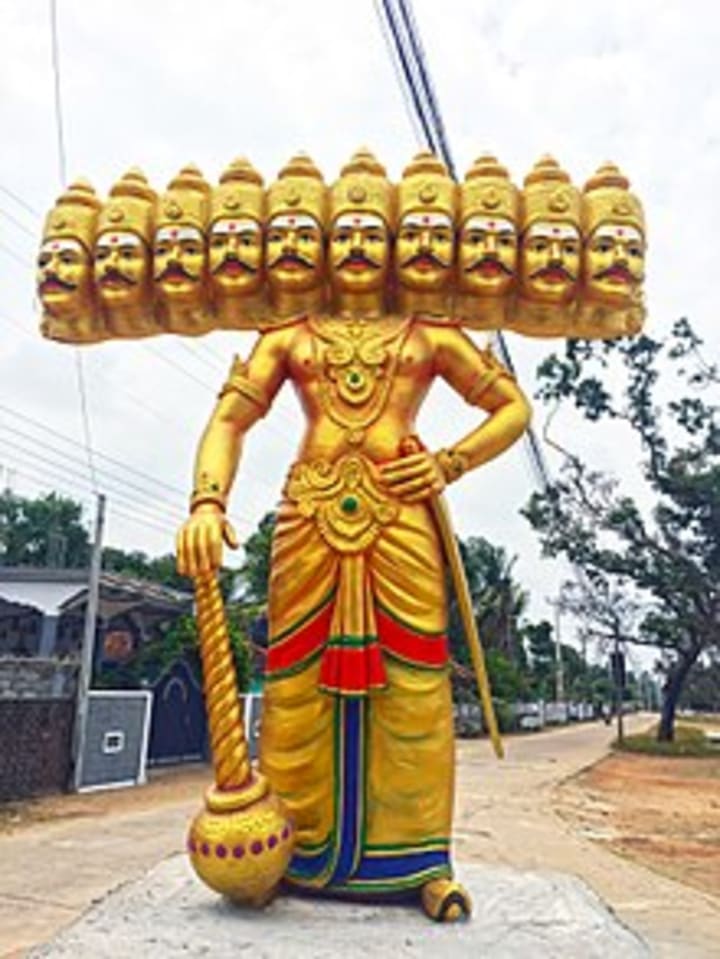
In the Ramayana, Ravana is also depicted as having ten heads. Here the ten heads mean that Ravana was the master of the ten fields. He is also hypothesized to have ten qualities like a great veena vidhuvan, a great devotee of Shiva, and a great fighting warrior.
Dravidian and Tamil nationalists who identified Ravana as a Tamil portrayed him as an anti-hero with good qualities and virtues. Some literature was fabricated with him as the hero. However, the traditional Indian view of Ravana as a deadly demon is widely accepted. Ravana also has a temple in a village in the state of Madhya Pradesh in India.
The Gond tribal people living in Madhya Pradesh, Gujarat and Rajasthan consider Bisrag as the birthplace of Ravana. It is near Greater Noida, Delhi. They also believe that Ravana's wife Mandothari was born in Vidisha in Madhya Pradesh. The Gonds, who claim Ravana as their lineage, erect idols of Ravana in their settlements, mourn during Dussehra and worship Ravana on the last day.
Name Description:
Ravana - Iru Avanan means one who is famous. And Ravana also has the meaning of beauty like no other.[4] Ravana - Ravana (Ira=darkness=darkness) also has the meaning of dark complexion like darkness.
Family:
Ravana, Vipeedanan Kumbakarna and Surpanagai were born to Sage Visrava, the grandson of Prajapati Pulasthiya and Kekasi, the daughter of Sumali, the leader of the Asura clan. Ravana - Born to Mandothari were Indrasittu, Atsayakumar, Trisira, Adhikaya, Prakasthan and Narandha - Devantha were Ravana's sons.
Kubera was Ravana's half brother. Ravana conquered the beautiful city Vishwakarma had built in Sri Lanka for Kubera and the Pushpaka Vimana.
Ravana's wooing of Sita:
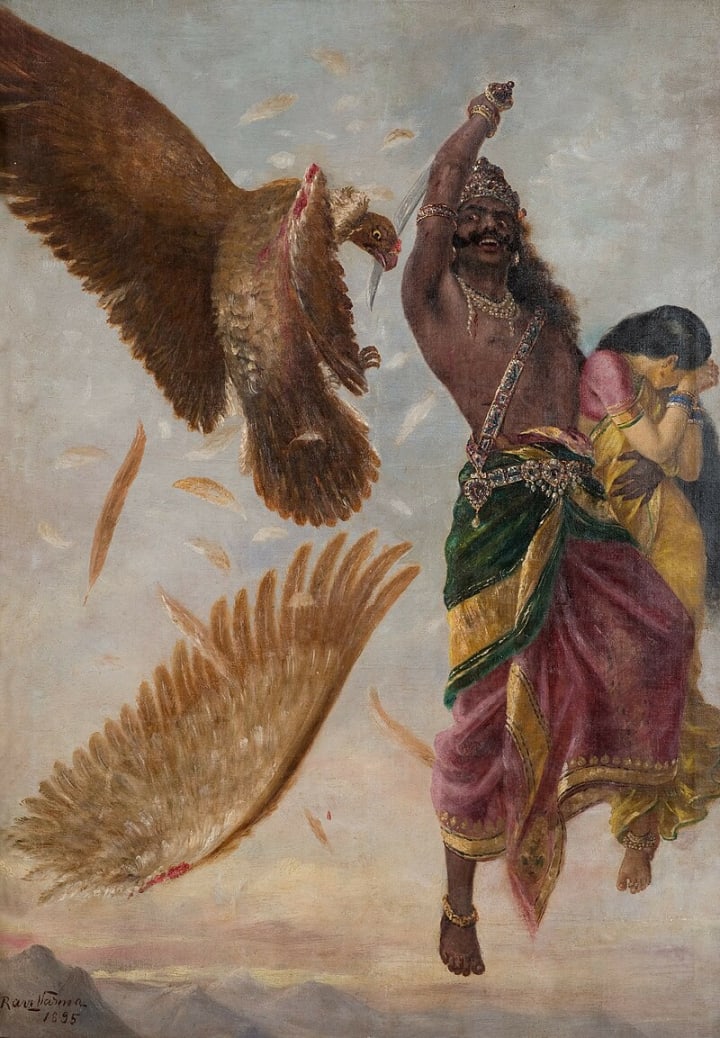
Surpanagai, who went to Sri Lanka, described Sita's beauty to her brother Ravana and urged him to woo Sita. Ravana thereupon went to Panchavati and sent Marisa in the form of a golden Maya deer to separate Rama's brothers from Sita. When Sita crossed the goal line and came to give food to Ravana disguised as a monk, Ravana abducted Sita in the sky. Seeing this, Jatayu fought with Ravana to rescue Sita. Eventually Ravana cut off Jatayu's wings.[8] Ravana imprisoned Sita in Sri Lanka's Ashoka Forest for not complying with his wishes.
Death of Kumbakarna, Indrajit, Ravana:
A war broke out between Rama and Ravana. Kumbakarna died in battle. His son Indrajit saved Ravana, who was saddened to hear that. After that, Indrajit named Meghnathan also participated in the war and died a hero's death. After the death of his younger brother and son, Ravana engaged in war.
Ravana's choice was killed by Rama. Ravana's chariot horses were killed by Vipitana. Rama, the charioteer of Indra, shot and killed Ravana with an arrow provided by Matali.
Ravana in Sri Lanka:
It is said in the Ramayana that Ravana, enchanted by the beauty of Rama's wife Sita, kidnapped Sita to Sri Lanka and imprisoned her, so Rama fought with Ravana and rescued Sita.
Ravana's wife, Mandothari, was a virtuous woman. There were many women in his house.
Regarding the Sri Lankans, the prevailing opinion is that Ravana was a king who ruled Sri Lanka. It is noteworthy that the same opinion is found not only among the Sri Lankan Tamils but also among the Sinhalese. Many people define Ravana as an evil character because of the Ramayana where Ravana abducts Sita and is the antithesis of Rama.
Vedic scholar:
Ravana was expert in Sama Veda. Ramayana itself takes this up. The Ramayana also says that he pleased Lord Shiva by singing Sama Ganam with his hand veins.
Ravana as a devotee of Shiva:
As a devotee of Shiva, Ravana always wears a turban.[3] Ravana prayed to Lord Shiva and prayed to Atmalingam to make Sri Lanka immortal. Delighted in his penance, Lord Shiva gave the Atmalinga to Ravana. No one can destroy the place where Atma Lingam is. No one can defeat the deadly Ravana if he has Atma Lingam. He also advised not to place it anywhere on the ground until it is placed in Sri Lanka. Once placed on the ground, it cannot be moved. But due to the intrigues of the gods, Ravana could not take the soul linga to Sri Lanka. The gods appealed to Ganesha. At dusk, Ravana will worship Lord Shiva. So he gave the Atmalingam to Vinayaka who came there in the guise of a boy and performed the pooja. Pretending to be unable to bear the pain, Lord Ganesha placed the Atmalingam on the ground. Enraged, Ravana tried to kill the boy. Ravana, knowing the boy to be Lord Vinayaka, bowed down to him and begged for forgiveness. Lord Vinayaka saw Ravana's humility and blessed him.
Ten heads:
In many paintings, Ravana is depicted as having ten heads. The Ramayana says that Sri Lanka was prosperous during the reign of Ravana and that Ravana had a vimana. It is worth noting here that Sri Lanka also has town names such as Wariyapola - "Vanodum Kalam Deskurumidam".Ravana is depicted as a Brahmin and a devotee of Shiva. At the same time, he is depicted as a demon and the king of demons. Views on Ravana differ in Sri Lanka, Tamil Nadu and other parts of India.
Temples of Ravana:
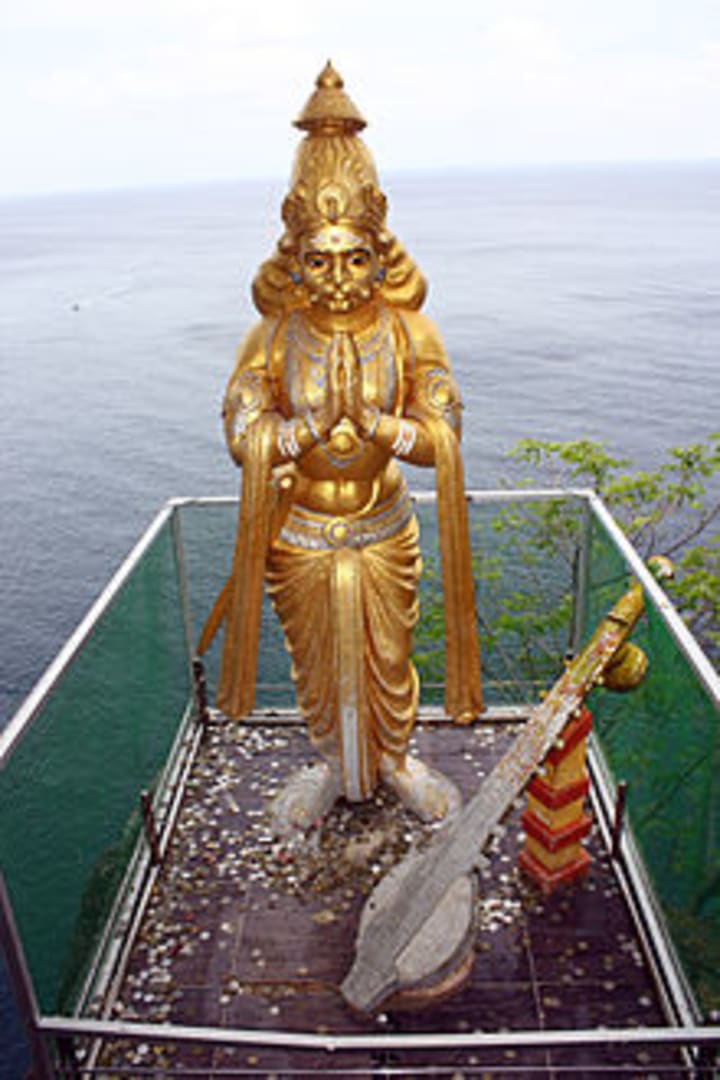
Ravana Temple, Bisrakh, Grader Noida, Uttar Pradesh, India.It is known as the birthplace of Ravana and mourning for Ravana is observed on Dussehra, the day of Ravana's death.
Ravana Temple, Ravana Village, Vidisha District, Madhya Pradesh, India
Daily prayers and rituals are observed at the Ravana temple here by thousands of Kanya Gupja Brahmins of this village.
Ravana Temple, Kanpur, Uttar Pradesh, India,
It was built a few centuries ago by a king named Shiva Shankar. It is opened once a year on the day of Dussehra. On that day, special pujas and rituals are performed here for the benefit of Ravana.
Ravana Temple, Jodhpur / Mandur, Gujarat, India.
The temple is worshiped by the Dev Brahmins, who claim to be the descendants of Ravana, and on Dussehra, the day of Ravana's death, they mourn Ravana and keep a pindam on that day.
About the Creator
Keep reading
More stories from writers in Writers and other communities.
Published in Portrait of New England
My quest to find many publications with prestige to submit to has worked out even better than I thought. I was searching for more publications with more prestige in order to bolster my resume. I truly thought I'd try this for a year and not get published anywhere... maybe if I was lucky... in one of them. And I was OK with that... I was just going to try again the following year, and the year after that, and so on.
By Stephen Kramer Avitabile29 days ago in Writers


Comments
There are no comments for this story
Be the first to respond and start the conversation.