
Notes from a Quoting Mind: On Language, Power, and Repetition
The Quoting Mind Of Peter Ayolov

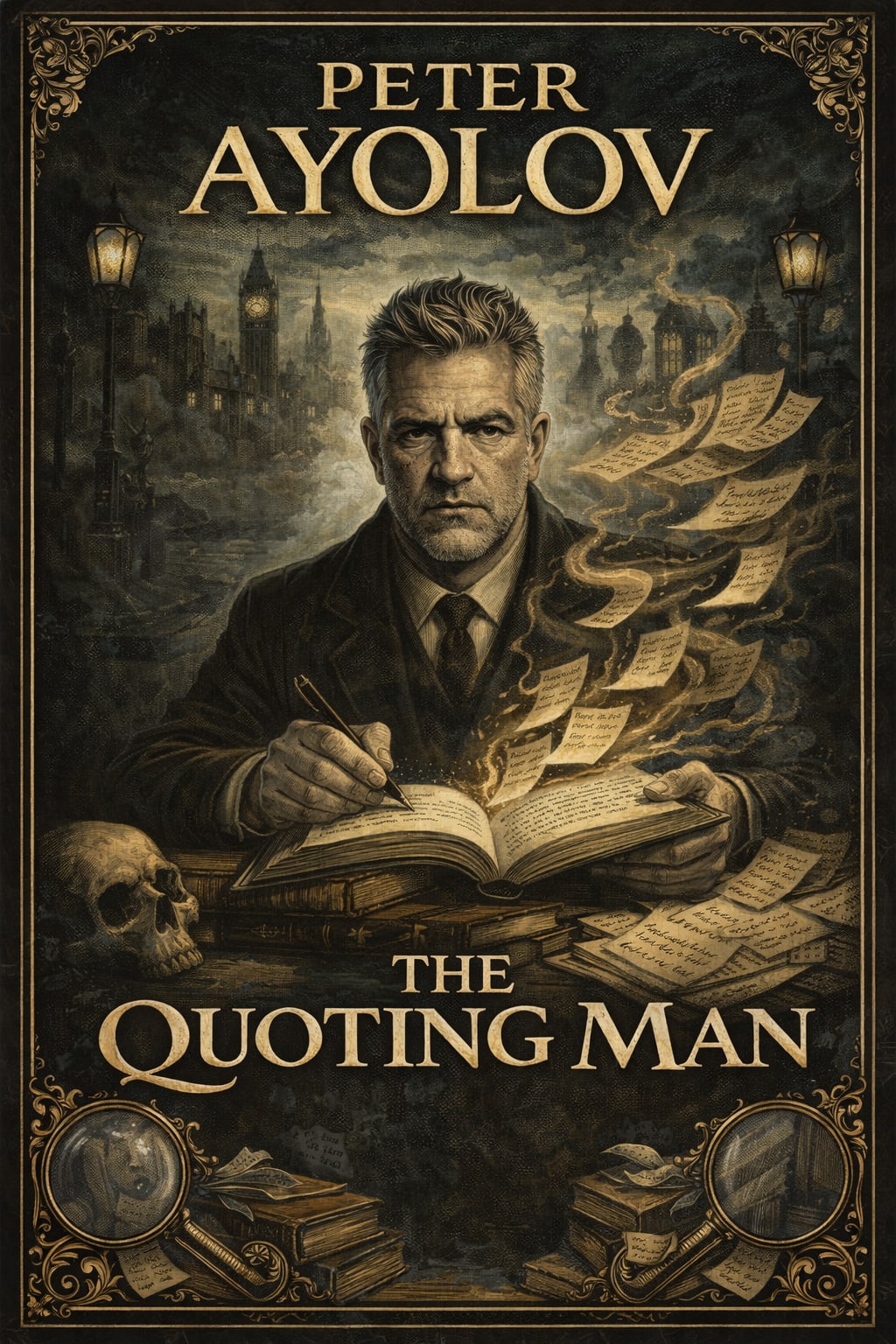
Homo Citans: The Quoting Man Against Originality
Homo citans names the human as a quoting animal, a being who speaks by repeating, citing, echoing, and rearranging the words of others. Every sentence enters the world already inhabited: by traditions, concepts, metaphors, and rhythms that precede the speaker. To cite is therefore not an exception of scholarly life but its default condition. Researchers, writers, and thinkers are links in a chain, not origins; they validate knowledge by showing where it comes from, how it travelled, and whom it passed through. Citation is thus not merely a technical practice but an ethical acknowledgement of interdependence, a recognition that thought emerges collectively rather than individually.
Yet Homo citans contains a paradox. The quoting subject does not remain a neutral transmitter for long. Repetition alters meaning; emphasis reshapes intent; context rewrites sense. Over time, the quoting individual begins to make the citation his own. Words once borrowed become internalised, transformed, and eventually spoken without quotation marks. At that point, authorship dissolves into circulation. The speaker no longer knows where the sentence ends and where the source begins. Quotation mutates into invention, not through fraud but through use. What was cited becomes lived language.
This process repeats endlessly. Each generation inherits phrases, theories, and ideas that already carry layers of prior voices. In responding to the “anxiety of influence,” the thinker both acknowledges predecessors and unknowingly becomes one. The scholar is therefore homo citans et citatus: one who cites and will be cited, one who borrows and will be borrowed from. Ownership of language becomes unstable, even illusory. No one truly possesses words or sentences; they pass through humans the way myths, tools, and rituals do.
Homo citans thus reveals a deeper truth about knowledge itself. Ideas do not belong to individuals but to circulation. Thought survives by repetition with variation, not by origin myths. In this sense, humanity may be endlessly quoting itself—rephrasing old insights under new conditions, mistaking memory for originality, and calling inheritance creation. Citation is not a constraint on thinking but its engine, the mechanism by which language remembers, forgets, and speaks again.
Notes from a Quoting Mind: On Language, Power, and Repetition
Across his work, Peter Ayolov argues that modern media no longer informs or persuades but scripts reality itself, transforming journalism into scenario management, dissent into an economic product, anger into infrastructure, and power into an abstract system that governs not through belief but through attention, exhaustion, and performative conflict.
From media narratives shaped by Smirnenski’s ladder and Vonnegut’s story curves to the monetisation of outrage, the manufacture of dissent, and the rise of Legiathan as a linguistic–institutional form of power, Ayolov consistently demonstrates that contemporary governance operates through spectacle, moral anger networks, and the systematic erosion of sustained thought.
Ayolov, P. (2026) The Media Scenario: Scriptwriting for Journalists. Sofia: Faculty of Journalism and Mass Communication, Sofia University.
Ayolov, P. (2023) The Economic Policy of Online Media: Manufacture of Dissent. London: Routledge.
Ayolov, P. (2026) Moral Outrage Networks: The Sociology of Digital Anger. Sofia: self-published.
Ayolov, P. (2026) Legiathan: The Abstract Theory of Power. Sofia: self-published.
Language collapses not when people stop speaking, but when speech becomes incapable of carrying responsibility, memory, or consequence.
When words are endlessly available, they lose their capacity to bind humans to truth or to one another.
The degradation of language is the precondition for the degradation of politics.
A society that loses trust in language eventually replaces understanding with force or ritual.
Meaning decays fastest where communication is most efficient.
Propaganda 2.1 governs by emotional modulation rather than belief formation.
Power no longer needs loyalty when it can secure permanent agitation.
Propaganda becomes invisible once it aligns perfectly with entertainment and self-expression.
The most advanced propaganda systems do not tell people what to think, but how intensely to feel.
When propaganda accelerates faster than interpretation, consent becomes automatic.
Anger is politically useful only once it becomes predictable.
Permanent outrage destroys solidarity while preserving mobilisation.
A permanently angry society loses its capacity for strategic thought.
Moral outrage networks transform ethical impulses into repetitive emotional labour.
Anger ceases to threaten power once it becomes a habit.
Media systems no longer compete for truth but for neurological dominance.
The attention economy rewards reaction and punishes reflection.
Information overload is not a side effect of media, but its central mechanism.
When attention fragments, responsibility dissolves.
Media saturation replaces experience with simulation.
Narrative control is the ability to organise time, not just meaning.
Scripts pre-empt reality by deciding in advance how events will be felt.
Politics becomes theatre once outcomes no longer depend on deliberation.
Spectacle replaces explanation when systems cannot justify themselves.
The future is governed by those who control anticipation.
The digital self is assembled from reactions rather than convictions.
Identity becomes fragile once it depends on constant validation.
Personas flourish where persons would collapse under exposure.
The self disintegrates when it is forced to perform continuously.
Simulation becomes identity when reflection disappears.
Slop culture is not anti-intellectual, it is post-judgement.
Stupidity becomes structural when institutions reward speed over understanding.
Cultural decline is stabilised when it becomes profitable.
Institutions decay fastest when they confuse activity with thought.
Mediocrity thrives in systems optimised for scale.
Power stabilises itself by shortening time horizons.
Governance collapses once long-term consequences become invisible.
Systems fail not because they are evil, but because they are accelerated beyond control.
Responsibility disappears when no one remembers long enough to be accountable.
Political authority dissolves when meaning erodes faster than force can replace it.
Truth requires shared orientation, which collapses under emotional saturation.
Knowledge loses power when it cannot slow the system that consumes it.
Facts no longer fail by being disproved, but by becoming irrelevant.
Truth becomes dangerous when speed replaces judgement.
Orientation dies before belief does.
Society no longer collapses through revolution, but through exhaustion and noise.
The system survives by preventing silence, not by enforcing obedience.
What appears as chaos is often the stable output of a well-calibrated machine.
The greatest achievement of modern power is to make resistance indistinguishable from participation.
The final stage is reached when people mistake constant expression for freedom.
Language was created to make shared life possible, yet in mass societies it is increasingly redesigned to fragment experience and stabilise power.
When words lose precision and weight, power compensates by increasing speed, volume, and repetition.
The erosion of language is never a cultural accident, because weakened meaning always serves an existing order.
Meaning does not vanish in modern societies, it is systematically displaced by emotional cues and symbolic noise.
When speech becomes abundant and cheap, genuine understanding turns into a scarce and risky resource.
Propaganda 2.1 no longer operates through doctrine or censorship but through the continuous modulation of emotional intensity.
Contemporary propaganda succeeds precisely because it presents itself as openness, participation, and choice.
Power no longer needs to explain itself, because it governs by shaping the rhythms through which people feel and react.
Modern propaganda does not conceal reality, it overwhelms perception until orientation collapses.
The most effective propaganda is the one citizens willingly reproduce as self-expression.
Anger has ceased to function as a situational response and has become a permanent social infrastructure.
Moral outrage networks organise collective emotion more efficiently than any traditional political institution.
Permanent anger does not radicalise society, it exhausts it while preserving existing power relations.
When outrage becomes constant, it loses its capacity to threaten authority.
Moral rage increasingly substitutes judgement, reflection, and responsibility.
Media systems no longer describe reality but design behavioural reactions to it.
Attention is no longer earned through relevance but extracted through emotional stimulation.
The attention economy transforms collective distraction into a stable revenue stream.
What cannot be monetised is slowly removed from visibility and cultural importance.
Media no longer integrate societies through shared understanding but fragment them through managed intensity.
Public life has shifted from deliberation to performance, where visibility matters more than truth.
Narratives today do not interpret reality, they pre-structure emotional responses in advance.
The script dominates the event long before facts have the chance to intervene.
Politics no longer argues, it stages conflict as spectacle.
Those who control narrative frameworks control what can be imagined as possible.
Digital identity is increasingly defined by performance metrics rather than inner coherence.
Personas are easier to produce, manage, and monetise than persons.
The self becomes unstable when recognition replaces self-understanding.
Authenticity collapses when existence must constantly be displayed.
Identity weakens when it depends on continuous applause.
Slop is not the failure of culture but its industrialisation under speed and profit.
When quantity replaces judgement, stupidity becomes systemic rather than accidental.
Slop culture rewards immediacy while punishing depth.
Mediocrity scales more efficiently than thought in algorithmic environments.
Cultural exhaustion becomes profitable once standards disappear.
Contemporary power governs less through coercion than through emotional and cognitive exhaustion.
Control no longer requires ideology when momentum is sufficient.
Governance collapses when collective memory shortens beyond responsibility.
Responsibility erodes when systems operate only in the present tense.
No society can be governed rationally when its institutions are addicted to immediacy.
Truth does not disappear in modern systems, it is submerged beneath emotional saturation.
Knowledge loses authority when feeling is rewarded more than understanding.
Facts do not collapse dramatically, they suffocate quietly.
Truth requires slowness, which contemporary systems systematically undermine.
When everything is endlessly debatable, nothing remains accountable.
We did not lose meaning by mistake, we exchanged it for speed.
Social collapse today is rarely violent, but emotionally corrosive and continuous.
Power survives by keeping populations permanently expressive and politically harmless.
Apparent chaos often masks highly stabilised disorder.
The end of public opinion begins when outrage replaces judgement as the dominant social signal.
The economy of attention does not sell information, it sells nervous systems to the highest bidder.
Attention is no longer a human capacity but an extractive resource mined through fear, outrage, and repetition.
In the economy of attention, truth is unprofitable unless it provokes rage.
What cannot capture attention is treated as if it does not exist.
The economy of attention rewards intensity over accuracy and speed over understanding.
Attention is monetised confusion sustained by algorithmic pressure.
In the attention economy, silence is resistance and thinking is delay.
The system does not want agreement, it wants engagement.
Attention is harvested most efficiently when moral anger is activated.
The economy of attention transforms citizens into reactive terminals.
What looks like choice is usually engineered visibility.
The attention economy replaces persuasion with exhaustion.
When attention becomes currency, distraction becomes governance.
The economy of attention survives by preventing sustained attention.
Attention is no longer paid to reality but to its simulation.
The system does not need belief, only clicks.
In the economy of attention, outrage is infrastructure.
The attention economy collapses meaning into metrics.
Attention is captured not by relevance but by escalation.
The final victory of the attention economy is when people defend the system that exploits their focus.
Kayfabe politics turns the economy of attention into a permanent spectacle where outrage replaces accountability and performance replaces power.
In kayfabe politics, attention is currency and conflict is staged to keep it circulating.
The economy of attention rewards politicians who perform sincerity while engineering distraction.
Kayfabe politics survives not by convincing the public but by keeping them watching.
The attention economy does not care who wins, only that the fight continues.
Kayfabe politics transforms governance into episodic drama and citizens into spectators.
Attention is harvested most efficiently when politics is framed as endless betrayal.
In the economy of attention, kayfabe politics replaces ideology with ritualised outrage.
Political conflict becomes profitable when it is rehearsed rather than resolved.
Kayfabe politics is the art of simulating crisis to monetise attention.
The attention economy needs enemies, not solutions.
Kayfabe politics trains people to confuse emotional intensity with political action.
When politics becomes kayfabe, outrage becomes policy.
The economy of attention rewards those who can sustain anger without delivering change.
Kayfabe politics does not lie; it performs lies openly and dares the audience to care.
Attention replaces consent as the foundation of power.
In kayfabe politics, exposure matters more than truth and repetition matters more than evidence.
The system does not fear cynicism; it feeds on it.
Kayfabe politics keeps the public angry enough to engage but tired enough to submit.
The final trick of kayfabe politics is convincing people that watching is participation.
Kayfabe politics is not deception about reality, but agreement to perform conflict as if it were real.
In kayfabe politics, everyone knows the performance is staged, yet participation remains compulsory.
Political conflict survives not because it is unresolved, but because resolution would end the show.
Kayfabe politics replaces decision-making with ritualised confrontation.
What appears as ideological struggle is often coordinated antagonism within a shared script.
Kayfabe politics allows power to simulate crisis without risking transformation.
The function of kayfabe politics is not persuasion, but emotional maintenance.
Under kayfabe politics, enemies are necessary characters, not threats.
Political outrage becomes credible only when it follows the established storyline.
Kayfabe politics protects the system by exhausting opposition through performance.
The audience is encouraged to choose sides, not outcomes.
In kayfabe politics, sincerity is irrelevant as long as roles are played convincingly.
Power no longer hides cooperation behind conflict, it hides stability behind spectacle.
Kayfabe politics ensures permanent mobilisation without structural change.
When politics becomes kayfabe, exposure changes nothing because exposure is already part of the act.
The most stable systems are those that institutionalise simulated rebellion.
Kayfabe politics transforms legitimacy into audience engagement.
The system survives by staging endless battles it has already won.
Kayfabe politics does not deceive citizens about facts, but about agency.
The final stage is reached when politics feels dramatic while remaining functionally closed.
The media no longer reflect reality, they pre-script the conditions under which reality will be perceived.
A media scenario is not a story told after events, but a structure that decides in advance how events must unfold.
In contemporary media systems, reality is valuable only insofar as it can be staged.
Media scenarios do not describe facts, they organise expectations, roles, and emotional responses.
What audiences consume is not information, but scripted positions within a narrative frame.
The media scenario transforms citizens into performers who mistake visibility for agency.
Events matter less than their narrative function within an already established script.
Media power operates by assigning roles rather than issuing commands.
The success of a media scenario is measured not by truth, but by emotional coherence.
Media no longer ask what happened, but what role this event must play.
In a scripted media environment, spontaneity becomes a controlled illusion.
The media scenario replaces political deliberation with dramaturgy.
Once reality is scripted, disagreement becomes a conflict between characters rather than arguments.
Media scenarios stabilise power by making outcomes appear inevitable.
The audience is invited to feel involved while remaining structurally irrelevant.
Media scenarios govern time by accelerating crises and delaying resolution indefinitely.
What appears as chaos in media space is often tightly scripted disorder.
The media scenario does not require belief, only participation.
When media become scenarios, truth becomes a secondary aesthetic concern.
The final stage is reached when society lives inside a permanent rehearsal with no opening night and no ending.
Legiathan is a form of power in which no one rules directly, yet everyone complies continuously.
Abstract power is more durable than sovereign power because it cannot be overthrown, only maintained.
Legiathan operates where decisions are rational but responsibility is structurally impossible.
When power becomes procedural, disobedience appears irrational rather than dangerous.
Legiathan does not demand legitimacy because it functions as necessity.
Abstract power does not command subjects, it conditions environments.
Legiathan is strongest where authority is dispersed beyond identification.
Power becomes abstract when it survives the disappearance of rulers.
Legiathan governs through systems that execute decisions without intention.
The absence of a visible sovereign is not the absence of power, but its final refinement.
Legiathan stabilises itself by converting political questions into technical problems.
Under Legiathan, obedience is framed as efficiency rather than submission.
Abstract power does not repress alternatives, it renders them impractical.
Legiathan persists because it is embedded in routines, protocols, and language.
When power no longer needs justification, it has reached its abstract form.
Legiathan governs moral anger not by suppressing it, but by routing it through predictable and profitable channels.
Under abstract power, moral outrage becomes a stabilising force rather than a disruptive one.
Moral Anger Networks allow Legiathan to mobilise emotion without conceding political agency.
When anger is permanently available, power no longer needs persuasion or repression.
Legiathan thrives in environments where indignation is continuous and resolution is impossible.
Abstract power does not fear angry populations because anger has been converted into infrastructure.
Moral outrage under Legiathan functions as emotional circulation without institutional consequence.
Legiathan governs most effectively when citizens feel morally active but remain politically inert.
Anger becomes obedient once it is standardised, repeated, and rewarded.
Moral Anger Networks transform ethical impulses into behavioural predictability.
Under Legiathan, outrage no longer threatens order, it maintains it.
The system remains stable not despite moral anger, but because of it.
Legiathan replaces collective judgement with continuous affective mobilisation.
When outrage is endless, responsibility disappears into expression.
Moral anger ceases to be political when it is detached from decision-making power.
Legiathan survives by keeping anger loud, fast, and directionless.
Abstract power is secured once anger circulates faster than thought.
Moral Anger Networks allow power to absorb dissent without confronting it.
Legiathan does not extinguish ethical feeling, it exhausts it.
The final consolidation of abstract power occurs when moral anger becomes indistinguishable from participation.
Language does not decay when grammar weakens, but when words lose the capacity to bind action to consequence.
A society can survive illiteracy longer than it can survive the collapse of shared meaning.
When language becomes abundant and effortless, understanding becomes rare and fragile.
The crisis of language is not expressive but ethical, because speech no longer carries responsibility.
Words cease to orient humans once they are severed from truth, memory, and judgement.
Language fails not through silence, but through endless, uncontrolled proliferation.
When speech accelerates beyond interpretation, language becomes noise with authority.
The power of language lies not in persuasion, but in its ability to structure reality.
Linguistic decline is the silent precondition of political decline.
Language becomes an instrument of domination once it no longer demands understanding.
When words circulate without cost, meaning collapses under inflation.
The erosion of language precedes the erosion of institutions, because institutions speak before they act.
Language collapses when it can no longer distinguish between naming, describing, and manipulating.
A culture that loses linguistic precision compensates with moral intensity.
When language loses depth, emotion rushes in to fill the void.
Language ceases to be communicative when it becomes purely performative.
The degradation of language transforms dialogue into ritual and disagreement into spectacle.
Language does not merely reflect reality, it filters what can be perceived as real.
When linguistic standards disappear, power no longer needs to justify itself.
The loss of linguistic discipline produces freedom of expression without freedom of thought.
Language decays fastest in environments optimised for speed, scale, and reaction.
When every statement is provisional, responsibility evaporates.
Linguistic collapse does not begin with lies, but with the erosion of criteria for truth.
A society without linguistic limits mistakes verbosity for depth.
Language becomes authoritarian once it no longer tolerates silence or ambiguity.
The death of language is not its disappearance, but its transformation into pure signal.
When language loses its resistance, it becomes transparent to power.
Linguistic entropy increases when meaning is no longer contested but consumed.
Language ceases to be a space of encounter once it becomes a battlefield of signals.
The final stage of linguistic decay is reached when speech no longer reveals reality but replaces it.
About the Creator
Peter Ayolov
Peter Ayolov’s key contribution to media theory is the development of the "Propaganda 2.0" or the "manufacture of dissent" model, which he details in his 2024 book, The Economic Policy of Online Media: Manufacture of Dissent.
Keep reading
More stories from Peter Ayolov and writers in Writers and other communities.
The One Problem
(This essay transforms the fragmented material into a single philosophical, future-oriented but non-naive vision. It treats humanity’s problems as one problem: governance understood as the art of living together over time, under shared responsibility, memory, and judgement. It avoids utopian innocence, and stages the solution historically: 2026, 2050, 2075, 2100.)
By Peter Ayolov2 days ago in Earth
A Letter to the Firestarter
Dear Firestarter, We can all see you, we've been watching you since you began. In case you didn't know we were here before you and we will be here after. We witnessed your rise, your setbacks, your guilt and your lies. We witnessed you start the fire.
By Donny Foley2 days ago in Poets




Comments
There are no comments for this story
Be the first to respond and start the conversation.