
My Favorite Essay
Eliot’s “Tradition and the Individual Talent”

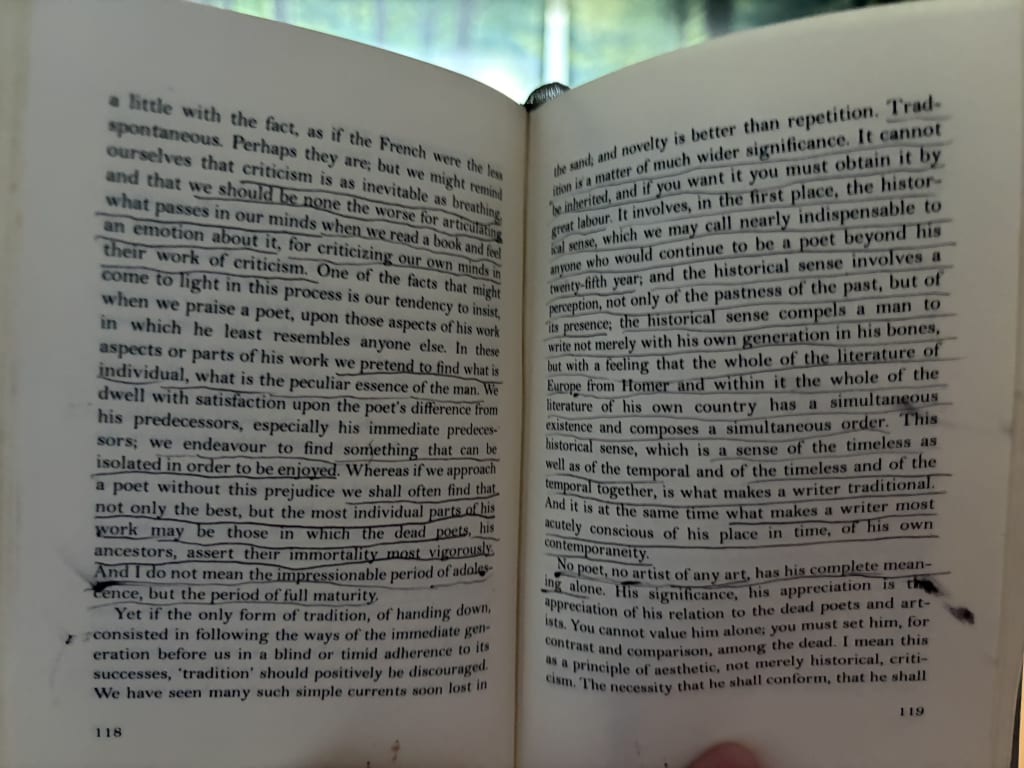
I return to this essay each spring, scattering my ink under Eliot’s. I remember Dr. Evans’s shock at my love for Eliot. It seemed incongruent with my love of Mark Twain and Steinbeck and all of those early loves who stole my heart with strong voices. Eliot employs voice differently than fiction writers, and for me, the voice of “Tradition and the Individual Talent” feels like the canon itself is speaking, directly to me, as if I am the recipient of a love letter from literature itself. When Wally (Dr. Evans) referred to Eliot (and Emerson and Hume) as stuffy old bastards, it was my turn to react with shock. I’m sure I looked at him like he had three heads or a tuba growing out of one ear. I feel an intimacy when I read Eliot. “Journey of the Magi” brought me to tears the first time I read it.
I would love to discuss this (currently) favorite meta essay. Rather than review it or delineate it, I invite you to read it and engage in discussion about it in the comments.
Do you read it the same way I do? I had classmates who found it unapproachable, intimidating. I’m curious as to whether there are other disparities concerning this essay, as well as curious to learn who here aspires to the canon (Eyes on you, Tim Carmichael). I’m also curious as to whether or not I’m an anomaly as a canonist.
To be clear, I’m a new canonist with great respect for post-colonial literature, especially if it carries the oral tradition in its suitcase and unpacks it well. No one can read the entire canon: it’s the greatest literature produced by humans, generations armed with pens came before us. Serious readers are the gatekeepers, and time is the gate. It’s not something you can be inducted into; either the work produced is worthy of inclusion or not. It’s not something people can vote on.
Eliot’s ideas present the canon as kaleidoscope for me—the new changes the old through context: the addition of the new contributes to context, and everything that contributes to context shapes it. New relationships are born of old meeting new. History is alive, and the canon breathes.
In literature programs at the turn of the millennium (how cool is it to have experienced that?), the canon and whether or not students were canonists was a hot topic. My class at my institutions (joint program) was heavily new canonist, much to the chagrin of our non-formalist professors.
What do I mean when I toss around this term, new canonist, in these rooms? I accept the canon, but I reject any academy, institution, school of thought, or dominant culture regulating it. More than anything in the world, it chooses its own. Inclusion is organic, period. I reject a canon that is exclusively male, exclusively white, exclusively western. Inclusion of the important literature of the human race is the point of the canon. It doesn’t exclude, but it only includes the best of the best—there isn’t room for anything else. People continue to read and engage with a text or they don’t. The text continues to be relevant or it doesn’t. Unlike religion, the canon rejects forgiveness.
Each culture chooses its best literature through two organic processes: cultural transmission and cultural diffusion. Is this literature passed down through the generations within the culture? Is it spreading into other cultures? Time itself is the only thing that can answer these questions, returning the work to us with one question: why?
I was born of and into paradox and have been in love with it for my entire life, and the paradox of the canon is one of my favorites. All may approach, but knowledge and/or awareness of this approach is all the individual can know. It is impossible to learn if one has been included, as the individual writer’s death is the first threshold to pass.
This makes some readers uncomfortable, which is okay. Learning isn’t comfortable if it includes growth. When I am troubled by pursuit of answers, I turn to Rilke, relearn to embrace the questions themselves, treat them as spaces to live, breathe, and work in. Obsession with answers disrespects good questions. Another uncomfortable fact about the canon is that no one can read the entirety of it. Time and language and culture keep more than one gate, and they never clock out, never take a coffee break, PTO, or vacation. No one can claim superior canonical knowledge; every human has only his or her reading of canonical texts and incomplete knowledge of what they haven’t read to form an opinion of the canon itself.
Any takers? Read my favorite essay with me this spring and indulge me with idea sharing?
The canon is alive and expecting you.
*Author note: I flagged this as a challenge to encourage engagement. I want to know the opinions and arguments for or against the canon inside this community. Meaningful discourse is the prize, and everyone who engages receives it.
About the Creator
Harper Lewis
I'm a weirdo nerd who’s extremely subversive. I like rocks, incense, and witchy stuff. Intrusive rhyme bothers me. Some of my fiction might have provoked divorce proceedings in another state.😈
MA English literature, College of Charleston
Keep reading
More stories from Harper Lewis and writers in Writers and other communities.


Comments
There are no comments for this story
Be the first to respond and start the conversation.