
I light a candle to St. Lucia (or Lucy), the Christian martyr from Syracuse, Sicily.
Mike's December $ prompt. Lucia's Festival of Light and Community.


St. Lucia (or Lucy) was a Christian martyr from Syracuse, Sicily, who died in 304 CE during the Diocletian persecution. Her name means “light”, and she became associated with vision, clarity, and illumination.
Her feast day was fixed on December 13, which, under the old Julian calendar, coincided with the winter solstice - the darkest day of the year. Hence the old rhyme:
“Lucy light, Lucy light, shortest day and longest night”.
St. Lucia’s Day is a fusion of Christian martyrdom, solstice symbolism, and communal ritual. It celebrates the return of light - both spiritually and naturally - making December 13 a day of hope in the winter calendar.
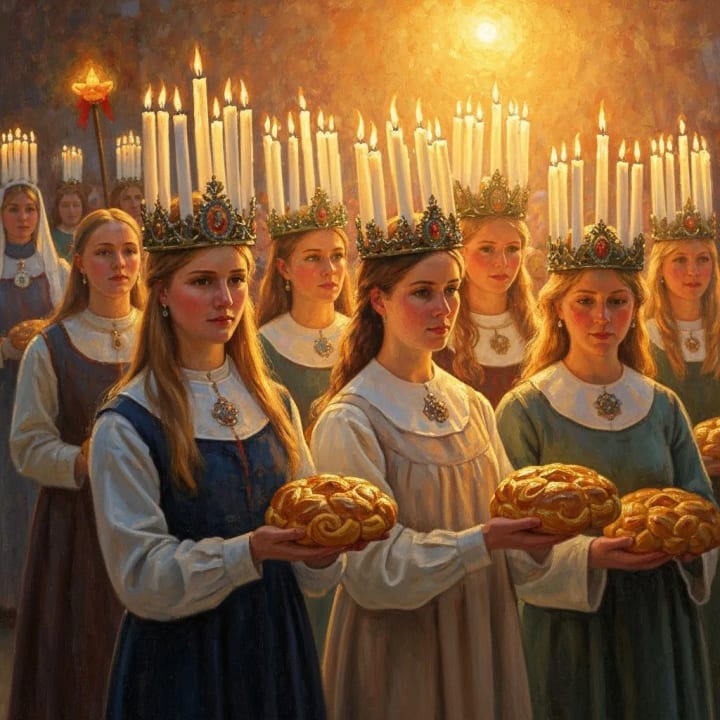
It captures the essence of St. Lucia’s Day as celebrated in Scandinavia - candle crowns glowing in the darkness, white robes with red sashes, and the warmth of saffron buns and mulled wine shared in community.

🕯️ Symbolism of Light
Lucia embodies hope, charity, and light in the midst of darkness. Her day marks the turning point when nights begin to shorten and daylight slowly returns.
The festival blends Christian devotion with pre-Christian solstice rituals, making it both religious and seasonal.
🎶 Traditions in Scandinavia (especially Sweden, Norway, and Finland):
- A girl dressed as Lucia wears a white robe and a crown of candles, leading processions of children singing traditional songs.
- Families bake lussekatter (saffron buns shaped like curled cats) and drink glögg (mulled wine).
- Candlelit concerts and parades fill towns, symbolizing light overcoming winter’s darkness.
- Italy (Lucia’s homeland):
- Celebrations are strongest in Syracuse, Sicily, with processions honoring her relics.
- She is invoked as a protector of eyesight and vision.
Cultural Importance:
- In Sweden, St. Lucia’s Day is as central as midsummer festivals, seen as the unofficial start of the Christmas season.
- The day emphasizes community, generosity, and strength, reminding people to share warmth and light during the coldest, darkest time of year.
📜 Key Takeaway
St. Lucia’s Day is a fusion of Christian martyrdom, solstice symbolism, and communal ritual. It celebrates the return of light - both spiritually and naturally - making December 13 a celebration of hope in the winter calendar.
~~Here’s a story that weaves together the mystical, ritual, and luminous heart of St. Lucia’s Day - told as if you were walking through it yourself:
“Lucy Light”
Once upon a light, in a little village deep in the northern winter, where the sun barely kissed the horizon and the snow blanketed the trees, December 13 arrived like the musical intro before a song. The villagers called it Luciadagen—St. Lucia’s Day - and it was the day when light returned, not just to the sky, but to the soul.
The morning began in velvet darkness. Children stirred before dawn, dressing in white robes cinched with red sashes, their breath fogging the windows as they peered out into the frost. In one quiet cottage, a girl named Helina stood before her mirror, placing a crown of evergreen on her head. Nestled in the wreath were four tall candles, their flames flickering like tiny suns. Her mother lit each one with care, whispering, “Lucy light, Lucy light, shortest day and longest night.”

Helina stepped outside, her candlelit crown glowing against the indigo sky. Behind her, a procession of children followed, each holding a single candle. They sang the old songs - melodies that blended Christian hymns with ancient solstice chants. Their voices rose like smoke, curling through the village, waking the sleeping houses.
Inside the church, the stone walls glistened with candlelight. The scent of saffron buns - lussekatter, golden and curled like cats - filled the air. Elders sipped warm glögg and watched the children with eyes that remembered winters long past, when Lucia’s day had truly been the darkest of the year.
Helina walked slowly down the aisle, her face serene, her gaze lifted. She was not just a girl in costume - she was the embodiment of Lucia, the Sicilian martyr who had brought light to the persecuted, whose name meant lux, and whose feast once marked the solstice before calendars shifted. In her silence, she carried the memory of fire, of vision, of resistance.
As she reached the altar, the choir fell quiet. One by one, the children placed their candles on the steps, until the church glowed like a hearth. Outside, the sky began to pale. The longest night was ending.
And in that moment, Helina understood: Lucia was not just a saint, not just a symbol. She was a promise - that even in the deepest dark, light would return. That warmth could be shared. That history, like flame, could be passed hand to hand.

Helina’s journey...her quiet transformation before the festival, the candlelit procession through snow and song, and the ancestral warmth of saffron buns and glögg shared in sacred communion.
..................................................................................
Afterword:
The Diocletianic Persecution, also known as the Great Persecution, was the last and most severe persecution of Christians in the Roman Empire, initiated by Emperor Diocletian in 303 AD.
This marked a significant shift in the Roman Empire's treatment of Christians. Prior to Diocletian's reign, Christians had experienced a period of relative peace, often referred to as the "Little Peace of the Church." However, as Diocletian sought to restore traditional Roman values and unify the empire, he began to view Christianity as a threat to the social order and imperial authority. (Wikipedia).....
Lucia's martyrdom.
St. Lucia was executed after refusing to renounce her Christian faith and her vow of virginity, which defied both Roman authority and a suitor’s claim.
- Lucia was born into a wealthy Roman family in Syracuse, Sicily, and secretly consecrated her virginity to Christ, vowing never to marry.
- Her mother, unaware of this vow, arranged a marriage with a pagan suitor. When Lucia refused, the suitor denounced her to Roman authorities as a Christian - a dangerous accusation during Emperor Diocletian’s reign.
- Lucia was sentenced to death, first by being burned alive. According to legend, the flames did not harm her.
- Authorities then attempted to drag her to a brothel to defile her, but her body became miraculously immovable, even when hitched to oxen.
- Ultimately, she was stabbed in the throat or killed by sword, though accounts vary. She died after receiving the Eucharist, her final act of devotion.
...They may murder our bodies, but they can't silence or voices or our spirits. Thy will ever live on.
Mike's prompt.
About the Creator
Novel Allen
You can only become truly accomplished at something you love. (Maya Angelou). Genuine accomplishment is not about financial gain, but about dedicating oneself to activities that bring joy and fulfillment.
Keep reading
More stories from Novel Allen and writers in Writers and other communities.
Days of Indian Summer
Although the exact origins of the term are uncertain, Indian Summer was perhaps so-called because it was first noted in regions inhabited by Native Americans, or because the natives first described it to Europeans. Or, it had been based on the warm and hazy conditions in autumn when Native Americans hunted.
By Novel Allen2 months ago in Writers
It's Winter
Anne Bernays and Pamela Painter — What If? Writing Exercise for Fiction Writers prompts The Exercise —Write a scene involving two characters. Have the point-of-view character presume something entirely different about the situation from what the other character's overt behavior seems to imply. For example, a landlord comes to visit, and the tenant suspects that it isn't a visit but an inspection. Make up several situations in which one character can fantasize or project or suspect or even fear what another character is thinking. The Objective - To show how your characters can use their imaginations to interpret the behavior and dialogue of other characters.
By Denise E Lindquist6 days ago in Writers
If You Love Me, You'll Do It
I met Jason when I was five years old. I could say that I loved him from the moment I saw him. He was so handsome to me and I felt in awe by his presence. When they introduced him as the new kid in school, I wanted to be his friend right away. I remember it like it was yesterday. I remember his smile and how he didn't seem shy. He appeared confident and ready to learn. I waved at him and said "hello," before anyone else could even say a word. He sat next to me, and I asked him if he wanted to be friends. He looked so happy as he said, "Yes!"
By Sidney Smith (Sid Smith)2 days ago in Fiction


Comments (11)
So much interesting information here. I'm not entirely sure about this one, but in my home country, Hungary we have a tradition of building a chair for St. Lucia (we call her Luca). It has to be build very slowly, one piece a day and by the day of St. Lucia it should be done. Congrats on the TS, Novel ❤️
Back to say congratulations on your Top Story! 🎉💖🎊🎉💖🎊
Congratulations 🎊
Back to say that I visited Sicily and Syracuse last June. Lovely work.
Just given you a shout out on Raise Your Voice here https://shopping-feedback.today/resources/raise-your-voice-thread-12-18-2025%3C/span%3E%3C/span%3E%3C/span%3E%3C/a%3E%3C/p%3E%3C/div%3E%3C/div%3E%3C/div%3E%3Cdiv class="css-w4qknv-Replies">
Thank you for sharing this, I had been seeing lots of things about St Lucia day, love all the photographs and images too
I wish I could have some of those saffron buns! I loved learning about Lucia. I feel so sad for her 🥺
Devotion, rituals and faith. Wow, so much detailed information here! She was true to herself and beliefs. Usually the women are bashed down. Loved the photos/drawings throughout and all the details you included. Great job!
Poor Lucia! Thx 4 sharing her story! What bold & brave faith she had! & Amen to your last line my friend! 💕
OH! This makes me mad as heck. and to think that women are still being persecuted in this 'modern' age. Happily, her death has given her eternal life in the hearts of the people. Such a sad beautiful story.
There was so much goodness to Lucy. The devil has always tried to snuff out that kind of light. Loved your story, too!