
Fire, Blood, and Empire: When the Mughals Invaded India”
The daring journey of Babur from Kabul to Delhi, and the battle that changed the fate of a subcontinent

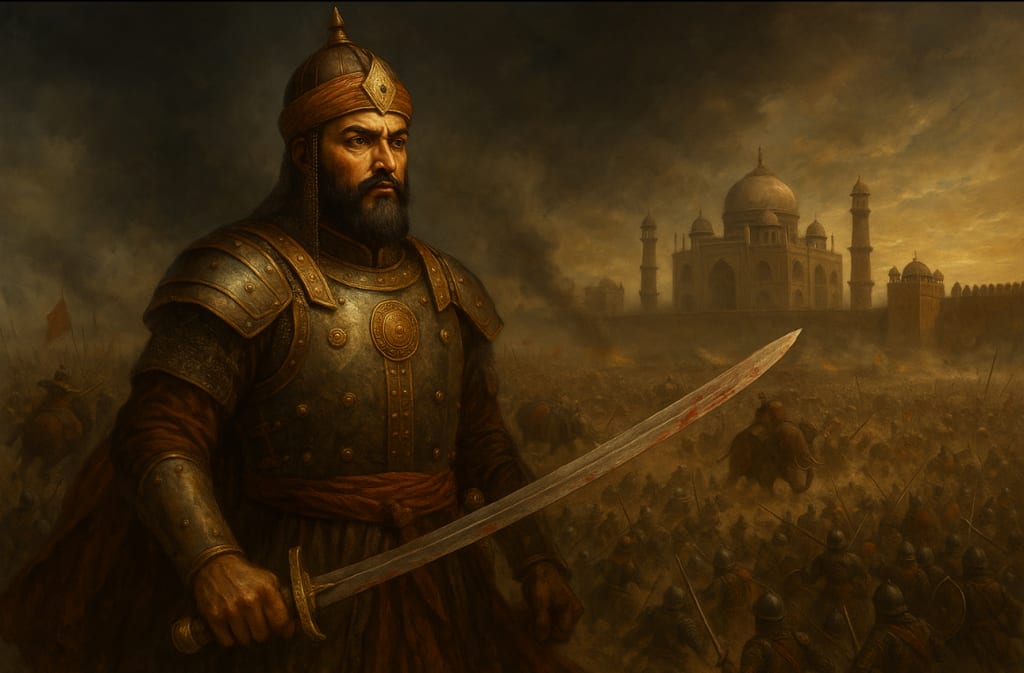
The year was 1525. The cold Kabul winds still whispered the last breaths of winter. Under a dark, starlit sky, a young man stood on the balcony of his fort — eyes not on the stars, but beyond them. His name was Zahir-ud-din Muhammad Babur, a descendant of both Tamerlane and Genghis Khan, and he had no intention of ruling a small mountain kingdom forever.
Babur, once ruler of Fergana in Central Asia, had lost his homeland to the rising Uzbek tribes. Exiled and desperate, he seized Kabul and made it his base. But Kabul was not his dream. His eyes were set on Hindustan — a land rich with gold, power, and legend. A land weakened by infighting and a crumbling Sultanate.
At that time, Ibrahim Lodi, the last ruler of the Delhi Sultanate, ruled much of North India. But his throne was shaky — his own nobles despised him, the Afghans mistrusted him, and his arrogance pushed allies away. For Babur, it was the perfect moment to strike.
The March Toward Destiny
With only 12,000 soldiers, Babur began his march from Kabul. But what he lacked in numbers, he made up for with strategy, discipline, and something India had never seen before: Ottoman-style artillery and field cannons. This would prove to be his most decisive advantage.
Crossing the treacherous passes and rivers of the Punjab, Babur’s army moved with speed and purpose. He inspired his men not just with the promise of loot, but with the dream of building a mighty empire.
In April 1526, Babur reached a dusty field near a town called Panipat, just north of Delhi. There, Ibrahim Lodi awaited him with over 100,000 men and 1,000 war elephants.
Babur was outnumbered nearly ten to one.
The Battle of Panipat
But Babur was not afraid. He had carefully chosen the battlefield and fortified his camp with trenches and wooden carts. His cannons were positioned to create a deadly crossfire.
On the morning of April 21, 1526, the sky above Panipat turned dark with dust as the two armies clashed. The Lodi forces, with their mighty elephants, charged forward in a thunderous wave. But Babur’s cannons roared to life — the ground shook, elephants panicked, and the Lodi ranks fell into chaos.
Babur’s cavalry, trained in fast, flanking maneuvers, sliced through the disorganized enemy. It was not just a victory — it was a massacre. Ibrahim Lodi himself was killed on the battlefield, along with over 15,000 of his soldiers.
The battle lasted only a few hours, but it changed the destiny of India forever.
The Birth of the Mughal Empire
After the victory, Babur entered Delhi — not as a raider, but as a conqueror. He was not interested in looting and leaving, like the invaders before him. Babur stayed.
He declared himself Emperor of Hindustan and laid the foundation for what would become the Mughal Empire — one of the richest and most powerful empires the world would ever see. An empire that would be ruled by his descendants for over 300 years, giving rise to emperors like Humayun, Akbar, Jahangir, Shah Jahan, and Aurangzeb.
But that day, under the skies of Panipat, it had all begun with one man, one vision, and one belief:
“If fortune favors the brave, let India be the reward of my courage.”
⸻
Conclusion:
The Mughal invasion of India was not just a military campaign — it was the beginning of a new chapter in South Asian history. With fire and blood, Babur didn’t just conquer land. He conquered legacy.
Follow and read my story full please .
About the Creator
Irfan stanikzai
⸻
“Bold heart, calm mind. A voice from Afghanistan — rooted in culture, driven by dreams, and shaped by stories untold.”
Keep reading
More stories from Irfan stanikzai and writers in Writers and other communities.
Difficulties Of Holidays On Vocal
Introduction Last week I had a wonderful week in Alnwick, but tried to keep up on Vocal, although my time was less than I normally have, plus a little more difficult because I was using a ten-year-old laptop with a faulty keyboard (the space bar does not always register, meaning I have to keep going back to separate words).
By Mike Singleton 💜 Mikeydred 4 days ago in Writers
Bomb Scare
It was 2027, and the world never thought it would happen. A missle hit the United States, but it wasn't where they had anticipated. A little town in the northeast was hit by a missile strike, they didn't know why, and they didn't know exactly where it hit, but they did know it was a coastal community, somewhere between Maine and Delaware.
By Gregory Payton7 days ago in Fiction




Comments
There are no comments for this story
Be the first to respond and start the conversation.