
Echoes of a Shattered City: Life in Kabul’s Chaos”
“Inside Kabul’s unseen battle for hope, dignity, and survival

A Day in Kabul Through the Eyes of a Street Child
The sun hadn’t yet risen when Rahim opened his eyes. The early call to prayer echoed through the cracked walls of the one-room shelter his family called home. The air was cold, and his breath made a faint mist in the dim light. His mother stirred quietly beside him, wrapping a tattered shawl around her sleeping children.
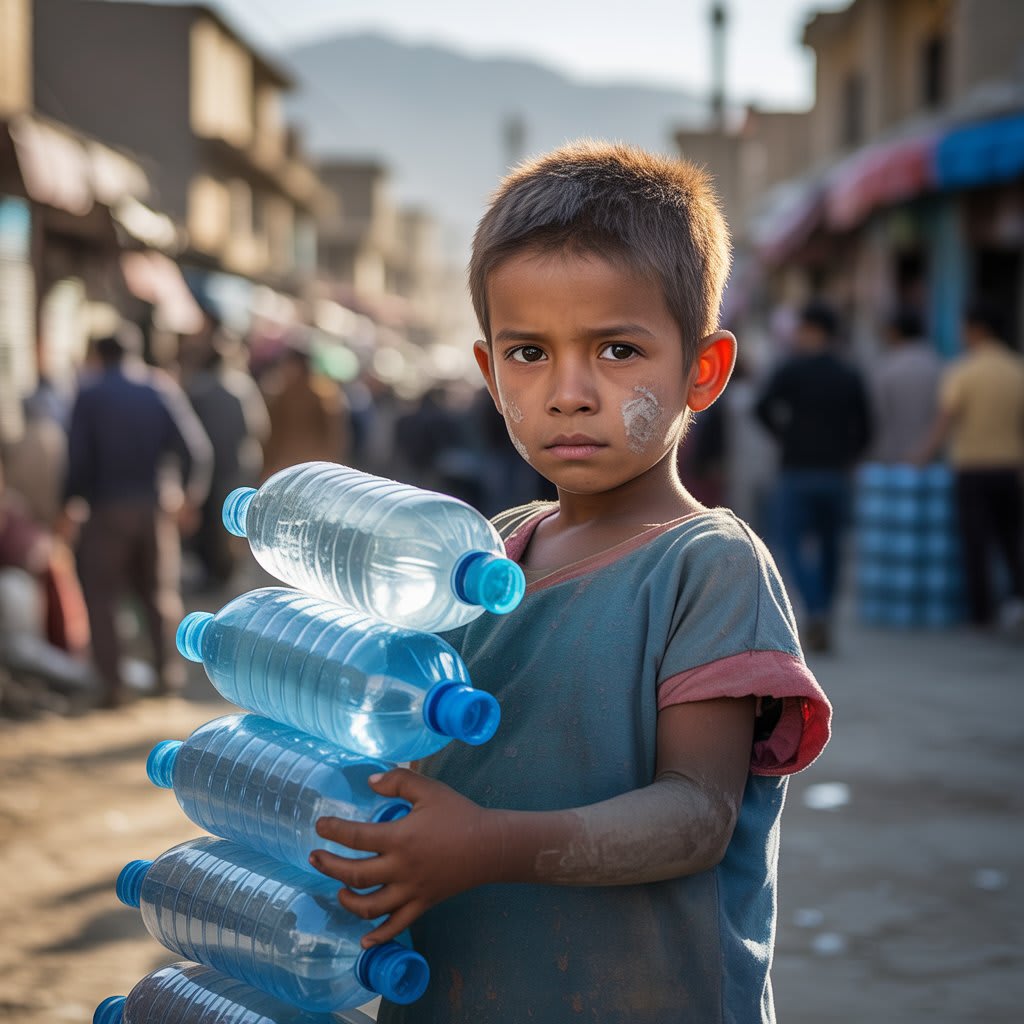
Rahim was only ten, but his back already carried a weight many adults would collapse under. His father had disappeared two years ago—perhaps taken, perhaps dead. No one knew. Since then, Rahim had become the “man” of the house. He didn’t go to school. He sold water bottles on the streets of Kabul, hoping each day to earn enough for bread, and maybe, on lucky days, a little extra.
He got dressed silently. His pants were too short, and his sandals had worn through, but they still served. He looked in the mirror—a small piece of cracked glass nailed to the wall—and saw a boy who should’ve been running, laughing, learning. Instead, he was preparing to walk into a city full of tension, dust, and danger.
“Be careful, my son,” his mother whispered, handing him the plastic bag with five water bottles they could afford to fill.
He nodded and left.
⸻
The streets of Kabul were already buzzing with life. Vendors shouted prices, motorcycles zipped between potholes, and the smell of naan from the corner bakery fought against the stink of exhaust and sewage. But behind the noise was a silence—an unspoken tension. Everyone walked with caution, eyes scanning corners, ears trained for the sound no one wanted to hear.
Rahim knew every block like the back of his hand. He knew which soldiers would let him pass, which corners had the best traffic, and which roads to avoid after dark.
He stood at the side of a busy intersection, holding out a water bottle. “Clean water, ten Afghanis,” he repeated, over and over. Most people ignored him. A few waved him off. One man, wearing a suit, handed him twenty without taking a bottle.
“Keep the change,” the man said, his eyes tired. “Buy something for your siblings.”
Rahim smiled, bowed his head in thanks, and placed the money carefully in his pocket.
⸻
At noon, the blast came.
A sharp BOOM split the air, followed by screams and dust. It came from a few blocks away—close enough to feel the ground shake. Rahim fell to the ground instinctively, hands covering his head. People ducked behind cars, mothers clutched their children, shopkeepers ran to close their shutters.
But within minutes, life began moving again. No sirens came. No ambulances. Just silence, then the slow return of noise, as if the city had paused for breath and then kept walking.
Rahim got up slowly, his knees dusty, his heart pounding. He had seen too many of these. He had learned not to run toward the smoke, not to cry, not to ask questions.
He remembered the day his friend Omar died.
They had been racing near a school gate. Laughing, teasing each other, when an explosion tore through the entrance. Omar never made it home. His shoes were found, torn and bloody. His backpack was returned, empty.
Rahim hadn’t raced since that day.
⸻
Later in the afternoon, Rahim sat under a tree, counting the coins he had made—sixty-three Afghanis. It wasn’t much, but it meant they could have bread and tea tonight.
He looked around. Life was moving, but everyone’s face was tight. A man argued with a soldier. A woman clutched a bag of flour like it was gold. A young boy—maybe younger than Rahim—sat in a wheelchair near a mosque, holding out his hand for coins.
Then, a group of schoolchildren passed by, laughing, backpacks bouncing on their backs.
Rahim watched them until they disappeared down the alley.
“Why not me?” he thought. “Why is school a dream for some and normal for others?”
His mother had once told him, “One day, you’ll go too.” But every day that passed, the dream felt further away.
⸻
As the sun began to set behind the smoky hills, Rahim returned home.
“Did you eat anything?” his mother asked. He shook his head. She smiled softly and tore a piece of naan in half. “Then let’s eat together.”
They sat together in the dim light of a candle, his younger siblings giggling at something only they understood. For a few moments, it felt like peace.
After dinner, Rahim stepped outside. The stars above Kabul were dimmed by pollution and smoke, but he looked at them anyway. Somewhere beyond those stars, he imagined, children were falling asleep with full bellies and warm beds. Somewhere, a ten-year-old wasn’t afraid of bombs.
⸻
He closed his eyes and made a wish.
Not for toys. Not for a phone or games.
He wished for silence.
For a day without blasts. For a morning without fear. For a classroom with a chalkboard and books.
He whispered into the cold air, “Maybe tomorrow… I can be a child again.”
And with that, he went inside, lay beside his siblings, and drifted into dreams — where Kabul was whole again, and children didn’t sell water… they drank it together in schoolyards full of laughter.
⸻
**~ End ~**
About the Creator
Irfan stanikzai
⸻
“Bold heart, calm mind. A voice from Afghanistan — rooted in culture, driven by dreams, and shaped by stories untold.”
Reader insights
Nice work
Very well written. Keep up the good work!
Top insight
Heartfelt and relatable
The story invoked strong personal emotions
Keep reading
More stories from Irfan stanikzai and writers in Writers and other communities.



Comments
There are no comments for this story
Be the first to respond and start the conversation.