
Echoes From the Barricades
How a Teacher and a Nurse Found Strength in Shared Struggles During a Sudden Lockdown

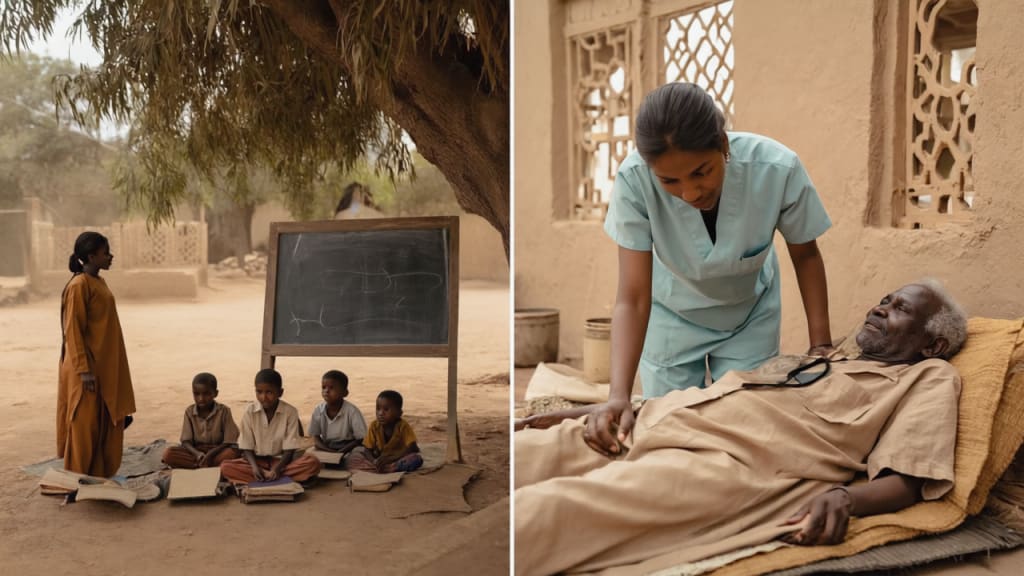
When the government announced an emergency lockdown across several tehsils in Punjab, life changed overnight. Roads were barricaded, transport halted, and movement between towns was strictly prohibited. For many, it was a time of confusion and fear. But for two women—one a schoolteacher in Chakwal, the other a nurse in Bahawalpur—it became a moment of quiet resilience, captured in the pages of their parallel diaries.
📚 The Teacher: Miss Sana from Chakwal
Miss Sana had been teaching English at a government school for over a decade. Her days were structured around lesson plans, morning assemblies, and the laughter of children. But when the lockdown hit, her school was shuttered indefinitely. With no internet access in her village and no way to reach her students, Sana felt helpless.
She began writing a diary—not just to document the chaos, but to preserve the stories of her students. She wrote about Ali, who had just learned to read full sentences, and Mehwish, who had finally mastered multiplication tables. Her entries were filled with longing, but also with hope.
> “Today I stood outside the school gate. It was quiet, too quiet. I imagined the children running in, their backpacks bouncing. I miss them. But I will keep writing. Maybe one day they’ll read this and know I never stopped thinking about them.”
Sana also started tutoring children in her neighborhood, using chalk and a broken blackboard nailed to a tree. Parents gathered, grateful for her effort. Her diary became a record of these improvised lessons, a testament to how education found a way even when institutions failed.
🏥 The Nurse: Farah from Bahawalpur
Farah was a senior nurse at a district hospital, used to long shifts and emergency calls. But the lockdown brought a different kind of urgency. With movement restricted, many patients couldn’t reach the hospital. Farah and her colleagues set up mobile clinics, traveling on foot or bicycles to nearby villages.
Her diary was raw and emotional. She wrote about treating a diabetic woman with no access to insulin, helping a pregnant mother deliver safely in her home, and comforting families who couldn’t visit their sick loved ones.
> “We stitched wounds under lantern light. We sterilized with boiled water. We improvised, because we had to. Every life mattered, even when the system couldn’t reach them.”
Farah’s entries also revealed her personal struggles—missing her own children, worrying about her aging parents, and the constant fear of infection. But like Sana, she found strength in service.
✉️ A Chance Connection
The two women didn’t know each other. But during a brief window when postal services resumed, Sana mailed a copy of her diary to a friend in Bahawalpur, who happened to be Farah’s cousin. Moved by the stories, Farah wrote back.
> “Your words reminded me why we do what we do. Even when no one is watching, even when it feels like we’re alone—we’re not.”
They began exchanging letters regularly, sharing updates, encouragement, and small joys. Sana sent sketches drawn by her students; Farah sent pressed flowers from her garden. Their diaries became intertwined, a shared chronicle of perseverance.
🌾 Quiet Resistance
Though the lockdown was meant to isolate, it sparked a quiet resistance. Teachers taught under trees. Nurses healed with limited tools. Communities came together, sharing food, stories, and strength.
About the Creator
Why Golf Is a Powerful Teacher of Emotional Stability
Golf is one of the few sports where the greatest battle takes place not against an opponent, but within the mind. Each round requires patience, discipline, and a calm response to unpredictable challenges. The quiet environment, long pauses between shots, and high degree of precision expose a player’s emotional patterns more clearly than almost any other activity.
By Jeb Kratzigabout 23 hours ago in Writers


Comments
There are no comments for this story
Be the first to respond and start the conversation.