
Easy Tricks to Represent the Solar System: In Simple Terms
Simple Tips to Know Very Well About Solar System

Looking for a method to showcase the functioning of the solar system? Describing the solar system can be difficult, particularly due to the huge distances and sizes involved. However, with a suitable strategy and creative tactics, it is possible to reduce this complex system to understandable words. This blog can help you to understand the simple strategies for representing the solar system using a space template.
Start with a detailed model
One of the most effective ways to describe the solar system is to build a detailed model. This helps to see the relative sizes and distances between planets.
Setting a scale
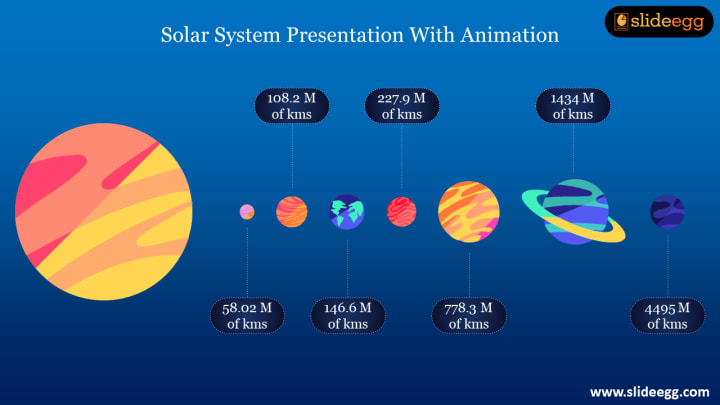
Sun: If you want to represent the sun, use a huge ball or a light source.
Planets: Use things of various sizes (e.g., beads, marbles or fruits) to represent the planets. For example, the sun may be a huge beach ball, Earth a small bead, and Jupiter a larger marble.
Distances: With a long length of rope or measuring tape, set each planet at a fixed distance from the Sun. For example, if the sun has a diameter of 100 cm, Earth should be located 11 meters far away. Neptune would be about 300 meters away.
Use a Digital Simulation:
Interactive Models
Consider using digital representations or interactive models of the solar system, available through internet tools and apps. These allow users to alter and study the solar system from a variety of perspectives.
Benefits of Digital Tools:
Accuracy: Digital computations can accurately portray the distances, sizes, and orbits of astronomical objects.
Engagement: Interactive components can help students learn more effectively and enjoyably.
Use infographics:
Infographics are an effective approach for presenting information into a visually pleasing and understandable manner.
Elements to include:
Planet Sizes: Use simple images to compare planet sizes.
Orbital Paths: Show the elliptical orbits of the planets around the sun.
Distances: Use a scaled line or bar for showing each planet's distance from the Sun.
Interesting Facts: Include fun facts about each planet to make the infographic more engaging.
Incorporate comparisons
Comparisons can help to explain complex concepts by relating them to familiar objects or experiences.
Examples:
Size Comparison: If the sun was the size of a basketball, Earth would be the size of a peppercorn, and Jupiter the size of a chestnut.
Distance Analogy: If the sun were on one end of a football field, Mercury would be at the 10-yard line, Earth at the 26-yard line, and Neptune at the far end.
Engage in physical activities
Engage students in physical activities that represent the solar system. This hands-on approach can improve memory and understanding.
Activity Example:
Solar System Walk: Define a vast area (e.g., a playground or a long hallway) and use scaled distances to place markers representing each planet. Have students walk from the sun to each planet, noting the increasing distances.
Use Space Powerpoint Template
Presentation templates can be an extremely useful resource for instructors. They provide a planned and attractive approach of presenting information.
Tips for using templates:
Consistency: To make the presentation more readable, use consistent colors, fonts, and styles.
Visible help: Use photos, diagrams, and videos to help people understand.
Use interactive elements on your slides, such as clickable links or included quizzes, to interest the audience.
Include fascinating statistics
Statistics may add a layer of interest and provide actual proof to support your explanations.
Key Statistics to Include:
Planetary Distances: The average distance between Earth and the sun is 93 million miles (150 million kilometers).
Sizes: Jupiter is the biggest planet, with a diameter of approximately 86,881 miles (139,820 kilometers), while Mercury is the smallest with a diameter of about 3,032 miles (4,880 kilometers).
Orbits: It takes Earth about 365.25 days to orbit the sun, whereas Neptune takes about 165 years.
Simplify Complicated Ideas
Break down hard astronomical concepts into more understandable language.
Example: To explain gravity, think of it as a magnet that attracts objects. The planets orbit the sun due to its gravity.
Conclusion
Representing the solar system in basic words does not have to be difficult. Expanded models, computer programs, infographics, comparisons, physical activities, presentation templates, interesting data and simple explanations can all help to express the wonder and complexity of our solar system. These simple tactics will not only make the solar system easier to understand, but also more engaging for both students and educators. Get to know more ideas, by visiting SlideEgg.
About the Creator
Akshaya
"Hi there! I'm a freelance writer. Specialised in exploring new spectrum and excel in my vertical (Blogs and Web content). I am also good in curating content for powerpoint templates. Let's collaborate to make your business even better.
Keep reading
More stories from writers in Writers and other communities.
Thoughts on Vocal and the way the world is
"Death cannot stop true love, only delay it." – Wesley in The Princess Bride. I decided to come back to Vocal on a very cold and dark night at the end of December. I had been, and still am, convalescing from a horrible staph infection that had gone misdiagnosed for months. This, paired with the increasing challenges of being healthy, making the best choices for my co-parented child, being a wife, and being a director at a new job, was a lot to manage.
By Jazzy 6 days ago in Confessions



Comments
There are no comments for this story
Be the first to respond and start the conversation.